The Technical Vault
By SOSCleanroom
17054F-50
50 mL Class A
±0.05 mL Tolerance
0.1 mL Graduations
Automatic Zero
Three-Way PTFE
Serialized & Certified
1 Buret / Case
KIMBLE 17054F-50: traceable Class A volumetric measurement for repeated titrations
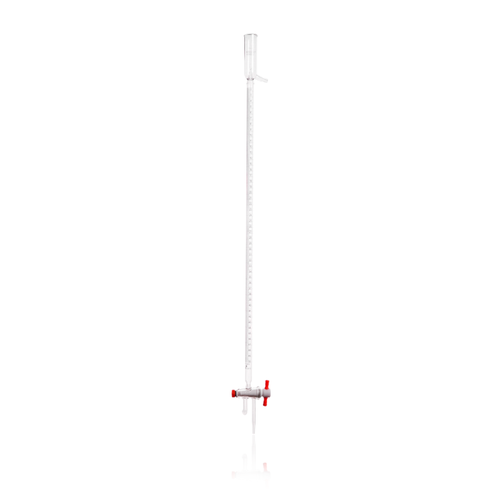
The KIMBLE® KIMAX® 17054F-50 is a precision-bore Class A volumetric buret manufactured by DWK Life Sciences. The instrument combines a 50 mL nominal capacity, automatic-zero upper arrangement, three-way PTFE stopcock, durable black graduation scale, and individual certification for analytical laboratory applications.
DWK specifies a ±0.05 mL tolerance, 0.1 mL graduation intervals, 1.5 to 50 mL published graduation range, and 740 mm overall length. The buret is manufactured from borosilicate glass 3.3 and supplied with a Certificate of Graduation Accuracy.
The automatic-zero design is intended to simplify repeated titration workflows, while the three-way stopcock enables filling through a bottom side-arm connection. Both the glass and PTFE components must be compatible with the selected titrant and laboratory operating procedure.
Operations takeaway: A Class A buret is an instrument within an analytical measurement system. Manufacturer tolerance, certification, correct meniscus reading, titrant preparation, stopcock condition, and an approved procedure all contribute to obtaining reliable volumetric results.
Specifications (SKU controls for purchasing, calibration records, and SOPs)
- Manufacturer: DWK Life Sciences
- Brand: KIMBLE® / KIMAX®
- Catalog Number: 17054F-50
- Product Family: Class A Serialized and Certified Burets with Three-Way Stopcock
- Configuration: Automatic-zero top; black scale
- Nominal Capacity: 50 mL
- Accuracy Class: Class A
- Volumetric Tolerance: ±0.05 mL
- Graduation Intervals: 0.1 mL
- Manufacturer Graduation Range: 1.5 to 50 mL
- Overall Length: 740 mm
- Body Material: Borosilicate glass 3.3
- Buret Construction: Precision-bore glass
- Scale: Black ceramic enamel
- Stopcock: Three-way PTFE stopcock plug
- PTFE Plug: Chemically resistant and self-lubricating
- Filling Connection: Bottom side arm accepts 1/4 inch ID flexible tubing
- Individual Identification: Permanent serial number
- Traceability: NIST-traceable, as described by DWK
- Included Documentation: Certificate of Graduation Accuracy
- Manufacturing Specifications: ASTM E694
- Accuracy Calibration Requirements: ASTM E542
- Replacement Stopcock Plug: 41530F-2, separately sold
- Purchase Quantity: 1 buret
- Primary Use: Repeated titrations requiring traceable volumetric accuracy
Specification control: Do not confuse the 0.1 mL graduation interval with the ±0.05 mL tolerance. They describe different characteristics. The published graduation range is 1.5–50 mL despite the automatic-zero configuration.
Class A accuracy: what the ±0.05 mL tolerance actually means
Class A volumetric glassware is manufactured to tighter volumetric tolerance requirements than lower-accuracy laboratory measurement classes. DWK specifies a Class A tolerance of ±0.05 mL for catalog number 17054F-50.
This tolerance is a manufacturer volumetric accuracy specification. It should not be treated as the uncertainty of an entire titration result or the smallest increment an operator can reliably estimate under every operating condition.
- Class A: Manufacturer-designated high-accuracy volumetric instrument class.
- ±0.05 mL Tolerance: Published volumetric accuracy requirement for the 50 mL model.
- 0.1 mL Graduation Interval: Distance in represented volume between adjacent printed scale divisions.
- 1.5–50 mL Range: Manufacturer-listed range of graduation markings for the 50 mL automatic-zero model.
- Certificate: Manufacturer documentation supporting the stated graduation accuracy and instrument identification.
- Method Uncertainty: Depends on the complete measurement procedure and relevant error sources.
Analytical distinction: A more finely subdivided scale does not automatically improve calibration accuracy, and a certified buret does not eliminate procedural errors. The selected method must establish acceptable uncertainty, reading technique, and instrument verification requirements.
Individual serialization, NIST traceability, and the Certificate of Graduation Accuracy
DWK states that this Class A buret is permanently marked with an individual serial number, is traceable to NIST standards, and is supplied with a Certificate of Graduation Accuracy. These attributes are useful when laboratories need to associate a physical measuring instrument with documentation and internal equipment records.
The manufacturer's technical guidance distinguishes different kinds of volumetric product certification, including individual works certificates, batch certification, and certain accredited calibration services. These categories are not interchangeable.
- Individual Serial Number: Identifies the specific buret for inventory, inspection, and documentation purposes.
- Certificate of Graduation Accuracy: Supplied with this manufacturer configuration.
- NIST Traceability: Described by DWK as part of the manufacturer's accuracy and calibration system.
- ASTM E542: Referenced by DWK for accuracy calibration requirements.
- ASTM E694: Referenced by DWK for manufacturing specifications.
- Recalibration Requirements: Must be defined according to the laboratory's quality system and intended use.
Certificate qualification: NIST traceability is not the same as a certificate issued by NIST. The manufacturer has not established an ISO/IEC 17025-accredited certificate for this specific SKU in the reviewed product listing. If accredited calibration is required, verify the certificate scope before purchase.
Review DWK's Technical Guide to Volumetric Product Certification
Borosilicate glass 3.3 construction and laboratory material properties
KIMBLE 17054F-50 is manufactured from borosilicate glass 3.3. This laboratory glass composition is characterized by relatively low thermal expansion, strong hydrolytic resistance, and resistance to attack from many common laboratory acids and organic solvents.
DWK's general material specifications identify 3.3-expansion borosilicate glass as conforming to ASTM E438 Type I, Class A and USP Type I glass-material categories. These descriptions are separate from the Class A volumetric accuracy classification of the buret.
- Glass Type: Borosilicate 3.3
- General Thermal Expansion: Approximately 3.3 × 10⁻⁶ K-1 over 20–300°C
- Hydrolytic Resistance: ISO 719 Class HGB 1, general material property
- Acid Resistance: DIN 12116 Class S1, general material property
- Alkali Resistance: ISO 695 Class A2, general material property
- ASTM Glass Classification: Type I, Class A under ASTM E438, for the material
- Pharmacopoeial Glass Classification: USP Type I, for the material
Two different Class A designations: ASTM E438 Type I, Class A describes a glass material category. Class A buret accuracy describes volumetric tolerance performance. Neither classification substitutes for the other's technical requirements.
Review DWK's Glass Types & Properties
Automatic-zero design: how it supports repeated titration workflows
The 17054F series features an automatic-zero top rather than the plain-top arrangement found in certain related buret series. DWK describes the automatic-zero design as self-zeroing, reducing an additional manual adjustment step during repeated analytical measurements.
In use, a compatible filling system supplies liquid to the buret through the three-way stopcock. The automatic-zero upper design is intended to establish a repeatable starting condition after correct filling and operation.
- Automatic Zero: Manufacturer-identified self-zeroing upper arrangement.
- Filling Method: Through the bottom side arm and three-way stopcock.
- External Supply: Compatible reservoir and tubing arrangement selected for the laboratory setup.
- Primary Benefit: Reduced repetitive manual initial-level adjustment.
- Measurement Requirement: Confirm the actual initial and final conditions under the approved procedure.
Terminology checkpoint: Automatic-zero does not mean electronically operated, digitally measured, motorized, or fully automated titration. It is a passive buret design feature. The operator remains responsible for correct filling, delivery, endpoint determination, and recording of measurements.
DWK lists the scale range as 1.5–50 mL. The manufacturer's graduation-range entry and the self-zeroing description should be retained as separate specifications rather than silently changing the printed range to 0–50 mL.
Three-way PTFE stopcock: filling, delivery, and replacement component selection
DWK supplies the 17054F-50 buret with a chemically resistant, self-lubricating PTFE stopcock plug. The three-way stopcock allows the instrument to be incorporated into a filling arrangement using the bottom side arm, while supporting controlled liquid delivery during titration.
PTFE is commonly selected for laboratory stopcock applications because of its broad chemical resistance and low-friction surface characteristics. However, actual reagent compatibility and operating limits should be evaluated for the complete wetted assembly.
- Stopcock Configuration: Three-way
- Plug Material: PTFE
- Lubrication: Manufacturer-described self-lubricating plug
- Filling Side Arm: Accepts 1/4 inch ID flexible tubing
- Current Replacement Plug: KIMBLE 41530F-2
- Replacement Plug Bore: 2 mm, according to its individual DWK specification
- Replacement Plug Size: 12.9/44 mm, manufacturer-listed for 41530F-2
Replacement-part control: DWK identifies 41530F-2 as the replacement plug for 17054F-50. The replacement plug is a separate purchase; its manufacturer listing specifies a quantity of six per package. Confirm current packaging and fit before ordering replacement components.
A PTFE plug should not be forced into an incompatible stopcock body. Check the bore, fit, retaining arrangement, and physical condition before use. Follow manufacturer and laboratory instructions for inspection and replacement.
Buret-only versus complete reservoir-bottle kits: avoid configuration errors
The 17054F-50 is supplied as a single buret with its specified stopcock plug and certificate. DWK does not identify an external reservoir bottle, squeeze bulb, drying tube, or flexible tubing kit as included with this SKU.
DWK separately catalogs 17124F-50 as a 50 mL automatic-fill buret with reservoir bottle. Its manufacturer description specifically identifies the additional reservoir and filling-system components.
| Configuration |
17054F-50 |
17124F-50 |
| Buret capacity |
50 mL |
50 mL |
| Class A tolerance |
±0.05 mL |
±0.05 mL |
| Graduations |
0.1 mL |
0.1 mL |
| Overall length |
740 mm |
1045 mm |
| External reservoir bottle |
Not listed as included |
Included; 2000 mL |
| Additional filling-system parts |
Not established as included |
Manufacturer-listed kit components |
| Order quantity |
1 buret |
1 kit |
Purchasing checkpoint: A self-zeroing buret is not necessarily a complete automatic-fill system. Verify whether the laboratory already has the compatible reservoir, connecting tubing, filling accessories, and mounting equipment before selecting the buret-only SKU.
Best-practice titration technique: meniscus, air bubbles, delivery, and endpoint control
A buret's manufacturer calibration cannot compensate for incorrect technique. Meniscus reading, solution temperature, cleanliness, trapped air, delivery behavior, and endpoint recognition influence the reliability of analytical measurements.
- Inspect the buret: Check the glass, stopcock, tip, and scale for damage, contamination, or defects.
- Secure vertically: Use a suitable stand and clamp without crushing or stressing the glass.
- Prepare and condition: Clean the buret and rinse with the intended reagent when required by the analytical procedure.
- Check connections: Confirm tubing compatibility, correct stopcock assembly, and safe routing of the filling line.
- Fill appropriately: Operate the three-way stopcock and self-zeroing feature according to the approved method.
- Remove air: Ensure the stopcock passage and delivery tip are free from trapped air bubbles.
- Read at eye level: Keep the scale vertical and avoid parallax while observing the appropriate meniscus.
- Deliver with control: Adjust the stopcock carefully, reducing flow as the expected endpoint approaches.
- Apply method-defined timing: Observe any required drainage, equilibration, or reading intervals specified by the method.
- Record measurements: Capture the initial and final conditions and calculate the delivered volume in accordance with the method.
- Clean promptly: Remove reagent residues and inspect the instrument following use.
Technique checkpoint: DWK emphasizes that dirty or greasy volumetric glassware can distort the meniscus and cause liquid droplets to adhere to the walls. Correct cleaning and vertical, eye-level readings are essential to accuracy.
Review DWK's Care & Maintenance Guidance
Common titration measurement errors and practical controls
| Potential error |
Recommended control |
| Parallax error |
Read the meniscus at eye level with the buret vertical |
| Air bubble in tip |
Prime the delivery path and verify that it is bubble-free |
| Dirty glass surface |
Clean and verify uniform wetting before the test |
| Stopcock leakage |
Inspect the PTFE plug, fit, and seals before use |
| Incorrect starting condition |
Verify the actual liquid level and auto-zero operation |
| Endpoint overshoot |
Reduce delivery rate near the expected endpoint |
| Temperature variation |
Follow the method and certificate's reference conditions |
| Reagent contamination |
Use appropriate preparation, rinsing, and handling controls |
These are general analytical technique considerations. The approved test method should determine the required measurement procedure, endpoint rules, and acceptance criteria.
Chemical compatibility: borosilicate glass and PTFE wetted components
The glass body and PTFE stopcock have different chemical resistance characteristics. DWK identifies borosilicate glass 3.3 as highly resistant to many common laboratory reagents but notes significant exceptions, including hydrofluoric acid, hot concentrated phosphoric acid, and strong alkaline solutions.
The PTFE plug generally offers broad chemical resistance. However, it is not appropriate to infer compatibility for the complete buret solely from the plug material. Tubing, any reservoir components, and the glass itself must also be evaluated.
- Many aqueous reagents: Borosilicate glass and PTFE are commonly appropriate after chemical compatibility review.
- Many organic solvents: Generally favorable glass resistance; evaluate PTFE and any tubing independently.
- Hydrofluoric acid: Attacks silica-based glass; do not assume this buret is suitable.
- Hot concentrated phosphoric acid: May cause significant glass corrosion.
- Strong alkaline reagents: Can attack borosilicate glass, especially with higher temperature or prolonged contact.
- External tubing: Material and compatibility depend on the separately selected filling system.
Compatibility rule: Evaluate the complete reagent formulation, concentration, temperature, contact duration, and wetted materials. Neither the glass nor PTFE material designation establishes universal resistance to every chemical.
KIMBLE 17054F series: comparison of Class A automatic-zero buret capacities
DWK lists four nominal capacities in the 17054F automatic-zero black-scale buret series. Although the models share the general construction and stopcock arrangement, their dimensional and volumetric specifications differ.
| DWK SKU |
Capacity |
Tolerance |
Graduation |
Range |
Length |
| 17054F-10 |
10 mL |
±0.02 mL |
0.05 mL |
0.5–10 mL |
520 mm |
| 17054F-25 |
25 mL |
±0.03 mL |
0.1 mL |
1.0–25 mL |
580 mm |
| 17054F-50 |
50 mL |
±0.05 mL |
0.1 mL |
1.5–50 mL |
740 mm |
| 17054F-100 |
100 mL |
±0.10 mL |
0.2 mL |
3.0–100 mL |
770 mm |
All listed models are separately cataloged DWK products. Select based on the intended titration volume, graduation interval, allowed tolerance, available mounting space, and analytical method.
Cleaning, inspection, storage, and ongoing instrument care
DWK recommends keeping volumetric glassware thoroughly clean because residual grease, chemical films, and adhered droplets can adversely affect meniscus formation and volume delivery.
The buret should be inspected before use and cleaned according to the laboratory's approved procedure. Avoid methods that could damage its calibrated bore, scale, stopcock, or delivery tip.
- Before First Use: Inspect and clean as appropriate for the intended procedure.
- After Titration: Remove reagent residues promptly using compatible cleaning methods.
- Rinsing: Use appropriate laboratory-grade rinse water or other approved solutions.
- PTFE Stopcock: Inspect for contamination, physical damage, improper fit, or abnormal operation.
- Glass Bore: Avoid scratching or abrasion of calibrated internal surfaces.
- Graduation Scale: Protect the markings from damage and unnecessary abrasive cleaning.
- Glass Condition: Remove cracked, chipped, etched, or damaged instruments from use.
- Storage: Protect the instrument from impact and contamination; support its full 740 mm length appropriately.
- Records: Preserve the serial number, certificate, maintenance history, and applicable instrument verification records.
DWK's general volumetric guidance discusses suitable cleaning and processing of volumetric glassware. However, the reviewed 17054F-50 product listing does not establish a specific finished-assembly autoclave program or universal processing cycle for the buret and PTFE stopcock.
Laboratory quality systems, calibration controls, and traceability
A serialized and certified Class A buret may be used within a laboratory's documented measurement-control system. The supplied manufacturer certificate provides useful receiving information, but continued suitability must be evaluated according to instrument condition, frequency of use, and the laboratory's method requirements.
- Instrument Identification: Record the permanent serial number and catalog number.
- Certification Records: Retain the Certificate of Graduation Accuracy.
- Initial Acceptance: Check physical condition, documentation, and the applicable accuracy class.
- Periodic Verification: Define according to the facility's calibration and quality program.
- Cleaning Records: Retain where the process or method requires them.
- Equipment Changes: Reassess suitability after stopcock replacement, damage, repair, or suspected measurement error.
- Method Suitability: Confirm that ±0.05 mL tolerance meets the analytical requirement.
Quality-system boundary: A supplied manufacturer certificate does not establish an ongoing calibration interval or automatically guarantee compliance with every GMP, GLP, ISO/IEC 17025, or other quality program. The facility must determine the required records and controls.
Packaging, receiving, and inspection checklist
DWK specifies one buret per purchase unit for catalog 17054F-50. Because the instrument is serialized and certified, physical receiving inspection and documentation matching are particularly important.
- Confirm Manufacturer SKU: Verify 17054F-50 against the purchase order and packing documents.
- Confirm Capacity: Verify the 50 mL Class A configuration.
- Confirm Features: Check the automatic-zero top, black scale, and three-way PTFE stopcock.
- Inspect the Glass: Check the entire 740 mm instrument for chips, cracks, scratches, or breakage.
- Inspect the Stopcock: Check the PTFE plug, retaining arrangement, and stopcock movement.
- Verify Documentation: Confirm the Certificate of Graduation Accuracy is present.
- Record Serial Number: Capture the permanent instrument identifier in the laboratory's equipment records.
- Check Filling Requirements: Verify availability of compatible tubing and any separate external reservoir equipment.
- Verify Fit: Confirm that the laboratory stand and available clearance accommodate the buret.
- Record Disposition: Release or quarantine according to the laboratory's receiving and quality procedures.
Receiving checkpoint: Do not substitute a plain-top or white-scale model when the procurement specification calls for the automatic-zero, black-scale 17054F-50. Likewise, do not interpret the buret-only purchase as including an entire external filling system.
Technical FAQs
What is the accuracy tolerance of KIMBLE 17054F-50?
DWK specifies a Class A volumetric tolerance of ±0.05 mL for the 50 mL model.
Are the graduation intervals 0.05 mL or 0.1 mL?
The graduation interval is 0.1 mL. The ±0.05 mL value is the manufacturer's volumetric tolerance, not the graduation interval.
Why does DWK list 1.5–50 mL as the graduation range?
That is the range listed on the current manufacturer product record. The self-zeroing mechanism is a separate design characteristic. Do not change the published scale range without manufacturer confirmation.
What does automatic zero mean?
The buret has a self-zeroing upper arrangement intended to reduce manual setup steps after filling. It is not an electronically controlled autotitrator.
Does the buret include its Certificate of Graduation Accuracy?
Yes. DWK explicitly states that the 17054F series is supplied with a Certificate of Graduation Accuracy and individual serialization.
Does NIST traceability mean NIST issued the certificate?
No. NIST traceability describes the manufacturer's stated connection to recognized measurement standards. It does not mean that NIST directly inspected or certified this individual buret.
Is the buret supplied with a reservoir bottle and squeeze bulb?
Those accessories are not identified as included with 17054F-50. DWK separately catalogs complete reservoir-bottle kits, including 17124F-50.
What tubing is used with the bottom filling connection?
DWK states that the bottom side arm accepts 1/4 inch inside-diameter flexible tubing. Confirm the selected tubing's material, attachment method, and compatibility with the titrant.
Which replacement stopcock plug is specified?
DWK's current SKU record identifies 41530F-2, a separate three-way PTFE stopcock plug with a 2 mm bore.
What is the difference between 17054F-50 and 17052F-50?
17054F-50 has an automatic-zero top and black scale. 17052F-50 is a related plain-top buret with a white scale. They are separate catalog configurations.
Can this buret be used for acid-base titrations?
It can be considered for appropriate acid-base and other volumetric titrations, provided that the complete wetted system is compatible and the method's measurement requirements are satisfied.
Does the manufacturer specify a fixed recalibration interval?
No universal recalibration interval is established by the reviewed SKU record. The laboratory should define instrument verification and recalibration requirements through its quality system.
Is this product supplied sterile or cleanroom certified?
The reviewed manufacturer listing does not establish a supplied-sterile designation or specific ISO cleanroom cleanliness classification. Class A refers to volumetric measurement accuracy.
Why purchase KIMBLE Class A burets from SOSCleanroom
- Exact manufacturer SKU control: SOSCleanroom helps customers distinguish automatic-zero, plain-top, reservoir-kit, and other buret configurations.
- Technical sourcing assistance: Our team can assist with capacity, tolerance, graduation, and replacement-part identification.
- Documentation support: Request assistance obtaining available manufacturer specifications and certification information.
- Laboratory procurement consolidation: Source laboratory consumables and related specialty products through SOSCleanroom.
- Configuration awareness: Avoid purchasing a buret-only assembly when a complete reservoir system is required.
- Responsive service: Contact SOSCleanroom for formal quotations, availability, and manufacturer product information.
Manufacturer documentation and authoritative technical references
-
DWK Volumetric Glassware:
Review Volumetric Measurement & Accuracy Guidance
— accuracy class terminology, volumetric glassware handling, cleaning, and general calibration principles.
-
DWK Certification:
Review Manufacturer Certification Guidance
— differences between individual certification, batch certification, and accredited calibration services.
-
DWK Glass Types & Properties:
Review Glass Material Technical Information
— general borosilicate glass classifications, chemical resistance, thermal behavior, and material properties.
-
DWK Care & Maintenance:
Review Laboratory Glassware Care Guidance
— inspection, cleaning, meniscus reading, and safe glassware handling.
-
DWK General Glassware Cleaning Advice:
Review General Cleaning Recommendations
— reagent-dependent cleaning and rinsing practices for laboratory glassware.
The specific dimensions, tolerance, graduation range, stopcock replacement number, and included certificate are taken from the manufacturer's 17054F-50 record. Linked technical guides provide additional general reference information and should not be interpreted as individual product calibration certificates.
For a copy of the applicable Certificate of Graduation Accuracy, exact certification details, or assistance with replacement component sourcing, contact SOSCleanroom.
If you have any questions please email us at Sales@SOSsupply.com or give us a call at (214) 340-8574.
For additional product guidance, use the SOSCleanroom AI ChatBot or contact our team for manufacturer documentation assistance.
Technical insight: Class A tolerance, graduation interval, automatic-zero operation, and calibration traceability describe different aspects of buret performance. Accurate titration requires correct instrument selection, compatible reagents, proper operating technique, and appropriate measurement controls.
Last updated: October 28, 2026
© 2026 SOSCleanroom. All rights reserved.