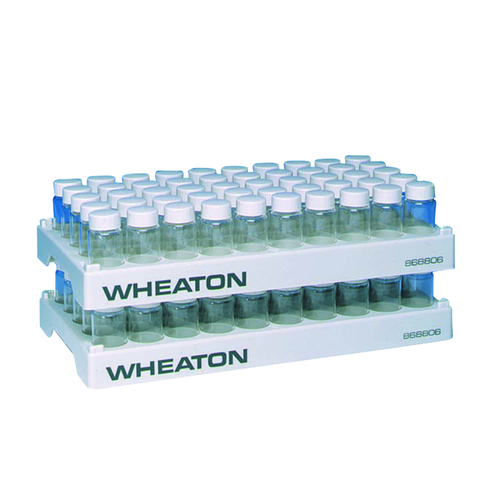
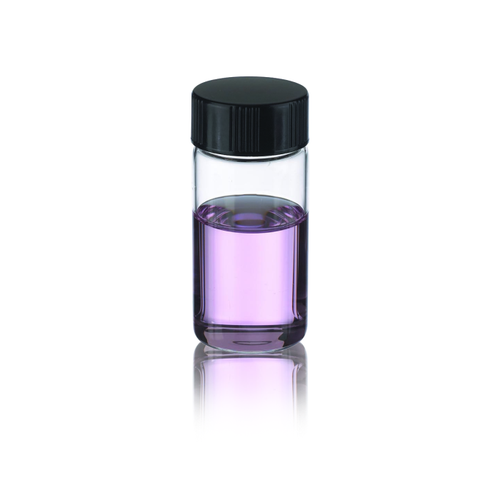
DWK 868806 WHEATON Polypropylene Vial Racks, 50 Positions, 28.1 mm Open ID

$328.21
SKU: 868806 CASE 7 - 10 Business Days
(No reviews yet)
Availability:
7 - 10 Business Days
Shipping:
Calculated at Checkout

WHEATON® 868806 Polypropylene Vial Rack - 50 Positions, 28.1 mm Well ID, White, 5/Case

WHEATON® 868806 Polypropylene Vial Racks from DWK Life Sciences provide an organized, reusable laboratory storage and handling solution for compatible sample vials. Each white polypropylene rack features 50 positions arranged in a 5-row by 10-column configuration, with a 28.1 mm inside diameter (ID) at each well opening.

The rack measures 330 mm long x 170 mm wide x 30 mm high (33 x 17 x 3 cm) and incorporates alphanumeric position indexing to help laboratory personnel identify, organize, and retrieve individual samples. The manufacturer describes the racks as sturdy and stackable, including when compatible vials are in place.

Each well has an opening at the bottom to facilitate drainage during cleaning and handling. The polypropylene construction is easy to clean and is identified by DWK as autoclavable at 121°C, supporting appropriately qualified laboratory cleaning and processing procedures.

WHEATON 868806 is designed for vials with an appropriate outside diameter. The vial's external diameter must not exceed the rack's 28.1 mm well ID, and actual fit should be checked using the complete vial geometry. The well diameter does not represent a vial capacity or a universal compatibility designation.

Ordering note: WHEATON catalog number 868806 is supplied as a case of 5 individual racks. Each rack has 50 positions, providing 250 total vial positions across all five racks. Vials and closures are not included. Verify the actual vial outside diameter and required working clearance before ordering.

Specifications:
  • Manufacturer: DWK Life Sciences
  • Brand: WHEATON®
  • Manufacturer part number: 868806
  • Product type: Laboratory vial rack
  • Material: Polypropylene (PP)
  • Color: White
  • Number of positions: 50 per rack
  • Well arrangement: 5 rows x 10 columns
  • Well inside diameter: 28.1 mm
  • Rack length: 330 mm (33 cm)
  • Rack width: 170 mm (17 cm)
  • Rack height: 30 mm (3 cm)
  • Position identification: Alphanumeric indexing
  • Stackable: Yes, including when compatible vials are in place, per manufacturer
  • Well construction: Bottom opening in each well to facilitate drainage
  • Cleaning: Easy-to-clean polypropylene construction
  • Autoclavable: Yes, at 121°C according to DWK
  • Vial selection: Intended for compatible vials whose outside diameter does not exceed the 28.1 mm well opening
  • Purchase unit: Case
  • Case quantity: 5 racks
  • Total positions per case: 250 across five separate racks
  • Vials included: No
  • Supplied sterility: Not designated as sterile in the reviewed manufacturer product specifications
Where WHEATON 868806 Fits in Laboratory Workflows

Laboratory vial racks help organize sample containers during preparation, testing, inspection, handling, and storage. WHEATON 868806 provides 50 individually indexed positions, allowing personnel to arrange compatible vials in a consistent layout rather than handling numerous loose containers.

The 5 x 10 arrangement can support laboratory procedures requiring defined sample sequences, grouped batches, or repeatable organization. Alphanumeric indexing helps operators identify individual locations and supports sample-handling procedures that use documented position assignments.

The manufacturer's stackable construction allows multiple racks to be arranged vertically when the selected vial configuration and laboratory handling procedure permit it. This can help laboratories organize work areas while maintaining separate racks for different sample groups or processing stages.

Vial-fit consideration: Select the rack using the vial's outside diameter (OD), not its nominal liquid capacity, cap thread size, or inside diameter. DWK states that vial OD cannot exceed the rack well ID. Check vial tolerances, cap clearance, height, and stability before standardizing a complete vial-and-rack combination.

About the Manufacturer:

WHEATON® is a laboratory product brand within DWK Life Sciences, offering laboratory vials, sample containers, closures, racks, and related sample-handling products. Its vial rack range includes multiple well diameters and position counts designed for different laboratory container formats.

DWK emphasizes vial outside diameter as the primary size-selection criterion for this rack family. WHEATON's polypropylene racks incorporate position indexing, stackable construction, and drainage openings to support sample organization and practical laboratory handling. Selecting the exact manufacturer catalog number helps ensure the correct well size, rack dimensions, and case quantity.

WHEATON 868806 Features:
  • White polypropylene laboratory rack construction
  • 50 individual vial positions per rack
  • 5-row by 10-column well arrangement
  • 28.1 mm inside diameter at each well opening
  • 330 x 170 x 30 mm overall rack dimensions
  • Alphanumeric indexing for sample-position identification
  • Stackable construction, including with compatible vials in place
  • Bottom drainage opening in each well
  • Easy-to-clean material and design
  • Manufacturer-listed autoclavability at 121°C
  • Five individual racks per manufacturer case
  • WHEATON catalog number 868806 for purchasing and receiving control
WHEATON 868806 Benefits:
  • Organized sample handling: Fifty individual positions help keep compatible vials arranged in a repeatable laboratory layout.
  • Position identification: Alphanumeric indexing helps personnel locate specific vials and document sample placement.
  • Space-conscious storage: Stackable construction provides an additional organization option when the load and vial configuration are appropriate.
  • Defined vial-size selection: The 28.1 mm well ID provides a specific dimensional requirement for matching vial outer diameters.
  • Convenient cleaning: Polypropylene construction and bottom well openings support washing and drainage.
  • Autoclave capability: Manufacturer-listed 121°C autoclavability allows the rack to be considered for approved laboratory processing workflows.
  • Reusable laboratory accessory: Durable polypropylene construction supports repeated use subject to inspection and appropriate care.
  • Bulk purchasing: Five racks per case provide 250 individual vial locations distributed across separate racks.
  • Exact-SKU consistency: Ordering manufacturer number 868806 helps prevent confusion with racks having different well diameters or position counts.
Common Applications:
  • Organization of compatible laboratory sample vials
  • Sample preparation and staging at laboratory workstations
  • Analytical and quality-control sample management
  • Research and development laboratory workflows
  • Laboratory sample sorting and identification by indexed position
  • Temporary staging of compatible vials during testing procedures
  • Arrangement of sample groups or laboratory processing batches
  • Organized storage of appropriately sized capped or uncapped vials
  • Laboratory washing and approved autoclave preparation workflows
  • Centralized laboratory supplies and reusable rack inventory programs

These are potential applications. Final suitability depends on vial dimensions, fill condition, stability, environmental requirements, and the facility's laboratory procedures.

Best-Practice Use:
  • Verify the vial OD: Confirm the vial outside diameter does not exceed 28.1 mm and that sufficient practical clearance exists for insertion and removal.
  • Check the full container: Consider vial height, closure dimensions, bottom shape, and center of gravity when evaluating stability.
  • Inspect the rack: Check the polypropylene structure for cracks, warping, broken well walls, or other visible damage.
  • Use consistent indexing: Define an alphanumeric sample-position convention in the laboratory SOP or sample tracking system.
  • Load on a stable surface: Place the rack on a suitable level work surface and insert vials carefully.
  • Stack appropriately: Confirm stable engagement and maintain a safe stacking height based on the actual vial and rack load.
  • Protect samples: Avoid sudden movement or loading arrangements that could increase the risk of vial tipping or breakage.
  • Clean routinely: Use an appropriate cleaning method and allow drainage through the bottom well openings.
  • Qualify autoclaving: Follow the manufacturer's plasticware guidance and the laboratory's approved cycle and loading procedures.
  • Inspect after processing: Check for deformation or other changes before returning racks to service.
Selection Notes (868806 vs. Other WHEATON Vial Racks)
  • 868806 vs. 868808: Both provide 50 positions in a 5 x 10 arrangement. Part number 868806 has 28.1 mm well openings; 868808 has larger 30.0 mm well openings and slightly different overall dimensions.
  • 868806 vs. 868805: Part number 868805 provides 36 positions with 23.1 mm well openings in a 3 x 12 arrangement, for smaller-diameter vials.
  • 868806 vs. 868810: Part number 868810 provides 90 positions with 17.1 mm well openings in a 6 x 15 arrangement.
  • Well ID vs. vial OD: The 28.1 mm measurement identifies the rack opening, not a recommended vial capacity or a guarantee of fit for every nominally 28 mm container.
  • Rack dimensions vs. shipping dimensions: The published 330 x 170 x 30 mm dimensions describe one rack, not the outside dimensions of a shipping case.
  • 50 positions vs. 5 per case: Each rack holds up to 50 appropriately sized vials. One case contains five racks.
  • Autoclavable vs. supplied sterile: Autoclavability does not establish that the rack arrives sterile or has been processed to a specified sterility assurance level.
  • Stackability: Manufacturer-listed stacking capability does not specify a universal maximum stacking height, weight limit, or transport rating.
  • Vial availability: Laboratory vials are separate products and are not supplied with the rack case.
Manufacturer Technical Documentation:

Care and Maintenance of Laboratory Plasticware: Review DWK Plasticware Care and Autoclaving Guidance — Manufacturer information about washing, cleaning agents, and autoclave processing.

Chemical Resistance of Plastics: Review DWK Chemical Resistance Guidance — General considerations for selecting laboratory plastics exposed to different chemicals.

Typical Properties of Plastics: Review DWK Polypropylene Material Properties — General physical and temperature-related properties of laboratory plastic materials.

Why Order WHEATON 868806 From SOSCleanroom?
  • Exact-SKU sourcing: SOSCleanroom helps customers identify the correct WHEATON rack configuration, well diameter, position count, and case quantity.
  • Vial-selection assistance: Our team can help locate available manufacturer dimensions when comparing vial and rack configurations.
  • Technical documentation support: Request assistance obtaining available DWK product specifications and material guidance.
  • Centralized laboratory purchasing: Source laboratory racks, vials, closures, and other critical-environment supplies through Specialty Optical Systems, Inc.
  • Responsive customer service: Contact SOSCleanroom directly for quotations, ordering, and availability information.

Notes: For further guidance on well diameter versus vial outside diameter, indexed sample organization, stackability, polypropylene cleaning, autoclaving, and related WHEATON rack sizes, open The Technical Vault.

SOSCleanroom.com supports laboratory and critical-environment supply programs with product sourcing, manufacturer documentation assistance, and responsive customer service. For pricing, availability, or product questions, email Sales@SOSsupply.com or call (214) 340-8574.

Product page updated: October 26, 2026

© 2026 Specialty Optical Systems, Inc. (dba SOSCleanroom). All rights reserved.

The Technical Vault By SOSCleanroom
WHEATON 868806 Polypropylene 50 Positions 28.1 mm Well ID 5 x 10 Grid 330 x 170 x 30 mm Stackable Autoclavable 121°C 5 Racks/Case

WHEATON 868806: selecting a vial rack by well diameter, sample organization, and processing requirements

WHEATON® 868806 is a reusable white polypropylene laboratory vial rack manufactured by DWK Life Sciences. It provides 50 individual wells in a 5 x 10 grid, with a 28.1 mm inside diameter at each well opening.

The rack measures 330 mm long, 170 mm wide, and 30 mm high. It incorporates alphanumeric position indexing, a stackable design, and drainage openings at the bottom of individual wells. DWK identifies the rack as easy to clean and autoclavable at 121°C.

The principal selection requirement is the relationship between the vial's outside diameter and the rack's well inside diameter. Although WHEATON offers sample containers in many nominal capacities, vial volume alone does not determine whether a vial will fit securely in this rack.

Operations takeaway: For WHEATON 868806, control four characteristics when standardizing the rack: 28.1 mm well ID, 50-position 5 x 10 layout, 330 x 170 x 30 mm overall dimensions, and a case quantity of five individual racks. Then verify vial fit, stacking stability, and any required cleaning or autoclave processing.


Specifications (SKU controls for RFQs, SOPs, and receiving)
  • Manufacturer: DWK Life Sciences
  • Brand: WHEATON®
  • Catalog number: 868806
  • Product type: Laboratory vial rack
  • Material: Polypropylene (PP)
  • Color: White
  • Number of positions: 50 per rack
  • Well configuration: 5 deep x 10 wide
  • Well inside diameter: 28.1 mm
  • Length: 330 mm
  • Width: 170 mm
  • Height: 30 mm
  • Position marking: Alphanumeric indexing
  • Stacking: Manufacturer-listed as stackable, including with compatible vials in place
  • Well drainage: Opening at the bottom of each well
  • Cleaning: Easy-to-clean polypropylene construction
  • Autoclavability: 121°C, per manufacturer
  • Purchase unit: Case
  • Quantity per case: 5 racks
  • Combined rack positions per case: 250
  • Vials supplied: No
  • Supplied sterility: Not established in reviewed SKU documentation
  • Maximum stacking load: Not established in reviewed specifications
  • Maximum recommended vial height: Not established in reviewed specifications
  • Product-specific chemical exposure limits: Not established in reviewed specifications
  • Storage-temperature range: No SKU-specific range confirmed

Specification-control note: The manufacturer's 330 x 170 x 30 mm dimensions describe one rack. They are not the dimensions of the shipping carton containing five racks. Likewise, the 28.1 mm value identifies an individual well opening, not the external vial diameter supplied with the product.


Well inside diameter versus vial outside diameter

The most important dimensional distinction for WHEATON 868806 is between the 28.1 mm well inside diameter (ID) and the outside diameter (OD) of the vial being inserted.

DWK's WHEATON vial rack guidance states that the vial outside diameter must not exceed the well inside diameter. For this rack, the maximum published nominal opening is 28.1 mm. However, this does not guarantee smooth insertion or removal of every vial whose nominal outside diameter is exactly 28.1 mm.

Dimension or feature Meaning for vial selection
28.1 mm well ID The manufacturer's nominal inside diameter of the rack opening
Vial outside diameter The external vial body dimension used for initial rack selection
Vial capacity in mL Describes volume, not a guaranteed body diameter or rack fit
Vial height Affects accessibility, handling, and the stability of loaded arrangements
Closure dimensions May affect clearance, vial access, and loaded stacking configurations
Dimensional tolerances Can affect actual clearance even when nominal dimensions appear compatible

Vial-fit rule: Select by the actual vial outside diameter and allow practical clearance. When dimensions are close to the 28.1 mm opening, verify fit with the complete container before adopting the rack for routine use. Do not force oversized vials into the wells.


Examples of WHEATON vials identified for rack 868806

WHEATON's manufacturer vial-selection guide identifies several glass vial configurations with approximately 28 mm outside diameters as suitable for rack 868806.

The following are examples from that guide. The references describe separate vial products and do not mean those vials are included in the rack case.

WHEATON vial SKU Nominal capacity Published diameter x height Guide-listed rack
225289 25 mL 28 x 73 mm 868806
W224590 25 mL 28 x 73 mm 868806
225290 40 mL 28 x 98 mm 868806
W224591 40 mL 28 x 98 mm 868806

These examples demonstrate why vial capacity alone is not a reliable rack-selection method: the manufacturer's 25 mL and 40 mL examples share a nominal 28 mm body diameter but differ substantially in height.

Compatibility checkpoint: These vial references come from a manufacturer selection guide and should be checked against current vial dimensions and availability before ordering. Cap geometry, actual tolerances, and loaded-rack stability must still be considered.


Understanding the 5 x 10 layout and alphanumeric indexing

WHEATON 868806 has a 5-row by 10-column arrangement. Alphanumeric indexing is indicated on the rack to simplify locating and identifying samples during handling.

A laboratory may use a documented row-and-column convention to associate each location with a sample identification number, work order, batch, or laboratory information management system (LIMS) record.

  • 50 positions: One location for each appropriately sized vial.
  • Alphanumeric identification: Supports finding individual vial positions without relying exclusively on memory.
  • Sample sequencing: Provides a consistent layout for planned analytical or sample-preparation procedures.
  • Batch grouping: Separate racks can be allocated to different processing stages or sample groups.
  • Inventory management: Supports documented placement and retrieval procedures.
  • Operator consistency: A defined orientation and position convention can help reduce sample-location errors.

The laboratory should document its selected rack orientation and labeling scheme. Do not assume that a particular letter-and-number convention in a LIMS automatically matches the physical orientation of the rack without verification.


Stackable rack construction and loaded-rack stability

DWK identifies the WHEATON polypropylene vial racks as sturdy and stackable, even when compatible vials are in place. This feature allows laboratories to consider vertical storage arrangements where workbench or shelf organization is important.

Stackability is a product-design feature, not a universal guarantee that any number of loaded racks can be stacked safely. Vial height, fill volume, weight distribution, closure dimensions, surface stability, and handling conditions affect the complete arrangement.

  • Check the surface: Use a suitable, level, stable work surface or shelf.
  • Inspect rack engagement: Confirm that the racks rest in their intended stacking arrangement without rocking.
  • Check loaded height: Evaluate vial protrusion, caps, and the clearance between stacked racks.
  • Distribute loads: Avoid unstable loading arrangements when storing different vial types or fill quantities.
  • Control movement: Follow approved handling procedures rather than moving tall stacks without assessment.
  • Inspect for damage: Remove racks with damaged stacking features, deformation, or cracks from use.

Stacking boundary: DWK does not publish a product-specific maximum loaded stacking height, allowable vertical load, or transport rating in the reviewed SKU specifications. Establish safe stacking limits for the actual laboratory configuration.


Bottom drainage openings and laboratory cleaning

Each well in WHEATON 868806 incorporates an opening at the bottom to facilitate drainage. This construction can assist with the removal of rinse water and other compatible cleaning liquids rather than retaining fluid in a completely closed-bottom well.

The rack's open drainage design does not by itself establish a validated cleaning procedure or a guaranteed removal level for chemical residues, particles, or microorganisms.

  1. Remove the vials: Prepare the rack for cleaning according to the facility's procedure.
  2. Inspect the wells: Identify visible deposits, spilled residues, or other contamination.
  3. Apply a compatible cleaner: Use a cleaning agent appropriate for polypropylene and the contamination present.
  4. Clean all surfaces: Include the well walls, bottom openings, rack edges, and stacking features.
  5. Rinse appropriately: Use the required water quality and rinsing procedure.
  6. Allow drainage: Position the rack to permit removal of rinse liquid.
  7. Inspect and dry: Confirm that the rack meets the facility's cleanliness and reuse criteria.

DWK's general laboratory plasticware guidance recommends suitable detergents and nonabrasive cleaning methods to minimize scratching and physical damage. The correct method depends on the laboratory's contamination-control requirements.


Polypropylene material science and laboratory properties

Polypropylene (PP) is a thermoplastic polymer widely used in laboratory products. DWK identifies polypropylene as a generally rigid material with useful chemical resistance and compatibility with appropriate steam autoclave processing.

The WHEATON 868806 rack uses white polypropylene construction. Its material provides a washable, reusable alternative to temporary vial organization methods that may not tolerate laboratory cleaning and moisture exposure as readily.

  • Material family: Polypropylene thermoplastic.
  • Construction: White laboratory rack.
  • General material characteristic: Rigid plastic with resistance to a range of laboratory chemicals.
  • Cleaning: Compatible with appropriate laboratory plasticware cleaning procedures.
  • Autoclavability: SKU 868806 is specifically identified as autoclavable at 121°C.
  • Application qualification: Exposure temperature, chemical resistance, repeated processing, and physical wear must be evaluated for the intended procedure.

Material property versus product specification: General polypropylene property tables should not be treated as a published maximum service temperature, load rating, or validated chemical exposure specification for the finished 868806 rack. Use the SKU-specific manufacturer information for product claims.


Chemical compatibility: selecting cleaning agents for polypropylene

Polypropylene has useful general resistance to many laboratory chemicals. However, compatibility varies according to chemical identity, concentration, exposure duration, and temperature.

DWK provides general chemical-resistance guidance for laboratory plastics. These resources can assist laboratories in evaluating whether a particular cleaning agent or incidental chemical exposure is suitable for the rack material.

Exposure or material Qualification consideration
Laboratory detergents Choose a compatible formulation and avoid unnecessarily abrasive cleaning methods
Aqueous chemicals Verify concentration, temperature, and duration of exposure
Alcohol-based cleaners Confirm compatibility with the exact formulation and intended contact time
Strong oxidizers Evaluate chemical effects on the polymer before routine exposure
Organic solvents Assess potential swelling, degradation, and changes in material properties
Hot cleaning solutions Evaluate combined chemical and thermal exposure

This table describes the compatibility assessment required for common exposure categories. It does not assign product-specific resistance ratings or guarantee the suitability of any cleaning chemical.

Chemical-selection rule: Do not assume universal chemical resistance or transfer compatibility ratings from unrelated polypropylene products. Where aggressive cleaning chemicals or repeated exposure are involved, qualify the actual rack material and cleaning conditions.

Review DWK Chemical Resistance of Plastics


Autoclavability at 121°C: processing guidance and limitations

DWK explicitly identifies WHEATON 868806 as autoclavable at 121°C. This is a manufacturer-listed product characteristic relevant to facilities using controlled steam processing for reusable laboratory accessories.

DWK's general Care and Maintenance of Laboratory Plasticware guidance defines a standard autoclave cycle as 121°C at approximately 15 psi (1 bar) for 20 minutes. This is general plasticware processing guidance; the 868806 SKU-specific product page identifies 121°C but does not separately publish a validated rack-specific cycle or allowable number of repetitions.

  1. Inspect the rack: Confirm that it is free from cracks, significant deformation, or other defects.
  2. Clean before processing: Remove visible residues using the approved cleaning method.
  3. Confirm the load: Establish whether the procedure covers the empty rack or an assembly with additional components.
  4. Arrange the load: Position the rack according to the facility's validated procedure to permit appropriate steam exposure and drainage.
  5. Apply the approved cycle: Follow the laboratory's validated process and the manufacturer's applicable temperature guidance.
  6. Allow cooling: Avoid mechanical loading that could distort hot plastic components.
  7. Inspect after processing: Check the rack's dimensions, wells, stacking features, and general condition.
  8. Document release: Apply any required inspection or sterilization-record controls.

Sterility and processing boundary: Autoclavability does not mean the rack arrives sterile. It also does not establish that every vial, closure, sample, or fully loaded rack can be processed under the same conditions. The complete load and process must be qualified independently.

Review DWK Laboratory Plasticware Cleaning and Autoclaving Guidance


Cleanroom and controlled-environment suitability

WHEATON 868806 may be considered for laboratory workflows performed in controlled environments when its materials, cleanliness, dimensions, and handling procedures meet facility requirements.

The reviewed manufacturer product specifications do not assign the rack an ISO 14644 product classification, particle-release limit, sterile packaging designation, or validated cleanroom-processing grade.

  • Material transfer: Follow approved packaging removal and controlled-area introduction procedures.
  • Cleaning requirements: Use the required cleaning or preparation method for the intended area.
  • Particle-sensitive operations: Evaluate cleanliness and condition rather than assuming a low-particle certification.
  • Aseptic procedures: Use only appropriately qualified racks and processing methods.
  • Sample traceability: Link rack locations and vial identifiers to the applicable recordkeeping system.
  • Reuse controls: Establish cleaning, inspection, and release criteria between laboratory processes.

Qualification note: ISO 14644 describes classified environmental conditions; it does not independently certify a polypropylene vial rack. Establish product and process suitability through the facility's contamination-control and quality procedures.


Comparing verified WHEATON polypropylene vial racks

DWK offers several polypropylene vial racks with different well diameters, well arrangements, and overall dimensions. Selecting the correct rack depends primarily on the vial outside diameter and the required position count.

WHEATON SKU Well ID Positions Dimensions (mm) Racks/Case
868810 17.1 mm 90 (6 x 15) 330 x 170 x 30 5
868805 23.1 mm 36 (3 x 12) 322 x 91 x 28 5
868806 28.1 mm 50 (5 x 10) 330 x 170 x 30 5
868808 30.0 mm 50 (5 x 10) 337 x 170 x 30 5

All four configurations are described by DWK as polypropylene racks with alphanumeric indexing, drainage openings, stackability, and 121°C autoclavability. Their well diameters and layouts are different.

Selection rule: Do not substitute 868808 for 868806, or vice versa, based solely on their common 50-position layout. The 28.1 mm and 30.0 mm well diameters are different, and the rack lengths also differ.


Distinguishing general vial racks from specialized vial-locking designs

The WHEATON vial rack range includes specialized configurations intended for particular sample containers. Some manufacturer guide references describe racks with vial-locking features for one-handed cap removal.

Those specialized features should not be assigned automatically to WHEATON 868806. The manufacturer identifies 868806 by its 28.1 mm openings, 50-position layout, polypropylene construction, alphanumeric indexing, drainage, stackability, and autoclavability.

Functional distinction: A rack that supports vials for handling does not necessarily incorporate a locking mechanism, prevent vial rotation, or provide validated one-handed decapping performance. Verify these features before making them procurement requirements.


Storage, handling, and rack reuse

The reviewed manufacturer specifications do not identify a numerical shelf life, maximum storage temperature, maximum supported vial weight, or approved transport load for WHEATON 868806.

Good laboratory practice includes protecting unused or cleaned racks from physical damage, chemical exposure, and contamination that could affect their continued suitability.

  • Maintain identification: Preserve the manufacturer catalog number and applicable inventory records.
  • Protect the wells: Avoid crushing, scratching, or loading oversized containers.
  • Control contamination: Store cleaned racks according to the laboratory's preparation status and handling procedures.
  • Inspect indexing: Confirm that position identification remains visible and usable.
  • Avoid unnecessary exposure: Do not subject the rack to chemicals or temperatures outside its approved procedure.
  • Establish replacement criteria: Remove racks with deformation, cracking, unstable stacking features, or damaged well structures.

Receiving and inspection checklist

Laboratories using controlled purchasing procedures should verify the correct rack configuration and physical condition before releasing the product for use.

  1. Verify manufacturer SKU: Match WHEATON 868806 to the purchase order.
  2. Confirm case quantity: Verify five separate racks per case.
  3. Confirm position count: Check the 50-position, 5 x 10 arrangement.
  4. Verify well size: Confirm the specified 28.1 mm well opening.
  5. Confirm dimensions: Check the listed 330 x 170 x 30 mm rack size.
  6. Check material and color: Confirm white polypropylene construction.
  7. Inspect physical condition: Look for cracks, deformation, damaged wells, or broken stacking features.
  8. Check indexing and drainage: Verify the alphanumeric markings and openings in the well bottoms.
  9. Confirm process requirements: Review any cleaning, inspection, or autoclave preparation needed before use.
  10. Maintain records: Capture required receiving identification and applicable manufacturer documentation.

Important limitations and unsupported assumptions
  • No universal vial capacity: Compatibility depends on outside diameter and complete vial geometry, not just volume in milliliters.
  • No guaranteed 28.1 mm vial fit: A nominally matching diameter may not provide adequate practical clearance.
  • No published maximum vial height: Evaluate actual height, closure, and stability.
  • No validated maximum stack load: Do not assume a universal number of safely stackable loaded racks.
  • No transport certification: The rack's organization and stacking features are not equivalent to validated shipping protection.
  • No supplied-sterile designation: Autoclavability does not establish sterile packaging or supplied sterility.
  • No product-specific ISO cleanroom class: The reviewed manufacturer specifications do not assign a cleanliness classification.
  • No universal chemical resistance: Evaluate the actual chemicals and conditions.
  • No verified extreme-temperature storage rating: Do not assume suitability for cryogenic or other specialized storage conditions.
  • No vial-locking guarantee: Do not transfer one-handed cap-removal claims from a separately designated rack design.

Technical FAQs

What is the exact well diameter of WHEATON 868806?

DWK specifies a 28.1 mm inside diameter at each well opening.

How many vials can one rack hold?

Each rack contains 50 positions in a 5 x 10 arrangement, intended for appropriately sized vials.

How many racks are included in a case?

The manufacturer supplies five individual racks per case, providing 250 total positions when all five racks are considered together.

What are the overall rack dimensions?

One rack measures 330 mm long x 170 mm wide x 30 mm high, or 33 x 17 x 3 cm.

Are these dimensions for the shipping carton?

No. They describe the individual rack. The shipping carton dimensions are not established in the reviewed manufacturer specifications.

Are the racks made from polypropylene?

Yes. DWK specifies white polypropylene (PP) construction.

Are the individual positions numbered?

The manufacturer describes alphanumeric indexing on the rack to support sample position identification.

Can the racks be stacked?

Yes. DWK identifies them as stackable, including when compatible vials are in place. The manufacturer does not establish a universal maximum loaded stack height in the reviewed SKU specifications.

Do the wells have drainage holes?

Yes. DWK describes an opening at the bottom of each well to facilitate drainage.

Can a vial with a 28 mm outside diameter fit?

A nominal 28 mm body diameter is within the stated 28.1 mm well ID. WHEATON's selection guide identifies certain 28 mm-diameter vials for rack 868806. Verify current vial tolerances and the complete container configuration before use.

Can I use a 30 mm outside-diameter vial?

Not in a nominal 28.1 mm opening. For larger vials, evaluate the separately designated WHEATON 868808 rack, which has 30.0 mm well openings. Verify practical clearance and vial fit.

Does the rack hold a specific vial volume?

Not universally. WHEATON's guide identifies certain 25 mL and 40 mL vials for this rack because they share suitable body dimensions. Capacity alone is not the correct selection criterion.

Are the racks autoclavable?

Yes. DWK lists autoclavability at 121°C for WHEATON 868806.

What autoclave cycle should be used?

DWK's general plasticware guidance describes a 121°C, approximately 15 psi, 20-minute cycle. The individual rack product record specifies 121°C but does not independently establish a validated rack-specific cycle. Follow the facility's approved procedure.

Are the racks sterile when purchased?

A supplied-sterile designation is not established in the reviewed manufacturer specifications. Autoclavability and supplied sterility are different characteristics.

Can the racks be cleaned with laboratory detergents?

DWK identifies the rack as easy to clean and provides general guidance on cleaning laboratory plasticware. Choose a detergent compatible with polypropylene and the actual residues.

Can this rack be used in an ISO-classified cleanroom?

Use in a classified environment depends on the facility's material introduction, cleaning, and contamination-control procedures. The rack is not assigned a product-specific ISO cleanliness class in the reviewed documentation.

What is the difference between 868806 and 868808?

Both have 50 positions and a 5 x 10 layout. Rack 868806 has 28.1 mm wells and is 330 mm long. Rack 868808 has 30.0 mm wells and is 337 mm long.

Are sample vials included?

No. The manufacturer case contains five vial racks. Vials and closures are separate products.


Manufacturer documentation and technical references

Product identity, well diameter, rack dimensions, position count, case quantity, and autoclavability were verified using the manufacturer's 868806 product specifications. Related rack dimensions and selected vial compatibility examples were cross-checked against WHEATON manufacturer information. Material guidance describes general polypropylene properties and does not constitute an additional product-specific certification.


Why purchase WHEATON vial racks from SOSCleanroom?
  • Exact-SKU purchasing: Confirm WHEATON 868806 to obtain the correct 28.1 mm well diameter, 50-position format, and five-rack case.
  • Vial compatibility assistance: SOSCleanroom can help locate manufacturer vial dimensions and identify appropriate rack-selection information.
  • Technical documentation support: Request assistance with manufacturer specifications and plasticware care guidance.
  • Configuration control: Avoid confusion between rack well diameters, position counts, and manufacturer case quantities.
  • Centralized laboratory purchasing: Source WHEATON racks, vials, closures, and related supplies through Specialty Optical Systems, Inc.
  • Responsive customer service: Contact SOSCleanroom directly for quotations, availability, and product-selection questions.

If you have any questions please email us at Sales@SOSsupply.com or give us a call at (214) 340-8574. For additional product guidance, use the SOSCleanroom AI ChatBot or contact our team for manufacturer documentation assistance. Technical insight: Rack selection begins with the vial outside diameter and well inside diameter. Correct sample organization also depends on the vial height, closure geometry, indexing procedure, and stability of the complete loaded rack. Last updated: October 26, 2026 © 2026 SOSCleanroom. All rights reserved.