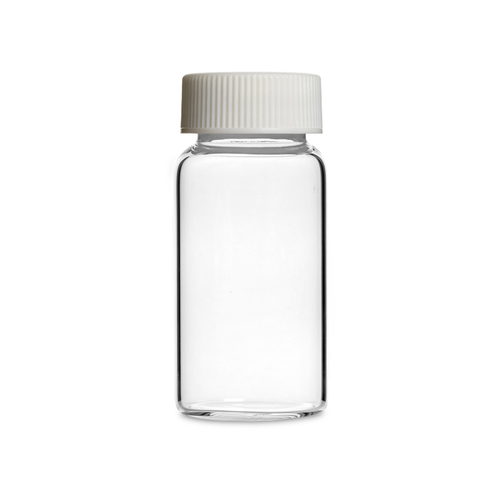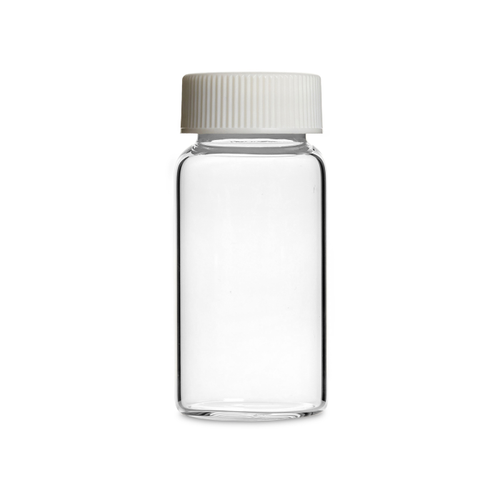
DWK 986548 WHEATON Liquid Scintillation Vials, Borosilicate Glass, 22-400 White Urea Caps Attached to Vials, Polyethylene Disc Liner, 20 mL

$398.73
SKU: 986548 CASE 7 - 10 Business Days
(No reviews yet)
Availability:
7 - 10 Business Days
Shipping:
Calculated at Checkout


WHEATON® 986548 Glass Liquid Scintillation Vials - 20 mL, White Urea 22-400 Caps, Polyethylene Disc Liners, 500/Case

WHEATON® 986548 Liquid Scintillation Vials from DWK Life Sciences are 20 mL clear borosilicate glass vials supplied with white urea 22-400 screw caps attached to the vials. Each cap features a polyethylene (PE) disc liner. This exact vial-and-closure combination is intended for compatible liquid scintillation counting and laboratory sample-handling procedures.

DWK specifies a 28 mm diameter and 57 mm glass-vial height without the cap; the total height including the cap is 61 mm. These dimensions help identify a vial format for a laboratory counting instrument, rack, or sample holder. Instrument compatibility must be verified for the complete assembly.

The manufacturer describes its liquid scintillation glass-vial family as having consistent, low background counts and high ultraviolet (UV) transmission. WHEATON technical literature historically identifies low-potassium borosilicate glass for its glass scintillation vials. These qualitative material characteristics do not establish a numerical background count, UV transmission percentage, or counting efficiency for any particular analytical setup.

The important difference between 986548 and 986546 is the liner: 986548 has a flat polyethylene disc, whereas 986546 has a polyethylene cone that forms a wedge-style seal along the inside neck. The disc is also distinct from foamed PE, foil/cork, foil/pulp, and PTFE-faced liners. Closure construction matters when selecting a scintillation cocktail, specifying a sample container, or matching a laboratory method.

DWK's Closure Liner Guide identifies the low-density polyethylene (LDPE) disc as manufactured from polyethylene and describes general suitability for distilled water, analytical standards, and reagents. The guide recommends testing closure liners under the actual application conditions. The manufacturer does not publish a universal solvent-compatibility or leakproof certification for the 986548 assembly.

WHEATON 986548 is specifically designated non-sterile and has no marking spot. Its current SKU page does not display an autoclavability rating. However, DWK separately lists the corresponding 22-400 white urea/PE-disc replacement screw cap 240817 as not autoclavable; do not autoclave the completed vial-and-cap assembly without manufacturer confirmation.

Ordering note: WHEATON 986548 includes 500 clear 20 mL borosilicate glass vials per case, each with an attached white urea 22-400 screw cap and polyethylene disc liner. The product is non-sterile and has no marking spot. The cap-and-liner system is not qualified here for autoclaving. Scintillation cocktails, counters, and separate racks are not included.

Specifications:
  • Manufacturer: DWK Life Sciences
  • Brand: WHEATON®
  • Catalog number: 986548
  • Product: Glass liquid scintillation vial with attached cap
  • Nominal capacity: 20 mL
  • Vial material: Clear borosilicate glass; Type I borosilicate glass tubing family
  • Outside diameter: 28 mm
  • Vial height without cap: 57 mm
  • Overall height with cap: 61 mm
  • Thread finish: 22-400
  • Cap included: Yes, attached to vial per manufacturer
  • Cap material: Urea
  • Cap color: White
  • Cap liner: Polyethylene disc
  • General liner material: LDPE disc, per DWK closure guide
  • Marking spot: No
  • Sterile status: Non-sterile
  • 986548 autoclave field: Not published on reviewed exact-SKU page
  • Matching replacement screw cap: WHEATON 240817 (22-400 urea/PE disc; separately sold; not autoclavable)
  • Scintillation characteristics: Manufacturer-described consistent low background and high UV transmission
  • Purchase unit: Case
  • Quantity per case: 500 complete vial-and-cap units
  • Numerical background / optical transmission: Not specified in reviewed exact-SKU record
  • Calibrated volume / instrument fit: Not established; requires method and instrument verification
  • Inner packaging, weight, country of origin: Not confirmed for this exact SKU
Why the Polyethylene Disc Liner Matters

A polyethylene disc liner is a flat-style closure component positioned within the cap. It differs from the PE cone design that contacts both the vial rim and inside neck diameter. DWK identifies an LDPE disc in its general liner guide and lists distilled water, analytical standards, and reagents as example applications.

This guidance is not an approved-chemical list for every scintillation cocktail. The finished 986548 assembly consists of three materials: borosilicate glass, white urea cap, and PE disc. All must be evaluated for the actual sample, solvents, vapor contact, temperature, storage duration, and method requirements.

DWK separately sells WHEATON 240817, a solid-top 22-400 white urea screw cap with a polyethylene disc liner, in cases of 1,000. That separate cap is identified as not autoclavable; it is not an additional component included with the 986548 case, which already contains attached caps.

Closure limitation: Neither the disc liner nor the 22-400 thread establishes a certified leakproof, vapor-tight, PTFE-lined, pressure-rated, or universally solvent-resistant container. Do not use the cone liner's torque-retention claims as properties of the disc.

About the Manufacturer:

WHEATON®, a DWK Life Sciences brand, manufactures and supplies laboratory vials, screw caps, glassware, and sample-handling products. Its liquid scintillation vial range includes multiple glass and plastic materials, closure sizes, cap materials, liner shapes, and cap-packing formats. Exact manufacturer part numbers distinguish configurations that may look similar but have different chemical or instrument considerations.

WHEATON 986548 Features:
  • 20 mL nominal clear borosilicate glass scintillation vial
  • Type I borosilicate glass tubing product family
  • 28 mm diameter; 57 mm height without cap
  • 61 mm overall height with attached cap
  • 22-400 glass screw-thread finish
  • White urea screw cap included and attached to each vial
  • Polyethylene disc liner (LDPE disc material in DWK general liner guidance)
  • Flat disc configuration, distinct from PE cone and foamed PE liner types
  • Manufacturer-described low, consistent scintillation background and high UV transmission
  • No marking spot on vial
  • Manufacturer-listed non-sterile presentation
  • 500 vials with attached caps per case
WHEATON 986548 Benefits:
  • Complete manufacturer-defined assembly: A specified 22-400 white urea cap and PE-disc liner are supplied with the glass vial.
  • Consistent vial geometry: Published 28 mm diameter and 61 mm capped height support instrument-fit planning.
  • Flat disc liner choice: Allows a lab to specify the PE-disc design rather than cone, foam, or foil-backed materials.
  • Scintillation-oriented material: Manufacturer describes low background and high UV transmission for the glass-vial family.
  • Manufacturer-documented liner category: DWK describes LDPE discs for distilled water, analytical standards, and reagents.
  • Clear process controls: Non-sterile status is explicit; the matched cap carries a non-autoclavable designation.
  • Case-scale ordering: A 500-count case supports analytical laboratory replenishment.
Common Applications:
  • Liquid scintillation counting (LSC) with compatible laboratory instruments
  • Radiolabeled samples handled under authorized research and analytical methods
  • Biological, biochemical, and isotope-tracer research
  • Environmental laboratory counting applications
  • Analytical sample handling requiring a 20 mL borosilicate vial
  • Laboratory methods specifying a 22-400 urea screw cap and PE-disc liner
  • Compatible sample storage where the vial/closure materials and seal are qualified

These are potential use cases, not guarantees of compatibility with a particular scintillation cocktail, radionuclide, sample matrix, counter, or regulated method.

Best-Practice Use:
  • Verify the exact SKU: Confirm 986548, 20 mL, urea 22-400 cap, and PE-disc liner.
  • Inspect the assembly: Check glass, rim, threads, cap, and disc liner for chips, damage, or contamination.
  • Review cocktail chemistry: Qualify the glass, urea cap, and LDPE liner against the entire sample and solvent formulation.
  • Verify instrument fit: Confirm 28 mm diameter and 61 mm assembled height with the counter or rack.
  • Use method-defined volumes: The 20 mL capacity is nominal; use the prescribed working fill and headspace.
  • Check closure performance: Follow approved handling and conduct leak or evaporation testing when needed.
  • Label samples appropriately: The vial has no manufacturer marking spot.
  • Use analytical controls: Follow blank, background, standard, and instrument QC procedures.
  • Follow safety procedures: Apply chemical, radiological, ventilation, and disposal controls.
  • Avoid unqualified thermal processing: The matched urea/PE-disc replacement cap is not autoclavable; request written DWK approval before processing a 986548 assembly.
Selection Notes: 986548 vs. Related WHEATON Vials
  • 986548: 20 mL borosilicate glass, white urea 22-400 cap attached; polyethylene disc liner; 500/case.
  • 986546: Same nominal glass size and 22-400 urea cap, but a polyethylene cone liner rather than a disc.
  • 986542: 22-400 white urea cap with metal foil/cork liner.
  • 986540: White polypropylene 22-400 cap with foamed PE liner.
  • 986541: White polypropylene 22-400 cap with metal foil/pulp liner.
  • 986568: White urea/PE-disc attached cap on a different 24-400 thread finish.
  • 986532: 20 mL clear borosilicate glass vial with 22-400 finish, without cap.
  • 240817: Matching 22-400 white urea/PE-disc replacement screw cap, separately sold in cases of 1,000; not included as an extra item.

Substitution rule: Similar 20 mL vials are not automatically identical in liner chemistry, seal geometry, thread finish, cap material, or sample handling.

Manufacturer Technical Documentation:

Closure Liner Guide: Review DWK low-density polyethylene disc guidance — General LDPE disc use, thread selection, and liner-qualification recommendations.

Glass Types & Properties: Review DWK borosilicate glass guidance — General glass classifications, material characteristics, and chemical durability.

Care & Maintenance: Review DWK glassware handling and inspection — General protection against glass damage.

General Advice for Cleaning Glassware: Review DWK cleaning and rinsing guidance — General laboratory glassware care; not authorization to autoclave the 986548 assembly.

Why Order WHEATON 986548 From SOSCleanroom?
  • Exact-SKU sourcing: Confirm the correct 22-400 urea cap and polyethylene disc liner rather than a cone or foil-lined variant.
  • Configuration comparisons: Get assistance distinguishing vial material, neck finish, cap and liner types.
  • Manufacturer documentation: Request current product information, certificates, and closure qualifications where applicable.
  • Centralized purchasing: Source laboratory glassware and critical-environment supplies through Specialty Optical Systems, Inc.
  • Responsive service: Contact SOSCleanroom directly for pricing, quotes, and availability.

Technical note: The Technical Vault covers the LDPE disc liner, differences from PE cone and foil liners, material compatibility, scintillation performance, instrument fit, and autoclavability documentation.

For pricing, availability, or product questions, email Sales@SOSsupply.com or call (214) 340-8574.

Product page updated: October 27, 2026

© 2026 Specialty Optical Systems, Inc. (dba SOSCleanroom). All rights reserved.


The Technical Vault By SOSCleanroom
WHEATON 986548 20 mL Type I Glass Family 22-400 White Urea Cap PE Disc Liner 28 x 61 mm Capped Non-Sterile Cap Not Autoclavable 500/Case

WHEATON 986548: exact vial and closure configuration

WHEATON® 986548 is a 20 mL clear borosilicate glass liquid scintillation vial with a white urea 22-400 screw cap attached to the vial and a polyethylene disc liner. DWK specifies a 28 mm outside diameter, a 57 mm uncapped vial height, and a 61 mm assembled height including the cap.

The manufacturer describes its glass scintillation-vial family as having consistent low background counts and high UV transmission. The exact 986548 listing specifies non-sterile and no marking spot; the manufacturer case quantity is 500 complete vial-and-cap units.

The defining difference between 986548 and 986546 is the flat polyethylene disc versus polyethylene cone liner. Both use white urea 22-400 caps, but the liners have different shapes, seating geometry, and general manufacturer descriptions. The liner choice must match the actual laboratory method and sample chemistry.

Operations takeaway: Order 986548 for 20 mL borosilicate glass, attached white urea 22-400 caps, and PE disc liners, 500/case. The exact vial SKU does not publish an autoclavability rating, but the separately sold matching 240817 cap is not autoclavable; do not autoclave the completed assembly without written DWK confirmation.


Exact-SKU specifications for purchasing, SOPs, and receiving
  • Manufacturer / brand: DWK Life Sciences / WHEATON®
  • Catalog number: 986548
  • Product type: Glass liquid scintillation vial with attached screw cap
  • Nominal capacity: 20 mL
  • Material: Clear borosilicate glass; Type I tubing product family
  • Diameter: 28 mm
  • Glass height without cap: 57 mm
  • Height including cap: 61 mm
  • Neck and cap finish: 22-400
  • Closure included: Yes; caps attached to vials in manufacturer-defined SKU
  • Cap color and body: White urea
  • Cap liner: Polyethylene disc
  • General disc liner material: LDPE, per DWK Closure Liner Guide
  • Marking spot: No
  • Supplied sterile: Non-sterile
  • SKU-level autoclavability: No 986548 value displayed in the reviewed current record
  • Matching replacement screw cap: WHEATON 240817 (22-400, urea, PE disc), not autoclavable; separately sold
  • Scintillation background: Manufacturer describes low and consistent counts
  • Optical characteristic: Manufacturer describes high UV transmission
  • Purchase unit: Case
  • Quantity per case: 500 vial-and-cap units
  • Calibrated volume tolerance: Not established; 20 mL is nominal
  • Leak rate / vapor seal / cap torque: Not established for finished 986548
  • Confirmed inner trays / case weight / carton size: Not established in exact-SKU record
  • Lot-specific analytical background / UV spectrum: Not established in reviewed public SKU data

Specification control: The listed 61 mm height includes the supplied cap. Do not assume the 20 mL capacity is a calibrated measuring volume, that a 22-400 finish certifies a leakproof seal, or that the properties of another liner apply to this PE disc.


Polyethylene disc liner: what DWK actually specifies

DWK calls the liner on 986548 a Polyethylene Disc. Its general Closure Liner Guide describes a Low Density Polyethylene (LDPE) Disk manufactured from polyethylene. Example uses listed by DWK include distilled water, analytical standards, and reagents. The manufacturer advises users to test closure and liner suitability for their specific conditions.

The disc is a flat liner rather than the cone-shaped liner supplied with 986546. The manufacturer's distinct PE cone guidance describes wedge contact at the inside diameter of a vial neck; that cone-specific geometry and torque-retention description must not be automatically assigned to 986548's disc liner.

Property Manufacturer-supported description
Exact 986548 liner namePolyethylene Disc
General DWK material designationLow Density Polyethylene (LDPE) Disk
General example usesDistilled water, analytical standards, reagents
GeometryDisc-style liner, not a cone or foamed PE construction
Manufacturer guidanceQualify liners under actual application conditions
Specific solvent exposure ratingNot supplied for the finished 986548 assembly
Cap torque or certified leak rateNo numerical value established
Autoclave ratingMatching 22-400 urea/PE-disc cap 240817 is not autoclavable

Material qualification: General LDPE-disc guidance does not certify every laboratory solvent, scintillation cocktail, radiolabeled sample, vapor exposure, or storage duration. The complete glass/urea/PE-disc assembly must be evaluated together.

Review DWK Closure Liner Guide for LDPE-disc information


PE disc versus PE cone: differences from WHEATON 986546

WHEATON 986548 and 986546 share the same nominal 20 mL glass-vial volume, 28 mm diameter, 57 mm glass height, 61 mm capped height, and attached white urea 22-400 closure family. The liner geometry is the important change.

Feature 986548: PE Disc 986546: PE Cone
Liner name Polyethylene Disc Polyethylene Cone
General material LDPE disc in DWK technical guide LDPE cone in DWK technical guide
Configuration Flat disc-style liner Wedge-shaped liner with inside-neck contact
DWK general guidance Distilled water, analytical standards, reagents Wedge-type seal and superior torque-retention description
22-400 white urea cap Yes, attached Yes, attached
Glass and dimensions 20 mL borosilicate; 28 x 61 mm capped 20 mL borosilicate; 28 x 61 mm capped
Sterility Non-sterile Non-sterile
Autoclavability Vial SKU field absent; matching cap not autoclavable Product SKU explicitly not autoclavable

Selection principle: A wedge-style cone may be relevant to a laboratory that specifies that seal geometry; the disc is the distinct manufacturer configuration of 986548. Do not infer that one is universally more chemically resistant, leakproof, or analytically superior. Follow the exact method, chemistry, and seal validation.


22-400 urea cap and matching WHEATON 240817 replacement closure

The included cap body is white urea, not polypropylene. The manufacturer specifies a 22-400 closure finish for both the vial and cap. DWK's thread guide cautions that the thread finish of container and closure must match; a 24-400 cap is not a drop-in substitute.

DWK separately lists WHEATON 240817 as a white urea, solid-top 22-400 liquid scintillation screw cap with polyethylene disc liner. It is a separately purchased replacement-cap catalog item, normally sold 1,000 per case, and is designated not autoclavable. This is useful for closure identification, but 240817 is not supplied as an additional spare cap with 986548.

  • Neck finish: 22-400 on 986548 and 240817.
  • Cap body: White urea, solid-top in the separately sold 240817 configuration.
  • Liner: Polyethylene disc rather than PE cone, foil/cork, or foamed PE.
  • Cap-only purchase: 240817, separate from the 500-count 986548 vial case.
  • Thermal processing: DWK explicitly identifies 240817 as non-autoclavable.
  • Compatibility: Verify seal integrity and the actual sample/cocktail chemistry before use.

Cap fit is not a leakproof rating: Even manufacturer-matched 22-400 threads do not establish a verified vapor barrier, hydrocarbon compatibility, inversion seal, pressure rating, or measured torque specification.


Autoclavability: important distinction between the vial and cap records

The current 986548 product page lists the item as non-sterile but does not display an autoclavability field. In contrast, DWK's separately listed 240817 white urea 22-400 cap with PE-disc liner is expressly not autoclavable. DWK also states that its liquid scintillation vial screw-cap range is not autoclavable.

Accordingly, this page does not represent the exact 986548 product listing as containing an explicit "not autoclavable" value. It instead follows the supported precaution: do not autoclave the finished 986548 vial-and-cap system unless DWK confirms an approved process. General borosilicate glass thermal properties are not sufficient to qualify a urea-cap/PE-liner assembly.

Component / information Evidence Handling recommendation
986548 exact vial SKU Non-sterile; autoclavability field absent Do not infer an approved sterilization cycle
240817 replacement cap 22-400 urea / PE disc; explicitly not autoclavable Do not autoclave this closure
Borosilicate glass family General heat tolerance described elsewhere Do not apply a glass-only cycle to a capped assembly
Sterile workflows 986548 supplied non-sterile Use separately qualified products/processes

Processing warning: Do not autoclave the completed WHEATON 986548 assembly based on the glass alone. Obtain written manufacturer confirmation before any proposed heat or sterilization procedure; do not assign an unverified 121°C cycle.


Liquid scintillation counting: performance and background considerations

Liquid scintillation counting (LSC) measures radioactivity in suitable prepared samples. A sample and compatible scintillation cocktail are placed in a vial, and light generated from energy deposited in the cocktail is detected by the instrument. The complete method involves vial geometry, sample chemistry, cocktail, instrument background, calibration, and handling practices.

DWK describes its glass scintillation-vial family as having low, consistent background counts and high UV transmission. WHEATON historical technical literature discusses WHEATON 180 low-potassium borosilicate glass for its scintillation containers. Low potassium matters because naturally occurring potassium includes radioactive potassium-40, which can contribute to background measurements.

  • Background controls: Establish method blanks and instrument-background corrections.
  • Optical transmission: Manufacturer calls it high; no SKU-specific wavelength curve or percentage is supplied.
  • Counting efficiency: Determined by the radionuclide, cocktail, sample matrix, counter, and validated method.
  • Quench effects: Follow the instrument and method's calibration and correction procedures.
  • Instrument holder: Confirm the assembled 28 x 61 mm geometry and accepted cap profile.
  • Liquid volume: Use method-defined sample/cocktail amounts, not a universal 20 mL fill requirement.

Analytical boundary: WHEATON 986548 is a laboratory container, not a calibrated radiation measurement device. Low-background and UV-transmission descriptors are qualitative and do not guarantee a counts-per-minute value or isotope-specific detection efficiency.


Borosilicate glass: chemical properties and historical standards

The exact product page identifies borosilicate glass; the broader product family is described as made from Type I borosilicate glass tubing. Older WHEATON literature describes low-potassium WHEATON 180 glass and discusses USP Type I and ASTM E438 Type I, Class A requirements for its glass scintillation range. These are manufacturer history and material descriptions, not a current 986548 lot certificate.

Borosilicate glass generally offers good hydrolytic and chemical durability, but it is not suitable for unlimited exposure to all chemicals. Hydrofluoric acid and certain highly alkaline conditions can attack glass. Actual compatibility also depends on the urea cap and LDPE disc; a glass-only resistance chart is insufficient for the finished assembly.

  • Current SKU material: Borosilicate glass.
  • Product-family construction: Type I borosilicate glass tubing.
  • Historical WHEATON material: Low-potassium WHEATON 180 references.
  • Exact glass composition / potassium assay: Not verified for 986548.
  • Current lot certificate: Request from DWK through SOSCleanroom if required.
  • Thermal processing: Treat the glass and non-autoclavable cap as distinct components.

Review DWK Glass Types & Properties technical guidance


Chemical compatibility: evaluate glass, urea cap, and LDPE disc together

A liquid scintillation vial may be exposed to sample liquids, scintillation cocktails, volatile solvent vapors, condensate, and cleaning chemicals. The glass vial, cap body, and disc liner should be assessed as one container-closure system. General LDPE-disc suitability for distilled water, analytical standards, and reagents is not a universal solvent classification.

Sample / exposure Laboratory qualification checkpoint
Distilled water / aqueous standards DWK lists LDPE-disc general use; verify complete formulation and analytical contamination limits
Analytical reagents and buffers Assess pH, concentration, exposure time, liner contact, and sample recovery
Organic scintillation cocktails Review every solvent constituent and vapor contact with glass, urea, and LDPE
Hydrocarbon or mixed-solvent cocktails Do not assume suitability without a compatibility check and seal testing
Volatile or flammable mixtures Check evaporation, cap integrity, ventilation, and secondary containment
Strong bases, HF-containing mixtures Assess potential glass attack and seek suitable material alternatives
Trace-sensitive analysis Evaluate background, carryover, possible extractables, and method blanks

No universal solvent approval: Polyethylene disc does not mean PTFE-faced, chemically inert, or leakproof. Chemical compatibility depends on the real cocktail, sample composition, time, temperature, and the complete assembly.


Vial dimensions and instrument compatibility

DWK lists the 28 mm diameter and 57 mm vial-only height, with a 61 mm height including the attached cap. The 20 mL nominal capacity identifies the vial class and should not be used as a calibrated measurement or mandatory cocktail fill volume.

Published specification Use in laboratory selection
20 mL nominal volumeCapacity class; method defines actual liquid fill and headspace
28 mm diameterVial rack, tray, or carousel fit
57 mm vial heightGlass container without cap
61 mm overall capped heightHeight clearance within counting instrument
22-400 threadMatched screw-cap specification; distinct from 24-400
No marking spotUse an approved separate labeling or barcoding method

Counting instruments may impose additional requirements concerning vial shape, cap profile, sample loading, and accepted container material. Confirm compatibility against the exact instrument model and laboratory SOP rather than assuming all 20 mL scintillation vials are interchangeable.


Related WHEATON scintillation vial configurations

The manufacturer's vial guide identifies several 20 mL clear glass and plastic configurations. They vary by cap material, liner construction, thread finish, and cap presentation. These items are not represented as included accessories or automatically interchangeable.

WHEATON SKU Vial / closure configuration Difference
986548 Glass; white urea 22-400; PE disc; attached Subject product
986546 Glass; white urea 22-400; PE cone; attached Cone, not flat disc
986542 Glass; white urea 22-400; metal foil/cork; attached Different liner
986541 Glass; white PP 22-400; metal foil/pulp; attached Different cap and liner
986540 Glass; white PP 22-400; foamed PE; attached Different cap and liner
986568 Glass; white urea 24-400; PE disc; attached Different thread finish
986532 Glass; 22-400; no cap included Uncapped vial
240817 White urea 22-400 cap, PE disc; replacement cap only 1000/case; not an extra item in 986548 case

Procurement rule: Specify 986548 for the attached-cap, 22-400, polyethylene-disc glass vial. The 24-400 version 986568, PE-cone 986546, and uncapped 986532 are separate catalog numbers.


Case quantity, receiving, and accessory checks

DWK lists 500 vials per case for 986548. The manufacturer's exact SKU title specifies caps attached to the vials. A third-party listing describes separate cap packing for this SKU, creating a presentation discrepancy; the current customer-facing listing follows DWK. If a facility depends on a particular inner package arrangement, confirm it at the time of purchase.

  • Part number: 986548, not 986546 or 986568.
  • Purchase quantity: 500 vial-and-cap units per case.
  • Cap presentation: Attached, per current DWK manufacturer title and vial guide.
  • Material check: Borosilicate vial; white urea cap; polyethylene disc liner.
  • Dimensional check: 28 mm diameter; 57 mm without cap; 61 mm with cap.
  • Inspection: Check cartons, glass, threads, cap, and liner for damage.
  • Inner packaging: Exact tray and shrink-wrap presentation not confirmed from current DWK SKU record.
  • Traceability: Retain the applicable purchase, lot, receiving, and sample records.

Optional scintillation vial racks or other storage accessories are not part of the 986548 manufacturer case unless explicitly listed on a separate SOSCleanroom offer.


Recommended laboratory preparation and quality-control checklist
  1. Verify product identity: Confirm 986548 and the attached white urea 22-400 PE-disc cap.
  2. Inspect components: Reject cracked, chipped, visibly contaminated, or defective vials or closures.
  3. Check compatibility: Evaluate scintillation cocktail, sample chemistry, and potential solvent vapor exposure.
  4. Check instrument fit: Verify the 28 x 61 mm capped configuration with the counting instrument.
  5. Prepare the sample: Follow the method's working volume, cocktail composition, and mixing procedure.
  6. Apply the closure: Use the facility's approved method; do not invent a numeric cap-tightening torque.
  7. Check sample identification: Apply suitable labels or barcodes; no marking spot is supplied.
  8. Run controls: Use blanks, standards, background, quench checks, and instrument QC as required.
  9. Handle hazards: Follow radiation safety, solvent ventilation, contamination, and waste procedures.
  10. Avoid unqualified autoclaving: The corresponding urea/PE-disc cap is explicitly not autoclavable.
  11. Document use: Maintain the necessary lot, sample, instrument, and process records.

Cleaning, re-use, and controlled-laboratory suitability

DWK's general laboratory glassware guidance discusses suitable cleaning, thorough rinsing, and avoiding abrasive tools. For 986548, any permitted cleaning or reuse must also account for the urea cap and LDPE disc, which may have different chemical and thermal limitations from glass. A vial previously exposed to scintillation cocktails or radioactive samples may require specific contamination controls or disposal.

The product is explicitly non-sterile. The reviewed SKU record does not establish an ISO cleanroom cleanliness class, certified sterile barrier, validated low-endotoxin specification, DNase/RNase-free designation, or low-particle release rating. Qualification for controlled laboratory or pharmaceutical use must follow the facility's actual requirements.

  • Before cleaning: Determine chemical and radiological contamination and whether the method allows reuse.
  • Cleaning: Select procedures compatible with glass, urea, and LDPE.
  • Inspection: Check cracks, glass edges, thread defects, cap damage, and liner deformation.
  • Analytical reuse: Apply background and carryover acceptance controls.
  • Sterilization: Do not assume the completed assembly can be autoclaved.
  • Controlled environments: Use material-transfer and contamination-control SOPs if applicable.

Controlled-use boundary: Type I glass-family information and low-scintillation-background claims are not certificates of sterile status, ISO classification, or aseptic-processing suitability.


Important limitations and unsupported assumptions
  • Non-sterile: Confirmed by current DWK exact-SKU specification.
  • Autoclave status: Not published for exact 986548; matched replacement cap is not autoclavable.
  • No universal chemical compatibility: Do not infer unrestricted use with every scintillation cocktail.
  • No PTFE lining: Exact liner is polyethylene disc, not PTFE-faced.
  • No cone seal geometry: Do not transfer the PE-cone torque-retention claims.
  • No certified leakproof seal: Screw cap and liner require application-specific evaluation.
  • No calibrated fill: 20 mL is nominal.
  • No universal instrument fit: Match the actual counter and holder.
  • No marking spot: Use suitable labeling.
  • No quantified background guarantee: Manufacturer low-background claim is qualitative.
  • No numerical UV curve: Manufacturer only describes high UV transmission.
  • No current lot-specific WHEATON 180 certificate: Historical documentation is not lot qualification.
  • No confirmed inner trays or package weight: Do not assert exact unverified case subdivisions.
  • No hazardous-material shipping approval: Normal vial packaging is not certified transport packaging.

Technical FAQs

What is WHEATON 986548?

A 20 mL clear borosilicate glass liquid scintillation vial with a white urea 22-400 cap attached and a polyethylene disc liner.

Are the caps included?

Yes. DWK names this exact SKU as having caps attached to vials. The case contains 500 vial-and-cap units.

What is the difference between 986548 and 986546?

986548 uses a polyethylene disc liner, while 986546 uses a polyethylene cone liner. Both use white urea 22-400 caps.

Is the disc liner polyethylene foam?

No. The exact liner is a polyethylene disc; foamed polyethylene is a distinct liner construction.

Is a polyethylene disc PTFE-faced?

No PTFE facing is specified for 986548. Do not assign PTFE chemical properties.

What material does DWK describe for a PE disc?

The general DWK Closure Liner Guide identifies a Low Density Polyethylene (LDPE) Disk.

What applications does DWK list for LDPE discs?

The general liner guide lists distilled water, analytical standards, and reagents; the complete vial must still be qualified for the actual solution.

Are these vials sterile?

No. The exact manufacturer SKU is listed as non-sterile.

Is WHEATON 986548 autoclavable?

The exact SKU page does not publish an autoclavability field. The separately sold matching urea/PE-disc cap 240817 is explicitly not autoclavable, so do not autoclave the finished assembly without manufacturer approval.

What are the dimensions?

28 mm diameter, 57 mm height without cap, and 61 mm total height with cap.

Is the 20 mL volume calibrated?

No calibrated tolerance is listed. Use the method-specific sample and cocktail working volume.

Is the included cap polypropylene?

No. DWK specifies a white urea cap for 986548.

Is the seal certified leakproof?

No SKU-specific leak rate, vapor-tight certification, or cap torque was established. Test for the intended use.

What is WHEATON 240817?

A separately sold white urea, 22-400 solid-top replacement screw cap with polyethylene disc liner, 1,000 per case. It is not an extra included cap.

What distinguishes 986548 from 986568?

986548 uses a 22-400 closure finish; 986568 uses 24-400. The thread sizes are different.

What distinguishes 986548 from 986532?

986548 includes attached white urea/PE-disc caps. 986532 is an uncapped 20 mL glass scintillation vial.

Does the vial have a marking spot?

No. The manufacturer lists no marking spot.

How many vials are in a case?

500.

Can I use this with any liquid scintillation counter?

No universal compatibility is established. Check the 28 x 61 mm capped geometry and the instrument manufacturer's accepted vial specifications.

What are the UV transmission and background ratings?

DWK describes high UV transmission and consistent, low background counts, but no exact SKU-specific numerical figures were established in the reviewed data.


Manufacturer technical references

All linked external references are DWK technical-information pages, not manufacturer product-detail pages, shopping links, or catalogs. General technical material does not replace product-specific closure qualification or any current lot documentation.


For quotations and product questions, email Sales@SOSsupply.com or call (214) 340-8574. SOSCleanroom can help verify WHEATON vial configurations, 22-400 cap and liner selection, case quantities, and available manufacturer documents. Technical insight: A flat LDPE disc liner differs from a cone, foam, or foil-backed liner. Scintillation-vial suitability depends on instrument geometry, analytical background, sample chemistry, and the complete glass/urea/PE-disc closure system. Last updated: October 27, 2026 © 2026 Specialty Optical Systems, Inc. (dba SOSCleanroom). All rights reserved.