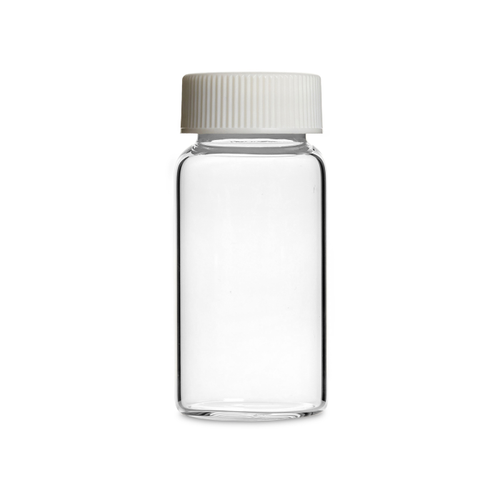
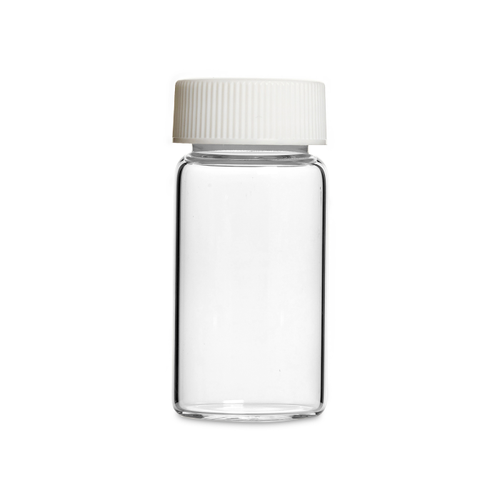
DWK 986562 WHEATON Liquid Scintillation Vials, Borosilicate Glass, 24-400 White Urea Caps Attached to Vials, Metal Foil / Cork Liner, 20 mL

$433.06
SKU: 986562 CASE 7 - 10 Business Days
(No reviews yet)
Availability:
7 - 10 Business Days
Shipping:
Calculated at Checkout

WHEATON® 986562 Glass Liquid Scintillation Vials - 20 mL, 24-400 White Urea Caps, Metal Foil/Cork Liners, 500/Case

WHEATON® 986562 Liquid Scintillation Vials from DWK Life Sciences are 20 mL clear borosilicate glass vials supplied with white urea 24-400 screw caps attached to the vials. Each closure has a metal foil/cork liner. This exact manufacturer-defined assembly is designed for suitable liquid scintillation counting and laboratory sample-handling methods.

The manufacturer specifies a 28 mm vial diameter, a 57 mm height without the cap, and a 61 mm overall height including the cap. The 24-400 thread finish is an important selection requirement when matching the vial to replacement caps, approved laboratory procedures, and instrument carriers.

DWK describes its glass liquid scintillation vial family as converted from Type I borosilicate glass tubing, with consistent, low background counts and high ultraviolet (UV) transmission. These are qualitative manufacturer characteristics. Actual analytical performance depends on the cocktail, sample, radionuclide, instrument, and measurement method.

The distinguishing closure is a white urea cap with metal foil/cork liner. This is different from the white polypropylene cap with metal foil/pulp liner used on WHEATON 986561 and the white polypropylene cap with foamed polyethylene liner used on 986560. Cork and pulp are different liner backing materials, and their chemical-resistance characteristics should not be treated as equivalent.

DWK's published Closure Liner Guide includes general chemical-resistance information for pulp/metal foil, but does not establish matching chemical-resistance ratings for this SKU's metal foil/cork construction. Confirm that the entire borosilicate glass, urea cap, and foil/cork liner assembly is appropriate for the actual scintillation cocktail, sample chemistry, exposure time, and temperature.

WHEATON 986562 is non-sterile and not autoclavable, as explicitly stated by DWK. It is supplied without a marking spot. Each case contains 500 glass vials with their specified attached caps. The 20 mL capacity is nominal, not a calibrated volumetric tolerance or a prescribed working fill.

Ordering note: WHEATON 986562 is the 24-400, 20 mL clear borosilicate glass scintillation vial with an attached white urea cap and metal foil/cork liner, supplied 500 per case. It is non-sterile and not autoclavable. Scintillation cocktails, counters, and separately sold racks or accessories are not included.

Specifications:
  • Manufacturer: DWK Life Sciences
  • Brand: WHEATON®
  • Manufacturer SKU: 986562
  • Product type: Glass liquid scintillation vial with attached screw cap
  • Capacity: 20 mL nominal
  • Vial material: Clear borosilicate glass
  • Glass family: Type I borosilicate glass tubing
  • Diameter: 28 mm
  • Height without cap: 57 mm
  • Height including cap: 61 mm
  • Neck and closure finish: 24-400
  • Cap included: Yes, attached to vial
  • Cap material: Urea
  • Cap color: White
  • Liner material: Metal foil / cork
  • Liner-specific chemical resistance: Not established in reviewed manufacturer technical guidance
  • Marking spot: No
  • Sterility: Non-sterile
  • Autoclavability: Not autoclavable
  • Manufacturer-described counting background: Consistent and low
  • Manufacturer-described optical property: High UV transmission
  • Primary application: Liquid scintillation counting
  • Purchase unit: Case
  • Quantity per case: 500 vials with caps
  • Calibrated volume tolerance: Not specified
  • Leakproof or vapor-tight certification: Not established
  • Instrument compatibility: Verify with the intended counter
  • Inner packaging, shipping weight, and carton dimensions: Not confirmed in reviewed exact-SKU data
Why the Metal Foil/Cork Liner Matters

The metal foil/cork liner identifies the exact closure configuration of WHEATON 986562. Its white urea screw cap and 24-400 thread finish are also critical specifications. Laboratories should consider these components together when specifying sample containment or comparing scintillation vial options.

Foil/cork is not foil/pulp. DWK's general closure guide documents foil bonded to pulp board and gives that different liner type general resistance ratings for certain chemicals. Those findings do not establish chemical compatibility for the cork-backed liner on 986562. The exact foil composition, cork construction, liner layer orientation, and finished-assembly leak rate were not confirmed in the reviewed public SKU information.

Evaluate compatibility with the entire liquid scintillation cocktail, sample matrix, solvent vapors, temperature, and contact duration. A foil-backed liner should not be advertised as PTFE-equivalent, universally chemical-resistant, hermetic, or pressure-rated without the appropriate test evidence.

Technical caution: Do not transfer the published foil/pulp resistance to hydrocarbons, alcohols, ketones, or acids/alkalis to foil/cork. Request product-specific guidance from DWK or qualify the chosen sample and cocktail experimentally.

24-400 Thread Finish: 986562 vs. 986542

WHEATON 986562 uses a 24-400 thread, while 986542 uses 22-400. Both are 20 mL clear borosilicate glass vials with white urea caps and metal foil/cork liners. Their published diameter and overall capped height are the same, but the closures are not automatically interchangeable.

DWK's closure guidance states that the thread finish of a container and screw cap must match. Always use the manufacturer-specified finish; matching nominal volume does not establish matching cap engagement or seal performance.

About the Manufacturer:

WHEATON® is a DWK Life Sciences brand offering laboratory glassware, liquid scintillation vials, sample containers, and closures. The product family includes multiple cap materials, liner constructions, and thread finishes. Exact manufacturer part numbers help laboratories avoid unintended changes in materials or geometry.

WHEATON 986562 Features:
  • 20 mL clear borosilicate glass liquid scintillation vial
  • Type I borosilicate glass tubing product family
  • 28 mm diameter and 57 mm height without cap
  • 61 mm overall height with attached cap
  • 24-400 screw-thread finish
  • White urea screw cap attached to the vial
  • Metal foil/cork closure liner
  • Manufacturer-described consistent low background and high UV transmission
  • No marking spot
  • Non-sterile and not autoclavable
  • 500 vials with their caps per case
WHEATON 986562 Benefits:
  • Defined glass-and-closure assembly: Vial, attached white urea cap, and metal foil/cork liner are specified together.
  • Scintillation-focused glass: DWK describes low background counts and high UV transmission for the vial family.
  • Closure-specific identification: Distinguishes foil/cork from foil/pulp, PE foam, and PE disc options.
  • Published assembled dimensions: Helps verify sample-carrier clearance.
  • Distinct 24-400 thread: Reduces the risk of substituting a similar 22-400 vial.
  • Case-based purchasing: Supplied 500 per case for routine laboratory replenishment.
  • Explicit processing restrictions: Non-sterile and not-autoclavable status is documented.
Common Applications:
  • Liquid scintillation counting (LSC) with compatible instruments
  • Radiolabeled samples analyzed under approved laboratory methods
  • Life sciences, biochemical, and tracer studies
  • Environmental and analytical laboratory scintillation workflows
  • Quality-control methods specifying a 20 mL borosilicate glass vial
  • Laboratory protocols requiring a 24-400 white urea cap and metal foil/cork liner
  • Compatible sample handling where the complete closure has been qualified

These are potential applications, not certifications for a particular scintillation cocktail, radionuclide, counter, sample matrix, or regulated analytical method.

Best-Practice Use:
  • Confirm exact product: Verify 986562, 24-400, white urea cap, and foil/cork liner.
  • Inspect before use: Check glass walls, rim, threads, cap, and liner for damage.
  • Assess chemistry: Review the actual sample and cocktail against glass, urea, and foil/cork materials.
  • Verify instrument fit: Check 28 mm diameter and 61 mm capped height.
  • Use method-defined fill volumes: Nominal 20 mL capacity is not a calibrated measuring mark.
  • Follow approved closure handling: Do not assume a certified leakproof seal or invent a cap torque.
  • Identify samples: No marking spot is included; use suitable labels or barcodes.
  • Run analytical quality controls: Use blanks, standards, background measurements, and instrument QC.
  • Apply laboratory safety procedures: Follow chemical, radiological, ventilation, and waste controls.
  • Do not autoclave: The exact finished SKU is explicitly not autoclavable.
Selection Notes: 986562 vs. Related WHEATON Vials
  • 986562: 20 mL glass, 24-400 white urea cap attached, metal foil/cork liner, 500/case.
  • 986542: White urea cap attached and metal foil/cork liner, but 22-400 thread.
  • 986561: 24-400 cap attached, but white polypropylene cap and metal foil/pulp liner.
  • 986560: 24-400 white polypropylene attached cap with foamed PE liner.
  • 986568: 24-400 white urea attached cap with polyethylene disc liner.
  • 986546: 22-400 white urea attached cap with polyethylene cone liner.
  • 986582: 22-400 white urea cap and metal foil/cork liner, with caps packed separately.

Substitution rule: Identical nominal volume or similar appearance does not guarantee the same thread finish, liner materials, or closure properties. Confirm the exact manufacturer number.

Manufacturer Technical Documentation:

DWK Closure Liner Guide: Review closure thread and liner selection guidance — General compatibility principles. The guide's foil/pulp resistance values are not verified ratings for this foil/cork liner.

DWK Glass Types & Properties: Review borosilicate glass technical guidance — General glass classifications and chemical durability.

DWK Care & Maintenance: Review laboratory glassware handling guidance — Inspection, care, and avoiding damage.

DWK General Glassware Cleaning: Review cleaning and rinsing guidance — General information, not permission to autoclave 986562.

Why Order WHEATON 986562 From SOSCleanroom?
  • Exact-SKU sourcing: Specify the correct 24-400 urea cap and metal foil/cork liner.
  • Configuration assistance: Compare 22-400 and 24-400 options and available liner types.
  • Manufacturer documentation: Request technical details or available certificates for product qualification.
  • Centralized purchasing: Source laboratory glassware and critical-environment supplies through Specialty Optical Systems, Inc.
  • Responsive customer service: Contact SOSCleanroom for quotations and availability.

Technical note: The Technical Vault covers foil/cork liner qualification, thread-fit differences, glass properties, liquid scintillation counting, and related WHEATON configurations.

For pricing, availability, or questions, email Sales@SOSsupply.com or call (214) 340-8574.

Product page updated: October 27, 2026

© 2026 Specialty Optical Systems, Inc. (dba SOSCleanroom). All rights reserved.

The Technical Vault By SOSCleanroom
WHEATON 986562 20 mL Borosilicate Glass 24-400 Thread White Urea Cap Metal Foil/Cork 28 x 61 mm Capped Non-Sterile Not Autoclavable 500/Case

WHEATON 986562: Exact Glass Vial and Closure Configuration

WHEATON® 986562 is a 20 mL clear borosilicate glass liquid scintillation vial with an attached white urea 24-400 screw cap and metal foil/cork liner. DWK specifies a 28 mm outside diameter, 57 mm glass-vial height without cap, and 61 mm overall height including the cap.

The manufacturer describes consistent low background counts and high UV transmission for its glass scintillation-vial family. DWK identifies the exact 986562 configuration as non-sterile, not autoclavable, and without a marking spot. The manufacturer case contains 500 vials with their specified attached caps.

For procurement, the crucial features are the 24-400 finish and urea/foil-cork closure. WHEATON 986542 uses a 22-400 finish with the same named cap and liner materials. WHEATON 986561 uses 24-400 but replaces the urea/foil-cork closure with polypropylene/foil-pulp.

Operations takeaway: Order 986562, 20 mL clear borosilicate glass, 28 x 57 mm without cap / 28 x 61 mm capped, attached white urea 24-400 cap, metal foil/cork liner, 500/case. Do not substitute the 22-400 version or apply foil/pulp chemistry claims to a foil/cork liner. The finished product is non-sterile and not autoclavable.


Exact-SKU Specifications for RFQs, SOPs, and Receiving
  • Manufacturer / brand: DWK Life Sciences / WHEATON®
  • Catalog number: 986562
  • Product type: Borosilicate glass liquid scintillation vial with cap
  • Nominal capacity: 20 mL
  • Vial material: Clear borosilicate glass
  • Glass family description: Type I borosilicate glass tubing
  • Outside diameter: 28 mm
  • Uncapped vial height: 57 mm
  • Overall capped height: 61 mm
  • Thread and closure finish: 24-400
  • Cap included: Yes, attached to the vial
  • Cap material: Urea
  • Cap color: White
  • Closure liner: Metal foil / cork
  • Marking spot: No
  • Sterility: Non-sterile
  • Autoclavability: Not autoclavable
  • Manufacturer-described counting background: Consistent and low
  • Manufacturer-described optical properties: High UV transmission
  • Primary intended use: Liquid scintillation counting
  • Purchase unit: Case
  • Quantity per case: 500
  • Specific foil/cork layer details: Not established by reviewed public SKU data
  • Certified liner chemical resistance: Not established for foil/cork
  • Certified leak rate, cap torque, and vapor seal: Not established
  • Calibrated volumetric accuracy: Not specified
  • Numerical background / UV-transmission figures: Not specified
  • Instrument compatibility: Verify with the specific counter and holder
  • Inner tray count, case weight, and carton dimensions: Not confirmed from exact-SKU manufacturer listing
  • Country of origin: Not verified

Specification boundary: The 20 mL capacity is nominal. The 61 mm overall height includes the supplied cap; 24-400 defines a thread finish and does not itself establish certified leakproof performance.


Metal Foil/Cork Liner: Confirmed Features and Documentation Gaps

The exact manufacturer SKU specifies a metal foil/cork liner inside a white urea cap. These are the correct closure materials for WHEATON 986562. The public specification does not establish the exact foil alloy, layer orientation, cork grade, any adhesive chemistry, liner thickness, or numerical seal-performance rating.

The manufacturer also publishes a general Closure Liner Guide. That guide includes pulp/metal foil, which it describes as aluminum foil bonded to pulp board. It does not provide equivalent material-specific test ratings for foil/cork. The two liner names describe different constructions.

Attribute986562 verification status
Cap bodyWhite urea; manufacturer verified
Thread finish24-400; manufacturer verified
Liner identityMetal foil/cork; manufacturer verified
Layer orientation and thicknessNot specified in reviewed product data
Foil/cork chemical ratingsNot published in reviewed general guide
Specific solvent compatibilityRequires DWK guidance or application qualification
Certified leakproof or vapor-tight sealNot established for finished assembly
Thermal processingExact finished SKU explicitly not autoclavable

Critical liner distinction: Do not copy the foil/pulp guide's hydrocarbon, oil, ketone, alcohol, acid, or alkali ratings onto foil/cork. The liner used on 986562 requires separate compatibility evaluation.


Foil/Cork vs. Foil/Pulp vs. Foamed Polyethylene

Several WHEATON 20 mL glass scintillation vials share a 24-400 thread but differ in cap material and liner chemistry. Use the exact closure specification rather than treating all foil-backed or polyethylene liners as interchangeable.

Feature986562986561986560
Cap bodyWhite ureaWhite PPWhite PP
LinerMetal foil/corkMetal foil/pulpFoamed PE
General liner descriptionNo detailed public rating verified for foil/corkAluminum foil bonded to pulp boardFoamed LDPE core between solid PE layers
Hydrocarbon resistanceNot establishedGood general resistance describedPoor general resistance described
Acids / alkalisNot establishedNot goodGeneral resistance described; qualify specific chemical
Thread finish24-40024-40024-400
Sterile / autoclavableNo / noNo / noNo / no

The foil/pulp and foamed PE material descriptions above are DWK's general liner guidance, not quantified performance data for the completed assemblies. Do not use them to claim that 986562 foil/cork is universally more or less chemically resistant.


24-400 vs. 22-400: Comparison with WHEATON 986542

WHEATON 986562 and 986542 share the same nominal glass-vial capacity and the same named white urea/metal foil-cork cap materials. 986562 uses 24-400; 986542 uses 22-400. The closure sizes are different even though their published overall capped dimensions are 28 x 61 mm.

Attribute986562986542
Thread24-40022-400
Capacity20 mL20 mL
Vial materialBorosilicate glassBorosilicate glass
Cap / linerUrea / foil-corkUrea / foil-cork
Capped dimensions28 x 61 mm28 x 61 mm
Case quantity500500

Thread-match requirement: DWK advises that container and cap thread finishes must match. Do not substitute a 22-400 cap on a 24-400 vial, or switch vial SKUs based only on nominal volume or overall height.


Liquid Scintillation Counting: Background, UV Transmission, and QC

Liquid scintillation counting (LSC) measures appropriate radioactive samples using light produced by interactions within a scintillation cocktail. The vial, sample matrix, solvent composition, background, instrument, and counting method jointly affect the result.

DWK describes its glass liquid scintillation vial family as having consistent low background counts and high UV transmission. The manufacturer does not provide a numerical background rate, potassium concentration, UV spectral curve, or instrument-independent detection efficiency for the exact 986562 product in the reviewed SKU listing.

  • Background: Measure with the method's blanks and instrument background checks.
  • UV transmission: Treat as a qualitative glass-family description without inventing a percent value.
  • Counting efficiency: Establish for the actual radionuclide, sample, cocktail, and counter.
  • Quench: Apply the method's calibration and quench-correction controls.
  • Geometry: Verify cap clearance, diameter, and accepted carrier design.
  • Working volume: Follow the validated sample/cocktail ratio and headspace.
  • Identification: The vial lacks a marking spot; apply an appropriate identification method.

Analytical limitation: The vial is not a calibrated measuring or radiation-detection device. No isotope-specific counting efficiency, detection limit, or universal counter fit is established by the general low-background description.


Borosilicate Glass Properties and Material Qualification

DWK identifies borosilicate glass for 986562 and describes the glass scintillation-vial family as converted from Type I borosilicate glass tubing. DWK's broader glass technical reference covers multiple borosilicate compositions and standards, but the reviewed exact-SKU page does not specify a particular thermal-expansion coefficient, certified elemental composition, or lot-specific material certificate.

Borosilicate glass generally provides useful chemical durability for laboratory work. However, hydrofluoric acid and some strongly alkaline conditions can attack glass. Compatibility of the complete product additionally depends on the urea cap and foil/cork liner, which may have different chemical limitations.

  • Verified exact material: Borosilicate glass.
  • Family description: Type I borosilicate tubing.
  • Numerical glass composition: Not confirmed for SKU 986562.
  • Material certification: Request current documents when needed.
  • Complete assembly: Glass-only chemical or thermal data do not qualify urea and foil/cork.
  • Autoclaving: The finished 986562 product is explicitly not autoclavable.

Chemical Compatibility: Evaluate the Entire Vial-and-Cap Assembly

During liquid scintillation workflows, a vial may be exposed to the sample, liquid cocktail, solvent vapors, condensate, cleaning residues, and repeated cap handling. Assess the borosilicate glass, white urea cap, and metal foil/cork liner as a complete system rather than relying on a single material's resistance chart.

ExposureWhat to check
Organic scintillation cocktailsEach solvent ingredient and its contact with the exact foil/cork liner and urea cap
Hydrocarbon or mixed solventsDo not substitute foil/pulp ratings; request foil/cork compatibility guidance
Aqueous solutions / bufferspH, ionic strength, liner exposure, and sample integrity
Acidic or alkaline reagentsGlass, cap, and foil/cork compatibility; no verified universal rating
Volatile mixturesVapor exposure, evaporation, ventilation, and containment
Trace-sensitive analysesPossible extractables, sample recovery, and blank background
Cleaning reagentsSuitability for each assembly component and previous contamination

This is an application-review checklist, not a manufacturer-certified chemical-resistance table for foil/cork. Confirm relevant exposure duration, temperature, solution concentration, and containment requirements.

Do not infer PTFE-like performance: A metal foil/cork liner is not a PTFE-faced liner and is not inherently solvent-proof, hermetic, or suitable for every scintillation cocktail.


Dimensions, Thread Fit, and Scintillation Counter Clearance

DWK distinguishes the 57 mm glass-vial height from the 61 mm overall capped height. The diameter is 28 mm, and the 24-400 screw finish is a separate cap-matching requirement.

SpecificationSelection significance
20 mL nominal capacityVial size classification; not a graduated or prescribed fill volume
28 mm diameterRack, carousel, or vial-holder fit
57 mm without capGlass-vial height
61 mm with capComplete assembly clearance
24-400 neck finishMatched screw cap; not interchangeable with 22-400
No marking spotUse appropriate external identification

Instrument-fit checkpoint: Nominal 20 mL capacity and 28 x 61 mm capped geometry do not prove compatibility with every liquid scintillation counter. Check the model-specific carrier and cap clearance.


Related WHEATON 20 mL Glass Scintillation Vial Configurations

WHEATON's manufacturer vial guide distinguishes the following configurations by cap material, liner, thread finish, and how caps are presented. These are separate catalog items, not automatically approved substitutions.

SKUCap / linerThreadPresentation
986562White urea / foil-cork24-400Attached
986542White urea / foil-cork22-400Attached
986561White PP / foil-pulp24-400Attached
986560White PP / foamed PE24-400Attached
986568White urea / PE disc24-400Attached
986546White urea / PE cone22-400Attached
986582White urea / foil-cork22-400Caps packed separately

The configurations listed in the manufacturer's guide are 20 mL glass vials with a case quantity of 500. WHEATON 986582 should not be treated as a 24-400 separately packed version: it uses 22-400. No 24-400 foil/cork separately packed SKU was established in the reviewed guide.

Procurement distinction: Choose 986562 for 24-400 foil/cork and attached caps. Do not substitute 986542 or 986582 if the laboratory requires 24-400. Do not substitute foil/pulp or PE-disc versions without approval.


Non-Sterile and Not Autoclavable: Exact-SKU Limitations

DWK explicitly lists WHEATON 986562 as non-sterile and not autoclavable. These exact-SKU designations apply to the complete vial-and-cap assembly and should not be overridden by general statements about the heat resistance of borosilicate laboratory glass.

The cap is urea and the liner contains metal foil/cork. Neither the assembled product nor its closure has a validated autoclave cycle documented in the reviewed exact-SKU information. No separate validated radiation, gas, or dry-heat sterilization process has been established for 986562.

  • Supplied sterile: No.
  • Autoclavable: No.
  • Validated steam sterilization: Not established.
  • Other sterilization methods: Not established for exact finished SKU.
  • General glass properties: Do not qualify the complete capped product.
  • Sterile-process needs: Select a separately documented alternative if required.

Do not autoclave WHEATON 986562. If a laboratory proposes processing only the bare glass, seek written product-specific manufacturer guidance and validate the process rather than assuming it is permitted.


Closure Handling, Solvent Vapor, and Seal-Integrity Limitations

The specified 24-400 white urea cap and foil/cork liner form the manufacturer-defined vial closure. However, a screw-cap liner is not, by itself, evidence of leakproof, vapor-tight, hermetic, pressure-rated, or hazardous-material transport performance. Those properties depend on the entire container and actual use conditions.

  • Inspect glass threads and rim for chips or residues.
  • Inspect cap threads and liner for defects, deformation, or contamination.
  • Use the correct 24-400 closure and approved capping procedure.
  • Do not invent an application torque or assume certified leakproof performance.
  • Evaluate liquid and vapor contact with the foil/cork liner.
  • Follow the laboratory's ventilation and secondary-containment requirements.
  • Control hazardous chemicals and radioactive samples according to applicable procedures.

Recommended Laboratory Preparation and QC Checklist
  1. Verify the order: Confirm SKU 986562, 24-400, white urea cap, foil/cork liner, and 500/case.
  2. Inspect the vial: Check the glass, rim, cap threads, and liner before use.
  3. Validate sample chemistry: Review all scintillation cocktail ingredients and exposure conditions.
  4. Check instrument fit: Confirm 28 mm diameter and 61 mm assembled height.
  5. Prepare method-defined volumes: Use approved sample and cocktail ratios, not nominal capacity.
  6. Apply the closure: Follow a laboratory-approved procedure and assess any seal requirement.
  7. Identify the sample: Use a suitable label or barcode; no marking spot is present.
  8. Run analytical controls: Use standards, blanks, background and quench procedures as required.
  9. Handle hazardous materials: Follow solvent, radiation, ventilation, and waste procedures.
  10. Do not autoclave: The exact finished product is not autoclavable.
  11. Retain records: Document applicable lot, sample, counting instrument, and method details.

Cleaning, Inspection, and Reuse Considerations

DWK's general glassware guidance addresses appropriate cleaning, rinsing, and care of laboratory glass. For 986562, the white urea cap, foil/cork liner, and prior sample or cocktail residues also affect whether cleaning or reuse is acceptable.

  • Confirm that the analytical method permits reuse.
  • Assess chemical, radiological, or biological contamination before handling.
  • Use a cleaning procedure compatible with all assembly materials.
  • Avoid impact and abrasive tools that may damage glass surfaces or threads.
  • Rinse and dry as specified by the approved method.
  • Inspect the cap and foil/cork liner for damage or retained residue.
  • Use background and carryover acceptance checks when reuse is permitted.
  • Do not autoclave the assembled product.

Used scintillation vials may contain radioactive or hazardous chemical residues. Reuse, decontamination, and disposal should follow laboratory procedures and applicable regulations.


Controlled-Laboratory and Cleanroom Qualification

WHEATON 986562 may be evaluated for suitable analytical laboratories, but its exact manufacturer designation is non-sterile. The reviewed public specification does not establish a product ISO 14644 cleanroom class, sterile packaging, validated endotoxin limit, DNase/RNase-free certification, or certified particle-release performance.

For controlled-environment work, follow the facility's material transfer, sample preparation, traceability, and cleanliness procedures. Type I borosilicate glass-family information or low-scintillation-background claims do not automatically qualify the assembled product for aseptic processing.

Qualification boundary: Do not treat this non-sterile, non-autoclavable scintillation vial as an ISO-classified or sterile-ready product without independent qualification.


Important Limitations and Unsupported Assumptions
  • Not sterile: Exact manufacturer designation is non-sterile.
  • Not autoclavable: Exact manufacturer designation is not autoclavable.
  • Not 22-400: The correct thread finish is 24-400.
  • Not a polypropylene cap: The specified cap is white urea.
  • Not foil/pulp: The liner is metal foil/cork.
  • Not PTFE-faced: No PTFE liner is specified.
  • No published exact foil/cork chemical chart: Do not import foil/pulp ratings.
  • No certified leakproof or vapor-tight rating: Test as required.
  • Not a calibrated volumetric device: The 20 mL capacity is nominal.
  • No marking spot: Use appropriate external sample identification.
  • No guaranteed numerical background: Manufacturer background description is qualitative.
  • No exact UV transmission curve: Do not invent a percentage.
  • No confirmed lot-specific glass composition: Request manufacturer documentation if needed.
  • No verified inner packaging subdivision: Confirm with DWK if tray counts matter.
  • No certified hazardous-material transport package: Vials and ordinary cases do not establish shipping approval.

Technical FAQs

What is WHEATON 986562?

A 20 mL clear borosilicate glass liquid scintillation vial with an attached white urea 24-400 cap and metal foil/cork liner.

Are caps included and attached?

Yes. DWK describes caps attached to the vials, with 500 units per case.

What thread finish does 986562 use?

24-400; it differs from the 22-400 finish on WHEATON 986542.

Is the cap polypropylene?

No. The manufacturer specifies a white urea cap.

What liner is included?

Metal foil/cork, not foil/pulp, foamed PE, or PE disc.

Is foil/cork the same as foil/pulp?

No. Cork and pulp are different liner backing materials, and their chemical properties should not be assumed equivalent.

Does DWK publish specific foil/cork resistance ratings?

Not in the reviewed exact-SKU data and general Closure Liner Guide. Request application-specific information if needed.

Can I use foil/pulp hydrocarbon ratings for foil/cork?

No. Those general ratings describe a different liner and should not be transferred to 986562.

How is 986562 different from 986561?

986562 uses white urea and metal foil/cork. 986561 uses white polypropylene and metal foil/pulp. Both have 24-400 threads.

How is 986562 different from 986542?

986562 uses 24-400 while 986542 uses 22-400. Both have white urea caps and metal foil/cork liners.

Is the vial sterile?

No. DWK identifies 986562 as non-sterile.

Can WHEATON 986562 be autoclaved?

No. DWK expressly lists the exact SKU as not autoclavable.

Does this vial have a marking spot?

No. An alternate sample-labeling method is required if identification is needed.

What are the dimensions?

28 mm diameter, 57 mm high without the cap, and 61 mm high with the cap.

Is 20 mL a calibrated measuring volume?

No calibrated tolerance is specified. Use the volume established by the analytical method.

Is the closure certified leakproof?

No exact-SKU leakage or vapor-tight certification was established in the reviewed data.

Will it fit every scintillation counter?

Not automatically. Verify the assembled 28 x 61 mm dimensions and model-specific carrier requirements.

Are the background and UV ratings numerical?

DWK describes low, consistent background and high UV transmission but provides no numerical exact-SKU values in the reviewed information.

How many vials come in one case?

500 vials with their specified attached caps and liners.


Manufacturer Technical References

These hyperlinks go to DWK technical-information pages only, not manufacturer product-detail pages, catalogs, or purchasing pages. General material guidance does not override the exact-SKU non-sterile and not autoclavable designations.


For quotations or product questions, email Sales@SOSsupply.com or call (214) 340-8574. SOSCleanroom can assist with WHEATON exact-SKU sourcing, 24-400 cap and liner comparisons, case quantities, and applicable DWK documentation. Technical insight: Liquid scintillation vial selection requires review of counter dimensions, sample chemistry, analytical background, and the complete cap-and-liner assembly. Metal foil/cork and metal foil/pulp are distinct closure materials. Last updated: October 27, 2026 © 2026 Specialty Optical Systems, Inc. (dba SOSCleanroom). All rights reserved.