The Technical Vault
By SOSCleanroom
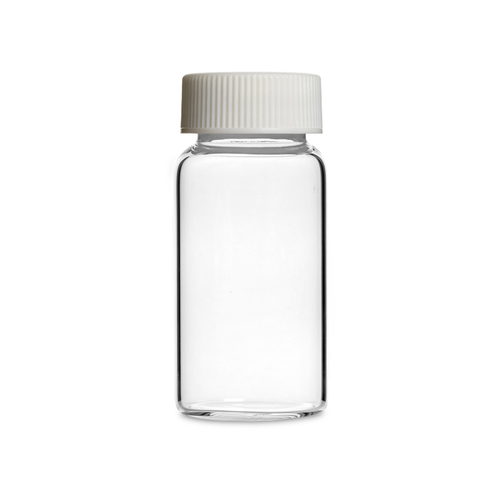
WHEATON 986540
20 mL
Borosilicate Glass
22-400
White PP Cap
Foamed PE Liner
28 x 61 mm Capped
Non-Sterile
Not Autoclavable
500/Case
WHEATON 986540: complete vial-and-closure configuration
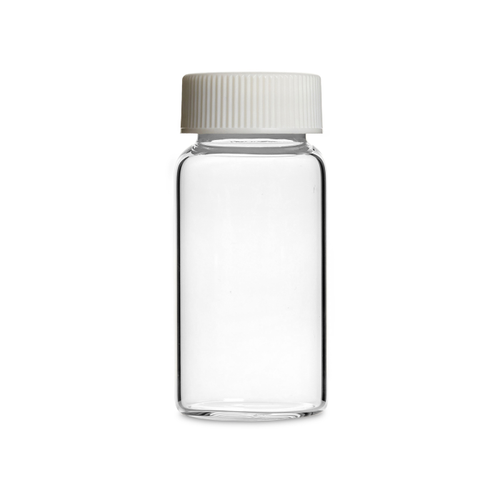
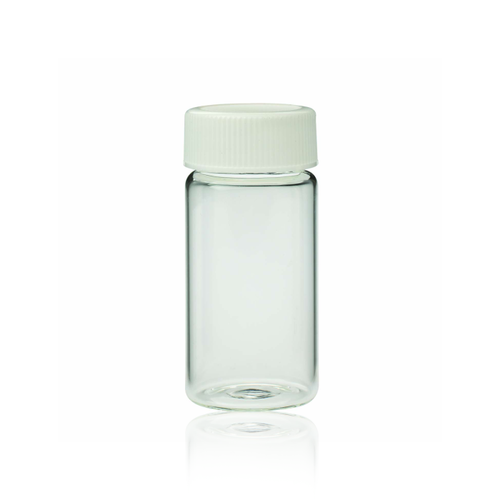
WHEATON® 986540 is a 20 mL clear borosilicate glass liquid scintillation vial supplied with a white polypropylene screw cap attached to the vial and a foamed polyethylene liner. The vial features a 22-400 screw-thread neck, a 28 mm outside diameter, and a 57 mm uncapped height. Overall height with cap is 61 mm.
DWK describes this liquid scintillation family as having consistent, low background counts and high ultraviolet transmission. The finished SKU is specifically listed as non-sterile and not autoclavable, with no marking spot.
Operations takeaway: Specify the entire configuration: 20 mL borosilicate glass + attached 22-400 white PP cap + foamed PE liner + 28 x 61 mm capped dimensions + 500/case. A cap with a different liner or a 24-400 thread is not the same manufacturer SKU. Do not autoclave the 986540 assembly.
Specifications for procurement, SOPs, and receiving
- Manufacturer / brand: DWK Life Sciences / WHEATON®
- Catalog number: 986540
- Product: Glass liquid scintillation vial with attached screw cap
- Nominal capacity: 20 mL
- Vial material: Clear borosilicate glass
- Glass product family: Converted from Type I borosilicate glass tubing
- Vial diameter: 28 mm
- Uncapped height: 57 mm
- Height including cap: 61 mm
- Vial / closure thread: 22-400
- Closure included: Yes; manufacturer specifies cap attached to vial
- Cap material and color: White polypropylene
- Cap liner: Foamed polyethylene
- Marking spot: No
- Supplied sterility: Non-sterile
- Autoclavable: Not autoclavable
- Manufacturer-described scintillation properties: Consistent low background counts and high UV transmission
- Purchase unit: Case
- Case quantity: 500 assembled vial-and-cap units
- Numerical background / UV transmission ratings: Not provided in reviewed SKU specifications
- Calibrated capacity tolerance: Not provided; nominal volume only
- Verified instrument compatibility: No universal instrument list established
- Country of origin, case weight, and shipping dimensions: Not verified in reviewed SKU record
Liquid scintillation counting: how the vial affects analysis
In a liquid scintillation counting (LSC) method, a sample is combined with an appropriate scintillation cocktail. Energy deposited by radioactive emissions can produce light that the counting instrument detects. The sample matrix, cocktail, vial, cap, instrument geometry, and counting parameters all influence the analytical result.
DWK identifies low, consistent background counts and high UV transmission as characteristics of its glass scintillation vials. This helps distinguish the product from a general-purpose glass sample container, although the manufacturer does not establish a numerical background-count rate or transmission percentage for SKU 986540 in the reviewed information.
- Low background: Relevant to detecting a signal above the method and instrument background.
- UV transmission: A manufacturer-identified optical property, not a certified spectral curve for this SKU.
- Sample geometry: Verify the vial and attached cap fit the instrument's carousel or sample holder.
- Counting method: Use blanks, standards, quench controls, and other checks specified by the validated method.
- Sample chemistry: Verify that the cocktail is suitable for the glass, PP cap, and foamed PE liner.
Analytical boundary: The vial does not independently establish isotope-specific counting efficiency, detection limits, quench correction, or instrument calibration. Laboratory blanks and performance checks remain essential.
Borosilicate glass, historical WHEATON 180, and background considerations
The 986540 manufacturer specification identifies borosilicate glass, and DWK's family description refers to Type I borosilicate glass tubing. WHEATON's historical technical literature describes its liquid scintillation glass as WHEATON 180 low-potassium borosilicate with USP Type I and ASTM E438 Type I, Class A material classifications.
Low potassium is relevant because naturally occurring potassium contains potassium-40, which may contribute to radioactive background. However, the exact potassium concentration of 986540, lot-specific radionuclide background, and instrument-independent counts-per-minute limit have not been established by the reviewed SKU specifications.
Borosilicate glass has useful general chemical durability. Exposure to hydrofluoric acid, strong alkaline reagents, or other aggressive conditions can damage glass. General material classifications do not certify suitability for every scintillation cocktail or analytical method.
Documentation distinction: Historical WHEATON material descriptions should not be presented as a current lot-specific certificate. For regulated, low-background, or trace-sensitive work, request applicable manufacturer documentation through SOSCleanroom.
Foamed polyethylene liner: construction and sealing role
DWK describes its foamed polyethylene (PE foam) liner as a three-ply coextruded construction: a compressible polyethylene foam core between solid polyethylene outer layers. This general-purpose design provides a compressible sealing surface under the polypropylene screw cap.
The liner is not described as PTFE-faced. It must not be confused with PTFE/PE foam liners, foil/pulp liners, polyethylene cones, or linerless closures. Each design has different suitability for solvents, sample protection, and sealing requirements.
- Cap body: White polypropylene (PP).
- Thread finish: 22-400; matched to the vial.
- Liner: Foamed polyethylene, with a foam core and solid PE facing layers.
- Manufacturer-described applications: General-purpose use across many mild laboratory formulations.
- Known material limitation: DWK identifies poor resistance of foamed PE liners to hydrocarbon solvents.
- Required evaluation: Confirm the actual cocktail, sample matrix, storage conditions, and seal integrity.
Critical chemical point: Many liquid scintillation cocktails contain organic solvents. Do not assume a foamed PE liner is suitable for every cocktail, particularly hydrocarbon-based formulations. Check the cocktail SDS, liner compatibility, exposure duration, and required seal performance.
Glass, polypropylene, and PE liner chemical-compatibility review
The complete container contacts or may be exposed to a combination of sample liquid, scintillation cocktail, vapors, cleaning chemicals, and residual reagents. The three material types must be evaluated as a system.
| Exposure |
Compatibility consideration |
| Aqueous samples / buffers | Check pH, concentration, sample recovery, and liner performance |
| Alcohol-based mixtures | Confirm specific alcohol and contact conditions |
| Hydrocarbon scintillation cocktails | Foamed PE is manufacturer-described as having poor resistance to hydrocarbon solvents; evaluate alternatives |
| Mixed organic solvents | Assess all components and vapors, not just the glass vial |
| Strong bases or HF-containing mixtures | Potential attack on glass; seek appropriate material alternatives |
| Volatile or hazardous samples | Validate closure, vapor management, containment, and laboratory safeguards |
This is a review framework, not a certified exposure-time chart or product-specific chemical approval. Conditions such as temperature, concentration, duration, and mechanical loading influence suitability.
28 mm diameter, 57 mm vial height, and 61 mm capped height
Instrument geometry matters because liquid scintillation counters may use defined sample racks, trays, or carousels. The manufacturer provides both the glass-vial height and assembled height for 986540.
| Dimension / feature |
Verified value and practical meaning |
| Nominal capacity | 20 mL; not a calibrated fill volume |
| Outside diameter | 28 mm; rack and instrument holder selection |
| Height without cap | 57 mm; glass vial dimension |
| Height with cap | 61 mm; assembled instrument-clearance dimension |
| Thread finish | 22-400; matched closure size, not leakproof certification |
| Marking spot | None; use an approved external identification method |
Instrument-fit checkpoint: Even with 28 x 61 mm capped dimensions, universal compatibility is not established. Verify the specific vial holder, cap clearance, and instrument manufacturer's requirements.
Comparison: attached-cap 986540 versus other 20 mL WHEATON SKUs
The following manufacturer catalog numbers are not identical. Cap presence, cap material, liner material, and thread finish can change laboratory compatibility and purchase requirements.
| WHEATON SKU |
Closure / liner |
Thread |
Qty/Case |
| 986540 | Attached white PP cap / foamed PE liner | 22-400 | 500 |
| 986532 | Uncapped; cap purchased separately | 22-400 | 500 |
| 986541 | Attached PP cap / metal foil-pulp liner | 22-400 | 500 |
| 986542 | Attached urea cap / metal foil-cork liner | 22-400 | 500 |
| 986546 | Attached urea cap / PE cone liner | 22-400 | 500 |
| 986560 | Attached PP cap / foamed PE liner | 24-400 | 500 |
Key distinction: 986540 includes the white PP/foamed PE combination on a 22-400 vial; 986532 does not include a cap; 986560 uses a different 24-400 thread. Do not substitute based on nominal 20 mL size alone.
Non-sterile and not autoclavable: explicit product restrictions
DWK explicitly specifies "Non-sterile" and "Not Autoclavable" for catalog number 986540. These are SKU-specific designations and take precedence over general guidance concerning the heat resistance or sterilization of some borosilicate glass containers.
The finished product contains an attached polypropylene cap with a polyethylene foam liner. Do not assume the polymer components tolerate the same temperature conditions as bare glass. Do not assign a 121°C steam cycle, dry-heat cycle, microwave procedure, or sterile claim to this SKU.
- Supplied sterile: No; manufacturer lists non-sterile.
- Autoclavable: No; manufacturer lists not autoclavable.
- Separate glass properties: General Type I borosilicate thermal information does not override the SKU restriction.
- Alternative requirements: If validated sterile presentation or autoclaving is essential, request an explicitly qualified alternative.
- Cleaning: Use a non-damaging method compatible with glass, polypropylene, foamed PE, and the encountered contaminants.
Do not autoclave WHEATON 986540. Any need for separately processing a bare glass component should be referred to DWK for product-specific technical clarification rather than assumed suitable.
Recommended laboratory selection and handling checklist
- Check SKU and quantity: Verify WHEATON 986540, 500 per case, with attached white 22-400 PP caps.
- Confirm the liner: Verify foamed polyethylene, rather than foil/pulp, cone, PTFE-faced, or other liner types.
- Inspect components: Reject damaged glass, defective threads, visibly deformed caps, or compromised liners.
- Verify instrument fit: Check 28 mm diameter and 61 mm total capped height.
- Check chemistry: Review scintillation cocktail and sample compatibility, especially hydrocarbon-solvent exposure.
- Use method working volume: Follow approved sample and cocktail volumes instead of filling to nominal 20 mL.
- Label appropriately: The vial has no marking spot; use identification suitable for the instrument and method.
- Close appropriately: Apply the approved cap-handling procedure, without assuming a certified leakproof seal.
- Run method controls: Use blanks, standards, background measurements, and applicable quality controls.
- Handle hazards correctly: Apply radiation safety, solvent ventilation, and chemical waste-management procedures.
- Do not autoclave: The manufacturer identifies 986540 as not autoclavable.
- Document traceability: Record receiving, lot, sample, and analytical information as required.
Cleanroom, controlled-laboratory, and storage considerations
WHEATON 986540 may be evaluated for appropriate analytical laboratory environments, but the SKU is explicitly non-sterile. The reviewed record does not assign a cleanroom ISO classification, low-endotoxin claim, DNase/RNase-free claim, validated particle-release limit, or sterile packaging designation.
Protect vials from mechanical shock, contamination, and inappropriate chemical or temperature exposure. Use a stable storage arrangement, follow the facility's controlled-area material introduction procedures when applicable, and avoid relying on ordinary case packaging as a certified sample-transport system.
Regulated-use limitation: A Type I glass-material description is not itself a sterile, cleanroom-ready, pharmaceutical-fill, or low-extractables certification of the assembled glass/PP/PE product. Request appropriate written documentation when those requirements apply.
Technical FAQs
Are caps included with 986540?
Yes. DWK describes white polypropylene 22-400 caps with foamed polyethylene liners attached to the vials.
What are the vial dimensions?
28 mm diameter, 57 mm glass-vial height, and 61 mm total height including the cap.
What is the liner made of?
Foamed polyethylene (PE foam). DWK's general guide describes a foam core between solid polyethylene layers.
Is the liner PTFE-faced?
No PTFE facing is specified for 986540. The manufacturer identifies foamed PE; PTFE-faced foam is a different liner construction.
Is foamed PE suitable for hydrocarbon scintillation cocktails?
Do not assume so. DWK specifically lists poor resistance of foamed PE liners to hydrocarbon solvents. Qualify the actual cocktail and assembly.
Are these vials sterile?
No. DWK designates SKU 986540 non-sterile.
Can 986540 be autoclaved?
No. The exact manufacturer SKU is listed as not autoclavable.
Does the vial have a marking spot?
No. Select an appropriate external identification method for the analysis.
Is the closure certified leakproof or vapor-tight?
No such certification was established in the reviewed SKU specification. Test closure performance for the specific use.
Why is low-potassium glass relevant?
Naturally occurring potassium includes potassium-40, which may contribute to scintillation background. WHEATON historically describes its glass scintillation products as low-potassium borosilicate.
How many vials are in a case?
500 vials, with their specified caps and liners.
What distinguishes 986540 from 986532?
986540 includes the attached white PP/foamed PE cap. 986532 is the uncapped glass version.
What is the difference between 986540 and 986560?
Both use white PP caps with foamed PE liners, but 986540 has a 22-400 thread and 986560 has a 24-400 thread. They are not identical.
Manufacturer technical references
These DWK technical pages provide general materials guidance. They do not override the explicit non-sterile and not autoclavable specifications for WHEATON 986540. For current product certificates, packing details, or method-specific compatibility questions, contact SOSCleanroom.
For quotations or product questions, email Sales@SOSsupply.com or call (214) 340-8574.
SOSCleanroom can help identify the correct WHEATON scintillation-vial configuration, cap/liner materials, manufacturer documentation, and case quantity.
Technical insight: Scintillation-vial suitability depends on glass composition, counting background, instrument geometry, sample chemistry, and the entire cap-and-liner system.
Last updated: October 27, 2026
© 2026 Specialty Optical Systems, Inc. (dba SOSCleanroom). All rights reserved.