The Technical Vault
By SOSCleanroom
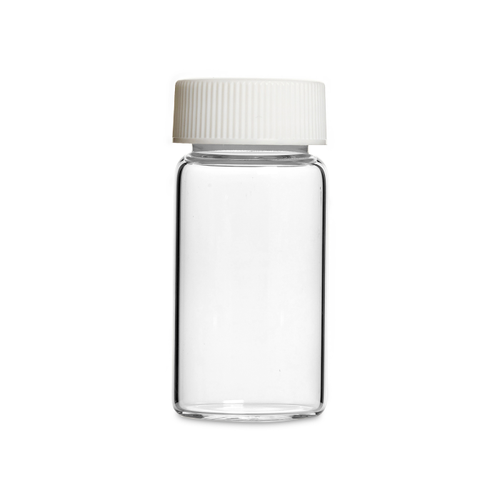
WHEATON 986561
20 mL
Borosilicate Glass
24-400 Thread
White PP Cap
Metal Foil/Pulp
28 x 61 mm Capped
Non-Sterile
Not Autoclavable
500/Case
WHEATON 986561: Technical Overview and Exact Configuration
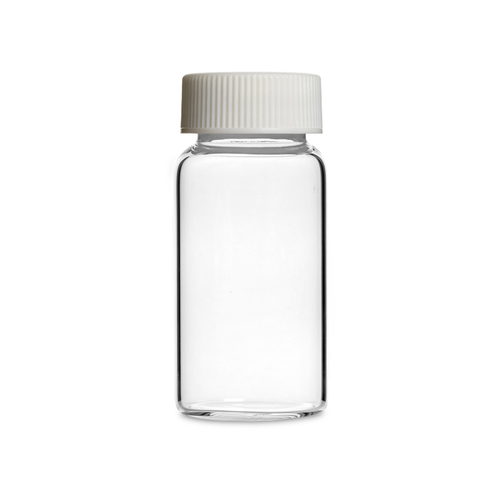
WHEATON® 986561 is a 20 mL clear borosilicate glass liquid scintillation vial equipped with a white polypropylene 24-400 screw cap attached to the vial and a metal foil/pulp liner. DWK specifies a 28 mm outside diameter, 57 mm height without cap, and 61 mm total height with cap.
DWK describes its glass scintillation-vial family as providing consistent, low background counts and high UV transmission. This exact SKU is designated non-sterile and not autoclavable, with no marking spot. The manufacturer case quantity is 500 vials with caps.
Two features are especially important when selecting 986561. First, its 24-400 thread differs from the 22-400 finish on WHEATON 986541. Second, its metal foil/pulp liner differs from the foamed polyethylene liner on WHEATON 986560. Those differences affect cap selection, chemical compatibility, and laboratory purchasing specifications.
Operations takeaway: Specify 986561, 20 mL clear borosilicate glass, 28 x 57 mm uncapped / 28 x 61 mm capped, attached white PP 24-400 cap, metal foil/pulp liner, 500/case. The exact product is non-sterile and not autoclavable. DWK describes good general foil/pulp resistance to hydrocarbons, oils, ketones, and alcohols, but not acids or alkalis.
Exact-SKU Specifications for RFQs, SOPs, and Receiving
- Manufacturer / brand: DWK Life Sciences / WHEATON®
- Catalog number: 986561
- Product: Glass liquid scintillation vial with attached screw cap
- Nominal capacity: 20 mL
- Vial material: Clear borosilicate glass
- Glass family description: Type I borosilicate glass tubing
- Outside diameter: 28 mm
- Vial height excluding cap: 57 mm
- Overall height including cap: 61 mm
- Neck / closure finish: 24-400
- Cap included: Yes; attached to vial per manufacturer designation
- Closure material: Polypropylene (PP)
- Closure color: White
- Liner material: Metal foil / pulp
- General liner construction: Aluminum foil bonded to pulp board
- General liner barrier properties: DWK describes them as good
- General liner resistance: Hydrocarbons, oils, ketones, and alcohols
- General liner limitations: Not good for acids or alkalis
- Marking spot: No
- Sterility: Non-sterile
- Autoclavability: Not autoclavable
- Scintillation background: Manufacturer-described consistent low counts
- Optical characteristics: Manufacturer-described high UV transmission
- Primary use: Liquid scintillation counting
- Purchase unit: Case
- Case quantity: 500
- Calibrated volume tolerance: Not established
- Certified leak rate or vapor-tight performance: Not established
- Numerical counting background: Not established in reviewed SKU specifications
- UV transmission percentage: Not established in reviewed SKU specifications
- Specific counter compatibility: Verify with the intended instrument
- Country of origin: Not verified
- Shipping weight / carton dimensions: Not verified
- Inner packaging quantity: Not confirmed by current exact-SKU record
Specification boundary: The 20 mL capacity is nominal rather than calibrated. The 61 mm height includes the supplied cap. The 24-400 thread identifies the required closure finish but does not establish a certified leakproof seal.
Metal Foil/Pulp Liner: Construction and Material Properties
DWK's Closure Liner Guide describes Pulp / Metal Foil as aluminum foil bonded to pulp board. The liner is designed to provide a sealing interface between the polypropylene screw cap and glass vial neck.
The manufacturer identifies good barrier properties and good resistance to hydrocarbons, oils, ketones, and alcohols. These characteristics can be relevant to scintillation counting procedures using compatible organic solvent formulations.
However, the manufacturer also states that this liner is not good for acids or alkalis. That limitation is important when the sample includes acidic buffers, alkaline reagents, or complex mixtures with multiple chemical components.
| Liner characteristic |
DWK general material guidance |
| Liner designation |
Pulp / Metal Foil |
| Construction |
Aluminum foil bonded to pulp board |
| Barrier characteristics |
Good barrier properties |
| Hydrocarbons |
Good general resistance |
| Oils |
Good general resistance |
| Ketones |
Good general resistance |
| Alcohols |
Good general resistance |
| Acids and alkalis |
Not good; do not assume suitability |
| PTFE facing |
Not specified for this product |
| Certified leak rate |
Not established for finished 986561 assembly |
This table describes general liner-material characteristics, not the results of chemical exposure testing on an individual completed vial. Actual performance depends on the sample, cocktail, concentration, temperature, contact duration, and closure application.
Critical material warning: Metal foil/pulp is not PTFE and is not the same as metal foil/cork. Do not assume universal chemical resistance, acid/alkali compatibility, or a certified vapor-tight seal. DWK recommends testing the liner for the intended application.
Metal Foil/Pulp vs. Foamed Polyethylene: 986561 and 986560
WHEATON 986561 and 986560 share a 20 mL borosilicate glass vial, 24-400 white polypropylene cap, and the same published vial dimensions. Their principal difference is the closure liner material.
| Feature |
986561 |
986560 |
| Liner |
Metal foil/pulp |
Foamed polyethylene |
| General construction |
Aluminum foil bonded to pulp board |
Foamed LDPE core between solid PE layers |
| Hydrocarbon solvents |
Good general resistance described |
Poor resistance identified by DWK |
| Acids / alkalis |
Not good |
General resistance described; verify actual chemical |
| Cap material |
White polypropylene |
White polypropylene |
| Thread |
24-400 |
24-400 |
| Case quantity |
500 |
500 |
| Sterility / autoclavability |
Non-sterile / not autoclavable |
Non-sterile / not autoclavable |
Selection principle: Foil/pulp and foamed PE have different chemical resistance profiles. Neither is universally superior. Select the configuration based on the complete sample formulation, approved laboratory method, and required seal characteristics.
24-400 vs. 22-400: 986561 Compared with 986541
The 24-400 thread finish is the key difference between WHEATON 986561 and WHEATON 986541. Both products have 20 mL clear borosilicate glass vials, white polypropylene caps, and metal foil/pulp liners, but their closure sizes are different.
DWK's Closure Liner Guide explains that container and closure thread finishes must match. A 24-400 cap should not be substituted for a 22-400 cap. The different thread size can affect neck engagement, liner seating, and closure fit.
| Specification |
986561 |
986541 |
| Thread finish | 24-400 | 22-400 |
| Nominal capacity | 20 mL | 20 mL |
| Vial material | Borosilicate glass | Borosilicate glass |
| Cap material | White PP | White PP |
| Liner | Metal foil/pulp | Metal foil/pulp |
| Capped dimensions | 28 x 61 mm | 28 x 61 mm |
| Case quantity | 500 | 500 |
Thread compatibility warning: Identical outside diameter, capped height, and nominal capacity do not mean the screw-thread finish is interchangeable. Specify 24-400 for WHEATON 986561.
Liquid Scintillation Counting: Background and Optical Properties
Liquid scintillation counting (LSC) is an analytical method used to measure activity in appropriate radioactive samples. A sample is combined with a scintillation cocktail, and energy from radioactive emissions can produce light that a liquid scintillation counter detects.
The vial is part of the measurement system. Glass composition, optical transmission, sample geometry, cocktail chemistry, background contribution, and counting-instrument settings can influence analytical results.
DWK describes its glass liquid scintillation vial family as providing consistent, low background counts and high UV transmission. These are qualitative manufacturer descriptions. Numerical results must be established for the actual instrument and laboratory method.
- Background: Measure using method blanks and instrument background checks.
- Optical transmission: Manufacturer-described as high, without an exact SKU-specific transmission curve.
- Counting efficiency: Depends on radionuclide, cocktail, sample matrix, counter, and calibration.
- Quench effects: Follow laboratory method and instrument correction procedures.
- Sample geometry: Verify vial dimensions and cap clearance.
- Working volume: Use the method-defined sample and cocktail quantities, not nominal capacity.
- Quality control: Run standards, blanks, and performance checks as required.
Analytical performance boundary: WHEATON 986561 is a laboratory sample container, not a calibrated radiation-measuring device. No isotope-specific counting efficiency, minimum detectable activity, or numerical background limit is established for this exact SKU in the reviewed information.
Borosilicate Glass: Material Characteristics and Standards Context
DWK identifies borosilicate glass as the vial material for 986561. The manufacturer's glass scintillation-vial family is described as converted from Type I borosilicate glass tubing.
Borosilicate glass offers useful general chemical durability, but resistance is not universal. Hydrofluoric acid and certain strongly alkaline solutions can attack glass. The glass material's resistance must be evaluated separately from the foil/pulp liner's explicitly stated limitations involving acids and alkalis.
Historical WHEATON technical literature discusses low-potassium borosilicate glass in liquid scintillation applications. Low potassium can be relevant because naturally occurring potassium contains potassium-40, which may contribute to background in sensitive counting methods. These historical material descriptions are not current lot-specific certification for WHEATON 986561.
- Exact-SKU vial material: Borosilicate glass.
- Family description: Type I borosilicate glass tubing.
- Historical low-potassium references: Not a certified potassium assay for the current product.
- Glass chemical resistance: Requires evaluation for aggressive reagents.
- Lot-specific material certificate: Request from the manufacturer when needed.
- Thermal processing: Finished 986561 assembly is explicitly not autoclavable.
Chemical Compatibility: Evaluate the Complete Assembly
WHEATON 986561 contains three distinct material components: the borosilicate glass vial, white polypropylene cap, and metal foil/pulp liner. A scintillation sample may contact the glass directly and expose the cap or liner to liquid, condensation, or solvent vapors.
The manufacturer's general foil/pulp liner guidance describes resistance to several organic solvent classes, but this does not establish compatibility with every scintillation cocktail or laboratory sample. Each formulation and exposure condition must be considered individually.
| Exposure |
Qualification consideration |
| Hydrocarbon-containing cocktails | Foil/pulp has general resistance; test actual mixture and seal performance |
| Alcohol-containing solutions | General resistance described; assess specific alcohol and conditions |
| Ketone-containing mixtures | General resistance described; evaluate full formulation |
| Oils | General resistance described; verify exposure and analytical requirements |
| Acidic reagents / buffers | DWK states foil/pulp is not good for acids |
| Alkaline solutions | DWK states foil/pulp is not good for alkalis |
| Volatile solvent vapors | Assess liner exposure, evaporation, containment, and ventilation |
| Trace-sensitive analytical samples | Evaluate method blanks, potential extractables, and sample recovery |
| Cleaning reagents | Verify suitability for glass, polypropylene, and foil/pulp |
Important: This is a compatibility-assessment framework, not a certified chemical exposure chart for the finished WHEATON 986561 assembly. Review the actual cocktail safety data sheet and request manufacturer guidance where necessary.
Vial Dimensions and Counting-Instrument Fit
DWK supplies separate uncapped and capped height specifications. The 57 mm height describes the glass vial without its cap, while 61 mm includes the attached closure. The vial diameter is 28 mm.
| Attribute |
Value and significance |
| Nominal capacity | 20 mL; not a calibrated fill volume |
| Outside diameter | 28 mm; rack and carousel fit |
| Uncapped height | 57 mm; glass vial dimension |
| Capped height | 61 mm; complete assembly clearance |
| Thread finish | 24-400; requires matching closure |
| Marking spot | None; use suitable sample identification |
Instrument-fit checkpoint: The published dimensions do not guarantee compatibility with every liquid scintillation counter. Verify the specific holder, cap profile, and instrument requirements before use.
Related WHEATON Liquid Scintillation Vial Configurations
DWK's WHEATON vial guide identifies the following nominal 20 mL glass configurations. They differ in cap material, liner construction, thread finish, or packing arrangement and should not be treated as automatically interchangeable.
| WHEATON SKU |
Cap / liner |
Thread |
Cap presentation |
| 986561 |
White PP / metal foil-pulp |
24-400 |
Attached |
| 986560 |
White PP / foamed PE |
24-400 |
Attached |
| 986541 |
White PP / metal foil-pulp |
22-400 |
Attached |
| 986562 |
White urea / metal foil-cork |
24-400 |
Attached |
| 986568 |
White urea / PE disc |
24-400 |
Attached |
| 986591 |
White PP / metal foil-pulp |
24-400 |
Caps packed separately |
| 986590 |
White PP / foamed PE |
24-400 |
Caps packed separately |
| 986581 |
White PP / metal foil-pulp |
22-400 |
Caps packed separately |
The WHEATON manufacturer guide lists these glass scintillation configurations at 20 mL and 500 per case. Exact cap and liner selection remains important even when the nominal vial size is identical.
Procurement distinction: 986561 and 986591 share the same named glass/PP/foil-pulp/24-400 configuration but differ in whether caps are attached or packed separately. WHEATON 986541 is the attached-cap 22-400 version.
Non-Sterile and Not Autoclavable: Exact Manufacturer Restrictions
DWK explicitly lists WHEATON 986561 as non-sterile and not autoclavable. These are exact-SKU designations and take precedence over general statements about the thermal resistance of borosilicate laboratory glass.
The finished product includes a polypropylene cap and foil/pulp liner. The thermal properties of the glass alone do not establish the heat or steam-processing suitability of the complete assembled product.
- Supplied sterile: No; manufacturer lists non-sterile.
- Autoclavable: No; manufacturer lists not autoclavable.
- Validated steam sterilization cycle: Not established for 986561.
- Dry-heat processing: No SKU-specific validated cycle established.
- General glass thermal properties: Do not override the complete-product restriction.
- Sterile application requirements: Select a separately qualified product when necessary.
Do not autoclave WHEATON 986561. If a laboratory proposes separate processing of bare glass components, obtain manufacturer guidance and validate the proposed procedure rather than assuming it is approved.
Closure Handling, Seal Integrity, and Vapor Control
The white polypropylene cap and foil/pulp liner form part of the manufacturer-defined vial assembly. However, the presence of a screw cap and a liner with good barrier properties does not establish a certified leakproof, vapor-tight, hermetic, or pressure-resistant container.
Actual containment performance depends on the condition of the glass neck, cap threads, liner compression, sample formulation, temperature, and method of cap application.
- Inspect the glass rim and thread for chips, cracks, or residue.
- Inspect the polypropylene cap and foil/pulp liner for damage.
- Use the matching 24-400 closure configuration.
- Follow the approved laboratory cap-application procedure.
- Do not invent a tightening torque or assume certified leakproof performance.
- Evaluate the effects of volatile solvent vapors on the closure.
- Use required ventilation and secondary containment.
- Follow applicable radiation and chemical safety procedures.
Recommended Laboratory Preparation and QC Checklist
- Verify identity: Confirm WHEATON 986561, 24-400 thread, white polypropylene cap, and foil/pulp liner.
- Confirm quantity: Verify a case quantity of 500 vial-and-cap units.
- Inspect components: Check the glass, rim, threads, cap, and liner for damage.
- Qualify materials: Evaluate sample and cocktail compatibility with glass, PP, and foil/pulp.
- Review acids and alkalis: Note DWK's explicit material limitation for foil/pulp liners.
- Verify instrument fit: Confirm 28 mm diameter and 61 mm capped height.
- Set working volume: Follow the method's required sample/cocktail quantities and headspace.
- Close appropriately: Follow the laboratory's approved cap-handling procedure.
- Identify samples: Use appropriate labels or barcodes; no marking spot is supplied.
- Perform analytical QC: Use method-required blanks, standards, calibration, and background measurements.
- Manage hazards: Follow laboratory chemical, radiological, and waste procedures.
- Do not autoclave: WHEATON 986561 is explicitly not autoclavable.
- Maintain traceability: Record applicable receiving, lot, sample, and instrument information.
Cleaning, Inspection, Storage, and Reuse Considerations
DWK provides general guidance on the cleaning and maintenance of laboratory glassware. For WHEATON 986561, any cleaning or reuse procedure must account for the polypropylene cap, metal foil/pulp liner, and previous sample or cocktail exposure, not only the glass vial.
- Determine whether the analytical method permits vial reuse.
- Assess chemical, biological, or radioactive contamination before handling.
- Choose a cleaning process compatible with the complete vial-and-cap assembly.
- Avoid abrasive tools and mechanical damage to the glass rim or threads.
- Rinse and dry according to method requirements.
- Inspect glass, cap, and liner for cracks, deformation, or residues.
- Run background or carryover controls if analytical reuse is permitted.
- Do not autoclave the assembled product.
- Store glassware to minimize impact, contamination, and closure damage.
Used scintillation vials may contain chemical or radioactive contamination. Laboratory safety procedures and applicable waste-handling requirements determine how they should be managed.
Controlled Laboratory and Cleanroom Qualification
WHEATON 986561 may be evaluated for suitable analytical environments, but the manufacturer expressly identifies it as non-sterile. The reviewed exact-SKU specification does not establish an ISO 14644 product cleanliness class, sterile packaging, validated endotoxin limit, DNase/RNase-free designation, or certified low-particle release rate.
For controlled laboratory use, follow the facility's procedures for material introduction, cleaning, contamination control, sample identification, and documentation. The use of borosilicate glass does not independently qualify the complete product for aseptic processing or sterile compounding.
Qualification boundary: Glass material classification and low-scintillation-background descriptions are not certificates of sterility, cleanroom suitability, or pharmaceutical-fill compliance.
Important Limitations and Unsupported Assumptions
- Non-sterile: Explicit manufacturer designation.
- Not autoclavable: Explicit manufacturer designation.
- Not 22-400: The exact thread finish is 24-400.
- Not foamed PE: The liner is metal foil/pulp.
- Not metal foil/cork: Pulp and cork are different backing materials.
- Not PTFE-lined: No PTFE-facing material is specified.
- Not universally chemical-resistant: Foil/pulp is not good for acids or alkalis.
- Not certified leakproof: A screw cap and barrier liner do not establish a measured leak rate.
- Not universally counter-compatible: Verify the instrument and vial holder.
- Not a calibrated volumetric device: 20 mL is a nominal capacity.
- No marking spot: Use an appropriate external identification method.
- No numeric background guarantee: Manufacturer low-background description is qualitative.
- No SKU-specific UV curve: Do not assign an unsupported transmission percentage.
- No verified current lot-specific glass composition: Request formal documentation if required.
- No confirmed inner packaging breakdown: Verify particular packing requirements with the manufacturer.
- No certified hazardous-material transport approval: Normal vial packaging is not a regulated shipping certification.
Technical FAQs
What is WHEATON 986561?
A 20 mL clear borosilicate glass liquid scintillation vial with an attached white polypropylene 24-400 cap and metal foil/pulp liner.
Are caps included?
Yes. DWK identifies white polypropylene caps attached to the vials. Each case contains 500 units.
What thread size does 986561 use?
24-400. It is different from the 22-400 finish on WHEATON 986541.
What is the difference between 986561 and 986560?
986561 uses a metal foil/pulp liner; 986560 uses foamed polyethylene. Both use 24-400 white polypropylene caps.
What is the difference between 986561 and 986541?
986561 uses 24-400; 986541 uses 22-400. Both use borosilicate glass, white polypropylene caps, and foil/pulp liners.
What is the difference between 986561 and 986591?
986561 has caps attached to the vials. The manufacturer guide identifies 986591 as the foil/pulp 24-400 version with caps packaged separately.
What is the liner made of?
DWK describes pulp/metal foil as aluminum foil bonded to pulp board.
Is metal foil/pulp resistant to hydrocarbons?
DWK describes good general resistance to hydrocarbons, oils, ketones, and alcohols. Actual compatibility still requires application-specific verification.
Is foil/pulp suitable for acids or alkalis?
DWK's general liner guide specifically states that pulp/metal foil is not good for acids or alkalis.
Is the liner PTFE-faced?
No PTFE facing is specified. The named liner is metal foil/pulp, a different construction.
Is the closure certified leakproof?
No exact-SKU leakproof, vapor-tight, or pressure rating was established. Test the complete closure for the intended use.
Are the vials sterile?
No. DWK explicitly lists 986561 as non-sterile.
Can WHEATON 986561 be autoclaved?
No. DWK explicitly lists the exact product as not autoclavable.
What are the vial dimensions?
28 mm diameter, 57 mm height without the cap, and 61 mm height including the cap.
Is the 20 mL capacity calibrated?
No calibrated measuring tolerance was established. Use the working fill specified by the analytical method.
Does the vial have a marking spot?
No. Use a laboratory-approved sample identification method.
Are low background and UV transmission quantified?
DWK describes consistent low background counts and high UV transmission, but does not establish numerical SKU-specific values in the reviewed specification.
Is this vial compatible with every scintillation counter?
Not automatically. Check the 28 mm diameter, 61 mm capped height, closure profile, and instrument requirements.
How many vials are in a case?
500 vials with the specified attached caps and liners.
Manufacturer Technical References
These are manufacturer technical-information pages rather than DWK product-detail, catalog, or purchasing links. General guidance does not override WHEATON 986561's explicit non-sterile and not autoclavable designations.
For quotations or product questions, email Sales@SOSsupply.com or call (214) 340-8574.
SOSCleanroom can help confirm WHEATON vial configurations, thread finishes, closure materials, case quantities, and applicable manufacturer documentation.
Technical insight: Liquid scintillation vial selection depends on background performance, sample chemistry, counting-instrument geometry, and the complete vial-and-cap system. Metal foil/pulp liners offer documented general resistance to several organic solvent classes but are not recommended for acids or alkalis.
Last updated: October 27, 2026
© 2026 Specialty Optical Systems, Inc. (dba SOSCleanroom). All rights reserved.