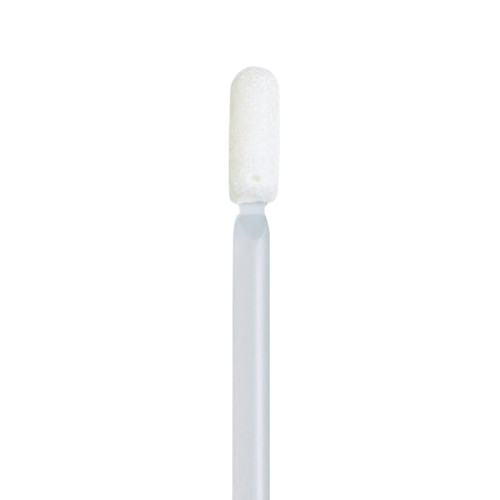
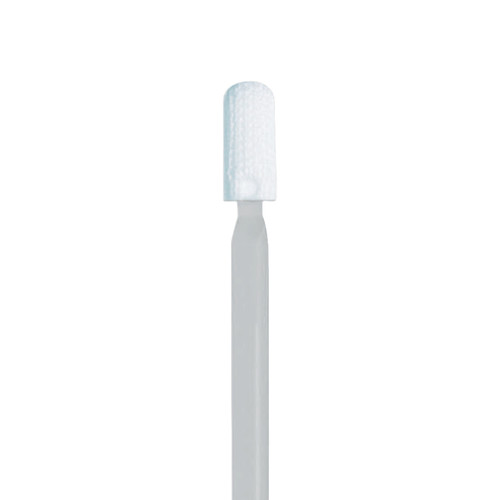
Texwipe TX768T Micro Pick ESD Swab - 0.1 mm Precision Tip - Non-Sterile
Texwipe TX768T is an ultra-fine ESD-safe micro pick designed for precision manipulation, localized debris removal, and controlled cleaning of miniature features in static-sensitive environments. Its 0.1 mm nominal pick tip provides access to extremely narrow recesses, seams, grooves, and intersecting surfaces where conventional foam or polyester cleanroom swabs may be too large.
Manufactured from Stat-Rite® inherently dissipative polymer, TX768T provides a solid precision tool for picking, lifting, separating, and removing small particles or excess materials. The 68.0 mm overall length supports close operator control, while the engineered polymer construction helps manage electrostatic charge without conventional carbon, metallic, or ionic antistatic additives. TX768T is cleanroom processed, lot coded, and packaged in protective anti-static bags.
Micro Pick Precision Advantage: TX768T combines an extremely fine 0.1 mm nominal tip with inherently dissipative Stat-Rite® construction for controlled pick-and-lift work in ESD-sensitive environments. Unlike foam, cotton, or polyester swabs, TX768T is a solid micro-pick tool rather than an absorbent wiping product. It is intended for localized mechanical manipulation and removal of debris, not bulk liquid absorption or conventional wet wiping.
Specifications:
- Manufacturer: ITW Texwipe
- Part Number: TX768T
- Product Family: ESD-Safe Micro Pick / Swab Tool
- Product Type: Solid Precision Micro Pick
- Swab Format: Dry, single-use precision pick tool
- Material: Stat-Rite® inherently dissipative polymer
- Head Construction: Solid, finely formed polymer pick tip
- Nominal Head Width: 0.1 mm (approximately 0.004")
- Nominal Head Thickness: 0.1 mm (approximately 0.004")
- Head Length: 9.0 mm (0.354")
- Handle Width: 2.6 mm (0.102")
- Handle Thickness: 2.6 mm (0.102")
- Handle Length: 59.0 mm (2.323")
- Overall Tool Length: 68.0 mm (2.677")
- Head Attachment: Manufacturer-described thermal-bond construction without adhesives
- ESD Characteristics: Inherently dissipative polymer construction
- Handle Additives: Designed without blooming carbon particles, metal fillers, or ionic antistatic additives
- Absorbency: Solid micro-pick construction; not intended for liquid absorption
- Cleaning Method: Precision pick, lift, and localized mechanical removal
- Sterility: Non-sterile
- Processing: Cleanroom processed
- Packaging: Anti-static protective bag
- Bag Quantity: 500 picks
- Inner Packaging: 5 inner bags of 100 picks
- Case Quantity: 60 bags of 500 picks
- Total Case Quantity: 30,000 picks
- Traceability: Lot coded for quality control
- Temperature Guidance: Applications below 194°F (90°C), subject to actual process conditions
- Available Purchase Options: Bag of 500 or case of 30,000 picks
- Availability: Stock item, subject to current inventory
About the Manufacturer:
Texwipe, an ITW company, develops contamination-control consumables for semiconductor manufacturing, electronics assembly, pharmaceutical production, biotechnology, medical devices, precision optics, and laboratory operations. Its specialized swab and precision-tool portfolio includes polyurethane foam, polyester knit, nonwoven polyester, and ESD-safe solid pick products for critical cleaning and handling applications.
The Texwipe ESD-Safe Swab Series incorporates Stat-Rite® inherently dissipative polymer technology to help manage electrostatic charge without conventional carbon-loaded, metallic, or ionic antistatic additive systems. TX768T uses this technology in an ultra-fine solid micro-pick configuration designed for repeatable precision contact and localized mechanical material removal.
SOSCleanroom is an authorized Master Distributor of ITW Texwipe. Our team supports customers with ESD-safe product selection, manufacturer documentation, product configurations, lot traceability, and procurement assistance for contamination-sensitive manufacturing operations.
TX768T Features:
- Ultra-fine 0.1 mm nominal precision pick tip
- Solid Stat-Rite® inherently dissipative polymer construction
- ESD-safe design for static-sensitive handling applications
- 68.0 mm overall length for controlled precision work
- 9.0 mm long micro-pick head for localized access
- Designed for picking, lifting, and manipulating small debris and materials
- Engineered for consistent geometry through precision automated manufacturing
- Manufacturer-described adhesive-free thermal-bond construction
- No conventional carbon, metallic, or ionic antistatic additives
- Cleanroom-processed material for controlled-environment applications
- Protective anti-static bag packaging
- Lot coded for traceability and quality control
- Non-sterile, single-use format
- 500 picks per bag with 5 inner bags of 100
- 60 bags per case, totaling 30,000 picks
TX768T Benefits:
- Ultra-Fine Access: The 0.1 mm nominal pick geometry supports contact with extremely small features where conventional cleaning swabs may not fit.
- Precision Debris Removal: Solid-tip construction allows operators to pick and lift localized particles or excess material without relying on an absorbent head.
- ESD Management: Stat-Rite® technology supports electrostatic control when used within an appropriately grounded ESD workstation.
- Controlled Contact: Small tip geometry helps limit contact with adjacent components during precise manipulation.
- Reduced Adhesive Contamination: Manufacturer-described thermal-bond construction avoids adhesive at the head attachment.
- Clean Material Design: Inherently dissipative polymer avoids conventional additives that can contribute particulate or ionic contamination.
- Operator Control: Short overall length permits close positioning and low-force manipulation of miniature features.
- Reduced Rework Potential: Controlled pick-and-lift procedures can help prevent debris from being pushed deeper into joints or transferred across adjacent surfaces.
- Repeatable Procedures: Defined tool geometry supports standardized operator handling and localized cleaning methods.
- Material Traceability: Lot identification supports receiving and quality-control procedures.
- Controlled Dispensing: Inner bags of 100 picks support point-of-use issuance and reduced unnecessary package handling.
- Bulk Procurement: Large case quantities support high-volume precision manufacturing and recurring material requirements.
Common Applications:
- Ultra-fine particle removal from semiconductor components
- Precision cleaning and rework of ESD-sensitive electronic assemblies
- Picking debris from micro-scale grooves and recessed features
- Removing localized excess adhesives and compatible process residues
- Separating or positioning small materials during inspection and rework
- Cleaning intersecting surfaces and miniature mechanical joints
- Removing fine powders from confined areas
- Controlled manipulation of small electronic components
- Microelectronics and sensor assembly operations
- Precision equipment maintenance and inspection
- Removing contaminants from miniature tooling and fixture features
- Localized work in ESD-protected cleanroom environments
- Process-controlled pick-and-lift debris removal
Best-Practice Use:
- Inspect Before Use: Examine the micro-pick tip for deformation, damage, contamination, or irregularities.
- Use an ESD-Protected Workstation: Follow established electrostatic-discharge control procedures during precision manipulation.
- Handle by the Body: Avoid touching the micro-pick tip with gloves, fingers, tools, or uncontrolled surfaces.
- Use Minimum Contact: Position the tip to contact only the intended particle, residue, or feature.
- Pick and Lift: Use a controlled lifting motion to remove debris rather than dragging contamination across adjacent surfaces.
- Control Applied Force: Use minimal pressure to reduce the likelihood of tip deformation, component damage, or surface scratching.
- Maintain Visual Control: Use appropriate magnification when working with extremely small or delicate components.
- Avoid Excessive Bending: Do not use the tip as a lever or apply mechanical forces beyond the intended precision-pick function.
- Prevent Recontamination: Do not place a used pick tip on a workbench or return it to clean packaging.
- Replace Damaged Picks: Discard picks when the tip becomes bent, contaminated, worn, or unable to perform the intended task.
- Use Compatible Chemistry: When removing material softened by a cleaning solvent, confirm compatibility with the pick polymer and the cleaned component.
- Maintain Traceability: Record lot information where required by the facility's procedures.
- Single-Use Handling: Dispose of used picks according to the applicable contamination-control and waste-management requirements.
Precision Pick-and-Lift Cleaning Guidance:
TX768T is designed for controlled mechanical removal of small particles and excess material rather than conventional absorbent wiping. Cleaning performance depends on tip positioning, applied force, contact direction, surface characteristics, and the amount of contamination being removed.
- Target the Contamination: Identify the location and type of residue or particle before bringing the pick into contact.
- Use Magnification: Appropriate inspection magnification helps operators control the 0.1 mm tip and avoid unintended surface contact.
- Establish an Approach Angle: Select a controlled contact angle based on the feature geometry and material being removed.
- Lift Rather Than Drag: When practical, separate and remove contamination with a short lifting movement rather than a long sliding stroke.
- Limit Contact Pressure: Avoid unnecessary force that could damage the pick tip or precision component.
- Control Debris Transfer: Remove detached particles from the work area according to the approved procedure.
- Avoid Re-Deposition: Do not reuse a contaminated tip on a previously cleaned surface.
- Verify Completion: Inspect the treated feature to confirm successful removal without surface damage or residual contamination.
- Standardize Technique: Establish appropriate contact pressure, movement direction, replacement criteria, and inspection requirements in the facility SOP.
Precision Handling Principle: Micro-pick cleaning is a localized mechanical process. The objective is to remove or reposition the target material with minimal force and minimal unintended surface contact. For extremely small features, controlled tip movement, proper magnification, and defined replacement criteria are essential for consistent results.
ESD Grounding and Charge-Control Guidance:
The Stat-Rite® inherently dissipative polymer construction supports electrostatic charge management during precision handling. However, effective ESD protection requires an established workstation grounding system, appropriate personnel controls, and handling procedures suited to the electrostatic sensitivity of the components.
- ESD-Protected Area: Perform precision work within a controlled ESD workstation when handling static-sensitive devices.
- Personnel Grounding: Use approved wrist straps, footwear, flooring, or other personnel grounding controls required by the facility.
- Grounded Work Surfaces: Verify the grounding and condition of ESD mats, workbenches, fixtures, and equipment.
- Dissipative Material: Stat-Rite® supports charge dissipation, but tool performance depends on the complete electrical pathway and contact conditions.
- Glove Selection: Consider whether cleanroom gloves or other handling materials interrupt the intended charge-dissipation path.
- Insulating Components: Use appropriate ionization or other approved controls when insulating materials cannot be grounded.
- Triboelectric Charging: Contact and movement between materials can generate electrostatic charge. Avoid unnecessary rubbing or dragging.
- Equipment Potential: Maintain appropriate potential control for sensitive components and conductive tools.
- ESD Qualification: Verify the resistance or charge-decay characteristics needed for the specific process under documented test conditions.
- Applicable Standards: ANSI/ESD S20.20 and IEC 61340-5-1 provide established frameworks for ESD control programs.
ESD Control Principle: Inherently dissipative construction helps manage electrostatic charge but does not independently guarantee complete ESD protection. Tool contact, grounding, operator handling, environmental conditions, and workstation controls must be considered together. TX768T should be incorporated into the facility's established ESD protection and qualification procedures.
Solid Micro Pick vs. Absorbent Swab Selection:
TX768T differs fundamentally from conventional cleanroom swabs because its working tip is formed from solid polymer rather than absorbent foam, cotton, or polyester. The correct product should be selected based on whether the cleaning operation requires mechanical manipulation, liquid absorption, solvent delivery, or wiping contact.
- TX768T Solid Micro Pick: Preferred when the process requires ultra-fine contact, mechanical separation, or controlled picking and lifting of debris.
- TX768D Micro Pick: Provides a larger 0.2 mm nominal pick geometry for precision operations that do not require the finer TX768T tip.
- TX769E ESD-Safe Stick: Offers double-ended precision micro-tips for controlled manipulation and access to small features.
- Polyurethane Foam Swabs: Appropriate when solvent absorption, localized solution delivery, or soft wiping contact is required.
- Nonwoven Polyester Swabs: Suitable for cleaning procedures emphasizing controlled absorbency and surface contact.
- Knitted Polyester Swabs: May be selected for durable wiping and precision cleaning where fabric-head performance is appropriate.
- Liquid Pickup: A solid pick does not contain a foam or textile structure designed to absorb liquid.
- Solvent Application: Select an absorbent swab when the process requires controlled solvent loading and delivery.
- Surface Protection: Solid pick tips concentrate force over a small contact area. Use appropriate pressure limits and confirm surface compatibility.
- Cleaning Validation: Changing between solid pick tools and absorbent swabs can affect removal efficiency, residue redistribution, and material-contact characteristics.
Product Selection Guidance: Choose TX768T when the cleaning task requires a 0.1 mm precision pick for localized mechanical removal. If the procedure requires solvent absorption, solution transfer, or broad wiping, use an appropriately qualified foam or polyester cleanroom swab. Solid micro picks and absorbent cleaning swabs should not be treated as interchangeable tools in controlled cleaning methods.
Solvent Compatibility and Material Handling:
- Polymer Compatibility: Confirm the Stat-Rite® material is compatible with any cleaning chemical that may contact the pick during use.
- Isopropyl Alcohol: May be suitable in approved cleaning procedures, subject to material and surface compatibility.
- Aggressive Solvents: Verify suitability before exposure to ketones, esters, hydrocarbons, or other chemical formulations.
- No Bulk Absorption: TX768T is a solid tool and is not intended to retain or transfer cleaning solutions by capillary absorption.
- Material Softening: Chemical exposure may alter polymer properties depending on concentration, temperature, and contact duration.
- Surface Compatibility: Evaluate the mechanical and chemical sensitivity of the component being cleaned.
- Residue Contribution: Assess extractables or surface residue contribution when used in contamination-sensitive processes.
- Particle Generation: Excessive force, abrasion, or tip deformation may increase the risk of polymer particle generation.
- Temperature: Follow the manufacturer's published use guidance below 90°C (194°F), along with any lower limits imposed by the process chemistry.
- Process Qualification: Establish cleaning effectiveness and material suitability using the actual equipment, contaminant, and method.
Packaging and Storage Recommendations:
- Bag Quantity: 500 picks
- Inner Packaging: 5 inner bags of 100 picks each
- Case Quantity: 60 bags
- Total Case Quantity: 30,000 picks
- Packaging Material: Protective anti-static bags
- Lot Identification: Retain manufacturer lot codes according to facility requirements
- Storage Environment: Clean, dry conditions protected from uncontrolled contamination
- ESD Handling: Follow facility procedures for packaging and staging materials near static-sensitive devices
- Package Integrity: Inspect bags before introducing picks into controlled areas
- Inner-Bag Dispensing: Open only the quantity needed for the current operation
- Tip Protection: Avoid crushing, bending, or contacting micro-pick tips during storage and handling
- Contamination Control: Protect unused picks from particles, oils, chemical vapors, and uncontrolled contact
- Single-Use: Discard used picks according to the applicable process procedures
Manufacturer Technical Documents:
Texwipe TX768T Manufacturer Product Information: Click Here
Texwipe ESD-Safe Swabs Product Brochure (PDF): Click Here
Texwipe Swab Technical Data Sheet Library: Click Here
SOSCleanroom TX768T Product Information: Click Here
Other Similar Products Available From SOSCleanroom.com
ESD-Safe Micro Pick and Precision Tools
Absorbent ESD-Safe Swab Alternatives
Notes: Need assistance selecting between a 0.1 mm micro pick, a larger precision pick, or an absorbent ESD-safe swab? Open the SOSCleanroom Technical Vault tab above for additional information about ESD grounding, pick-and-lift techniques, material compatibility, contamination control, and micro-tool selection. For dimension-critical applications, confirm current manufacturer tolerances before establishing acceptance criteria.
SOSCleanroom.com supports contamination-control programs with cleanroom swabs, precision picks, ESD-safe consumables, wipers, cleaning solutions, and specialized products for semiconductor, electronics, optical, laboratory, and precision manufacturing applications. Our team provides manufacturer documentation, product selection assistance, packaging information, and procurement support.
Product description updated: October 19, 2026 (SOS Technical Staff)
© 2026 SOS Supply. All rights reserved.