The Technical Vault
By SOSCleanroom
KIMBLE 60975L-4
OPTICLEAR
16 mL / 4 Dram
51 Expansion Glass
USP Type I
ASTM Type I Class B
Tooled Neck
PE Closures Unattached
72 / Shelf Pack
288 / Case
Technical overview: OPTICLEAR vial and separately supplied PE closure
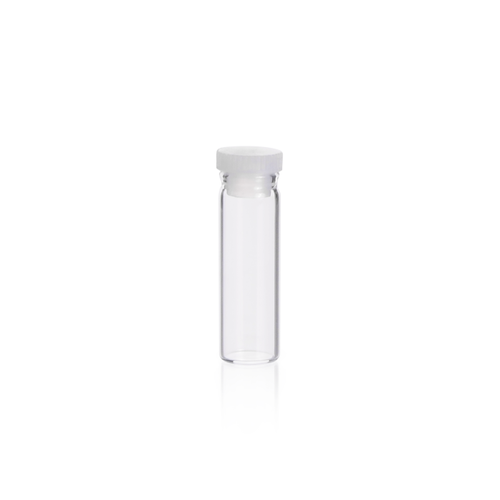
The KIMBLE® OPTICLEAR™ 60975L-4 is a 16 mL (4 dram) clear borosilicate laboratory vial with a tooled neck intended for fitting with its accompanying polyethylene (PE) closure. DWK supplies the closures unattached rather than preinstalled, while including matching vial and closure components in the manufacturer pack and case.
The vial is made from 51-expansion borosilicate glass tubing that DWK identifies as USP Type I and ASTM E438 Type I, Class B. The vial measures 25 mm outside diameter by 52 mm height. The included closure is described by DWK as a closed-bottom, two-piece polyethylene design.
DWK's OPTICLEAR catalog describes this tooled-neck vial family as suitable for consideration in drug-product packaging. Material selection and the proposed packaging use must be supported by the actual formulation, closure integrity, cleanliness, processing, and stability qualification. Supplied sterility or ready-to-use pharmaceutical status is not established by the reviewed SKU listing.
Operations takeaway: Order 60975L-4 for the 16 mL, 25 x 52 mm, 51-expansion Type I borosilicate vial with a tooled neck and separate PE closure. The closures are included but not attached. Manufacturer quantities are 72 sets per shelf pack and 288 sets per case.
Specifications: exact SKU, glass, closure, and packaging
- Manufacturer: DWK Life Sciences
- Brand / Family: KIMBLE® OPTICLEAR™
- Manufacturer Catalog Number: 60975L-4
- Product Category: Clear glass tooled-neck vial
- Nominal Capacity: 16 mL
- Dram Size: 4 dram, manufacturer commercial designation
- Vial Material: 51-expansion borosilicate glass tubing
- Glass Classification: USP Type I; ASTM E438 Type I, Class B
- Glass Color: Clear
- Outside Diameter: 25 mm
- Vial Height: 52 mm
- Neck Style: Tooled neck, designed for the included polyethylene closure
- Published Screw-Thread Finish: None specified
- Closure Included: Yes
- Closure Packaging: Unattached (not preinstalled)
- Closure Construction: Two-piece, closed-bottom as described by DWK
- Closure Polymer: Polyethylene (PE), exact resin grade unspecified
- Separate Rubber Liner: Not specified
- Separate PTFE Facing: Not specified
- Needle-Pierceable Septum: Not specified
- Manufacturer Shelf Pack: 72 sets
- Manufacturer Case: 288 sets
- Purchase Unit: CS (case)
- Manufacturer-Suggested Application: Packaging of compatible drug products after qualification
- Certified Volumetric Tolerance: Not stated
- Supplied Sterility: Not stated
- Validated Assembly Autoclave Cycle: Not stated
- Pressure/Vacuum Rating: Not stated
The 25 x 52 mm dimensions are vial dimensions, not shipping-carton dimensions or a manufacturer-certified equipment clearance. Exact closure outer dimensions, mouth inside diameter, and total installed height are not established in the reviewed DWK SKU record.
51-expansion borosilicate glass: USP Type I, ASTM E438 Type I Class B
DWK identifies the OPTICLEAR tooled vial family as converted from Type I, 51-expansion borosilicate tubing. Manufacturer catalog documentation gives the ASTM designation as Type I, Class B. This is a different glass specification from the commonly referenced 3.3-expansion ASTM Type I Class A borosilicate used in other laboratory containers.
Both Class A and Class B borosilicate types can fall under USP Type I classifications. That common USP designation does not make their glass compositions or coefficients of thermal expansion identical. A specification requiring ASTM E438 Type I Class A should not be treated as satisfied simply because this product is also USP Type I.
| Characteristic | 60975L-4 | Selection consequence |
|---|
| Glass family | Borosilicate | Not soda-lime glass |
| Manufacturer expansion designation | 51 expansion | Do not apply 3.3 glass values |
| USP | Type I | Glass material classification |
| ASTM E438 | Type I, Class B | Not ASTM Type I Class A |
| Vial color | Clear | No amber light shielding specified |
DWK's glass materials guide describes neutral borosilicate glass (ASTM E438 Type I Class B) as having useful chemical resistance for packaging a range of formulations. The published guide contains family-level glass properties; they are not a validated storage-temperature or processing specification for this finished PE-closed vial.
Glass standard checkpoint: Use 51 expansion / USP Type I / ASTM E438 Type I Class B. Do not describe 60975L-4 as 3.3-expansion Class A, amber glass, soda-lime glass, or certified volumetric glassware.
DWK Glass Types & Properties
Tooled-neck design: why it matters for closure selection
The 60975L-4 is specified with a tooled neck, manufactured to provide an accurate fit with the supplied polyethylene closure. A tooled neck refers to its finished mouth and neck geometry. DWK does not provide a standard screw-thread finish such as 13-425 or 20-400 for this SKU.
The included PE closure should be used and evaluated as the intended mating component. Selecting a replacement closure by the 25 mm outer body diameter would be incorrect: body outside diameter is not necessarily the size of the mouth or closure interface.
- Published Neck Type: Tooled for accurate closure fit.
- Intended Mating Material: Polyethylene closure supplied in the pack.
- Published Thread Designation: None provided.
- Glass Body Diameter: 25 mm; not an established closure-diameter measurement.
- Neck Inside Diameter: Not specified by DWK's current SKU page.
- Exact Closure Fit Tolerance: Not published in the reviewed product record.
- Replacement Closures: Confirm with DWK or SOSCleanroom using the exact vial SKU.
Do not substitute: A 13-425 screw cap, crimp seal, or unrelated snap/plug closure based solely on apparent size. The 60975L-4 system is defined by its tooled neck and manufacturer-selected PE closure.
Closed-bottom, two-piece polyethylene closure: what is established
DWK's product description explicitly identifies closed-bottom, two-piece closures. It also states that the vials and closures are supplied together but the closures are unattached. The closure material is polyethylene (PE).
The reviewed SKU listing does not assign an exact polyethylene grade (LDPE versus HDPE), PTFE liner, elastomer material, closure outside dimension, or independent pressure/leak rating. It also does not identify a needle-pierceable or pre-slit septum. Product-specific design drawings or testing would be needed to establish the details of the two-piece assembly beyond the manufacturer description.
- Included: Yes, matching polyethylene closures.
- Preinstalled: No; manufacturer describes unattached closures.
- Construction: Closed-bottom and two-piece per DWK.
- Polymer: Polyethylene; grade not specified.
- Rubber Liner: None specified.
- PTFE Facing: None specified.
- Needle Septum: Not identified.
- Thread Finish: No screw-thread standard established.
- Seal Integrity / Tamper Evidence: No universal rating established.
Inspect the individual closure components before use and follow the approved fitting procedure. Do not force an improperly fitting closure onto the glass; damage to the neck or closure can compromise the integrity of the vial.
Closure terminology: Unattached means not fitted to the vial when supplied. It does not mean the PE closure is excluded from the purchase.
Packaging: 72-set shelf packs versus 288-set cases
The manufacturer provides the OPTICLEAR vials and their separate closures in both shelf-pack and case quantities. For 60975L-4, 72 is the manufacturer shelf-pack count and 288 is the full case count. Four 72-set shelf packs correspond to one 288-set manufacturer case, subject to the manufacturer's exact carton arrangement.
| Level | Quantity | Description |
|---|
| Vial and closure | 1 set | Glass vial plus included separate PE closure |
| Shelf pack | 72 sets | Manufacturer inner purchase/pack level |
| Case | 288 sets | Standard SOSCleanroom purchase unit for this listing |
A manufacturer shelf pack is not necessarily an independently offered SOSCleanroom selling unit. Confirm any requested break-case sale, availability, or shipping charge with the sales team. Do not confuse the 72-count inner pack with the 288-count case when creating purchase orders or online product records.
Packaging checkpoint: When receiving a case, verify 288 vial-and-closure sets and the correct manufacturer SKU. A 288-count vial-only case without the specified closure components would not match this supplied configuration.
Chemical compatibility: evaluate borosilicate glass and polyethylene separately
The vial body and closure are different materials. Borosilicate Type I glass generally provides useful hydrolytic and chemical durability, while polyethylene closure compatibility depends on the exact resin grade, chemical, concentration, contact duration, and temperature. Both materials must be qualified for the intended fill.
DWK's glass technical guide discusses resistance to water, acids, and other chemicals for neutral borosilicate glass. Its plastics guide emphasizes that polymer compatibility varies and should be checked against the actual chemical. The presence of a USP Type I glass body does not establish that the PE closure is suitable for every reagent or solvent.
- Glass body: Evaluate hydrolytic and chemical durability for the sample.
- PE closure: Review chemical resistance using the actual polyethylene grade where available.
- Solvents: Test potential swelling, permeation, deformation, or leaching of the PE closure.
- Acids and bases: Evaluate both glass and polymer at the intended concentration.
- Temperature: Compatibility can change with heat or cold.
- Storage time: Brief contact is not equivalent to long-term formulation storage.
- Sample quality: Assess extractables, adsorption, contamination, and stability where applicable.
Compatibility rule: Do not treat 60975L-4 as universally solvent-proof, pressure-tight, or chemically inert as a complete system. Glass Type I is not a substitute for polyethylene closure testing.
DWK Chemical Resistance of Plastics
Drug-product packaging: what the manufacturer application statement does and does not establish
DWK's catalog states that tooled-neck OPTICLEAR vials are excellent for packaging drug products. This is a manufacturer-described application category. It does not establish that the specific 60975L-4 vial, its PE closure, or the finished assembly has already passed qualification for every injectable, compounded, refrigerated, frozen, or long-term storage formulation.
Drug packaging commonly requires evaluation of vial and closure materials, cleanliness, sterilization/depyrogenation if needed, filling compatibility, extractables/leachables, container closure integrity, and storage stability. Requirements depend on the product, route of administration, process, governing standards, and quality system.
- Establish material suitability: Confirm Type I Class B glass and polyethylene closure compatibility.
- Determine required preparation: Identify washing, sterilization, depyrogenation, or other processing controls.
- Evaluate closure fit: Develop and verify the applicable closure-application procedure.
- Validate integrity: Determine whether the assembly meets the required sealing or barrier performance.
- Assess extractables and leachables: Qualify the sample-contact materials for the actual formulation.
- Validate storage: Establish stability, temperature, light exposure, orientation, and holding period.
- Document acceptance: Obtain manufacturer records and test results required by the facility.
Pharmaceutical qualification boundary: Do not market these unattached-closure vials as supplied sterile, RTU aseptic filling containers, validated vaccine vials, or ready for patient-use injectable packaging without current supporting documentation.
Cleaning, handling, and analytical contamination control
The manufacturer provides glass vials and PE closures as separate parts. The reviewed product listing does not identify a pre-cleaned analytical grade, sterile packaging, or a validated ready-to-use decontamination state. Laboratories should prepare both components according to the applicable process before filling.
- Inspect the glass: Reject chipped rims, cracks, scratches, and visible contamination.
- Inspect the PE closure: Check both pieces for deformation, damage, or foreign material.
- Determine cleanliness requirements: Use the actual method's acceptance criteria.
- Use compatible cleaning agents: Follow glass and polymer compatibility limitations.
- Control rinsing and drying: Avoid residues and recontamination of product-contact surfaces.
- Prevent cross-contamination: Keep cleaned components protected before filling and closure.
- Qualify the assembly: Verify the closure seats correctly after any approved component preparation.
- Document appropriately: Maintain records, sample blanks, and certificates where required.
General DWK glassware guidance recommends inspection before first use and appropriate washing. Cleaning parameters appropriate for glass may not be appropriate for the included PE closure. Process the materials separately if required by the validated method.
Analytical qualification: No SKU-specific particle counts, extractables, endotoxin limits, pre-cleaned status, or lot analytical blank is established here. Request manufacturer documentation when such values affect the method.
Autoclaving, temperature excursions, pressure, and polymer limits
The reviewed 60975L-4 listing does not specify a validated autoclave cycle for the assembled vial and PE closure. Borosilicate glass has general temperature-resistance characteristics, but the closure is polyethylene, which may have substantially different thermal and mechanical limits.
Do not transfer maximum temperature values for 3.3 borosilicate, generic polyethylene, or unrelated closures to the complete 51-expansion vial-and-closure assembly. Any heat-based processing requires the exact materials, application condition, and process to be validated.
- Validated Autoclave Cycle: Not established for this combination.
- Closure Polymer Grade: Not specified; temperature limits cannot be assigned.
- Maximum Assembly Temperature: Not published for the SKU.
- Pressure/Vacuum Rating: No product-specific rating.
- Cryogenic Use: Not qualified by the current SKU listing.
- Heating a Sealed Vial: Hazardous pressure can develop; follow approved vessel safety controls.
- Freezing Liquids: Requires appropriate expansion headspace and material qualification.
Temperature safety: Do not autoclave or thermally process the complete vial-and-PE-closure assembly based solely on the glass composition. A compatible validated procedure is required.
16 mL nominal capacity versus 4 dram size designation
DWK labels this variant 16 mL (4 dram). These are manufacturer commercial size designations. The dram value should not be used as a calibrated volumetric tolerance or a substitute for the current manufacturer's nominal 16 mL specification.
The product page does not provide a calibrated line, certified brimful volume, recommended fill level, or safe headspace for every sample. A laboratory must determine its working fill and delivery volume using an appropriate measuring device and an approved method.
- DWK Nominal Capacity: 16 mL.
- DWK Dram Designation: 4 dram.
- Calibrated Tolerance: Not specified.
- Brimful Volume: Not specified.
- Method Fill / Headspace: Determine separately.
- Accurate Measuring: Use appropriate certified liquid-handling equipment.
Capacity checkpoint: Use 16 mL as the official current product-page nominal designation. Do not relabel 60975L-4 as a certified 15 mL measuring vial based on another distributor's listing.
Clear glass: visibility versus protection of light-sensitive contents
The OPTICLEAR vial is clear glass, which assists observation of sample appearance, phase separation, color, or visible precipitates. No product-specific amber coating or validated ultraviolet transmission requirement is provided for 60975L-4.
For photosensitive ingredients, reagents, or drug products, qualify an amber container or other light-protective storage method according to the sample's stability requirements. Clear glass is not a substitute for independently established light protection.
KIMBLE OPTICLEAR 60975L family: capacities, dimensions, and cases
The manufacturer offers four tooled-neck OPTICLEAR clear borosilicate vials with unattached PE closures. Although the closure concept is similar, different vial sizes have different mouth geometry and case quantities. Do not assume the PE closures interchange across sizes.
| DWK SKU | Capacity | OD x Height | Case |
|---|
| 60975L-1 | 4 mL / 1 dram | 15 x 45 mm | 864 |
| 60975L-3 | 12 mL / 3 dram | 21 x 50 mm | 432 |
| 60975L-4 | 16 mL / 4 dram | 25 x 52 mm | 288 |
| 60975L-5 | 20 mL / 5 dram | 27 x 55 mm | 216 |
The 60975L-3 and 60975L-5 dimensions and case quantities are listed by DWK's current product pages, and the 60975L-1 entry is supported by the manufacturer's established product-family documentation. Confirm smaller or larger sizes separately when the application has dimensional or closure fit requirements.
Tooled-neck OPTICLEAR versus screw-thread or crimp-finish vials
Different KIMBLE vial families use different glass types, cap constructions, and neck finishes. A similar nominal capacity is not sufficient evidence of equivalent physical fit, closure performance, or packaging qualification.
| Feature | OPTICLEAR 60975L-4 | Other vial systems |
|---|
| Neck | Tooled neck | Screw-thread or crimp finish may differ |
| Closure | Two-piece PE, unattached | Phenolic cap, liner, or stopper/seal may differ |
| Glass | 51 expansion / Class B | 3.3 expansion / Class A or other glass possible |
| Needle access | No septum specified | Septum access only if explicitly specified |
| Closure included | Yes, separate | May be attached, separate, or excluded |
Substitution checkpoint: Do not use a screw-cap vial's thread designation or PTFE liner specification to describe this tooled-neck PE-closure SKU. Confirm glass classification, exact vial dimensions, closure material, and packaging before changing the manufacturer's part number.
Receiving, inspection, and lot-control checklist
Unattached closures should be counted and inspected as a separate component of the complete product set. The laboratory should establish inspection criteria for both the vial and the PE closure before releasing them for sample handling or filling.
- Verify manufacturer SKU: KIMBLE 60975L-4.
- Confirm size: 16 mL / 4 dram; 25 mm OD x 52 mm high.
- Identify glass: Clear 51-expansion USP Type I borosilicate.
- Identify closure: Included separate two-piece polyethylene closure.
- Count case: 288 vial-and-closure sets.
- Check shelf packs: Manufacturer-listed 72-set inner packaging.
- Inspect glass: Check for shipping damage, cracks, chips, scratches, or damaged necks.
- Inspect PE parts: Check for deformation, split material, missing pieces, or contamination.
- Confirm cleanliness: Apply the receiving and preparation requirements of the laboratory.
- Maintain traceability: Record part number, applicable lot identification, and quality documents.
- Release disposition: Accept, reject, or quarantine in accordance with facility SOPs.
Receiving rule: A glass vial without its separate matching PE closure is not equivalent to the manufacturer-described set. Check both components, not just the count of glass vials.
Technical FAQs
What is KIMBLE 60975L-4?
A 16 mL / 4 dram clear borosilicate vial with a tooled neck and included, unattached two-piece polyethylene closure.
Are the closures included?
Yes. DWK supplies both vials and matching PE closures within the manufacturer packaging.
Are the closures already installed?
No. The manufacturer specifically calls them unattached.
What is the closure material?
Polyethylene. The exact PE resin grade is not published on the current SKU page.
What does two-piece, closed-bottom mean?
It is the closure description published by DWK. Exact component geometry and performance should be confirmed with a current manufacturer drawing where critical.
Is the closure a screw cap?
A screw-thread finish is not specified. DWK describes a tooled neck made for the matching PE closure.
Is there a PTFE liner or rubber septum?
Neither a PTFE liner nor a rubber septum is identified for this SKU.
What type of glass is used?
51-expansion Type I borosilicate glass; ASTM E438 Type I, Class B, according to DWK catalog specifications.
Is it 3.3-expansion Type I Class A?
No. This OPTICLEAR vial is identified as 51-expansion Class B, a different glass designation.
What are the dimensions?
25 mm outside diameter and 52 mm vial height.
What does 4 dram mean?
It is DWK's commercial vial-size designation paired with its current 16 mL nominal capacity.
Are the vials graduated or calibrated?
No certified graduation scale or volumetric tolerance is provided for this general sample vial.
How many are in a shelf pack?
72 vial-and-closure sets.
How many are in a case?
288 vial-and-closure sets.
Are the vials supplied sterile?
No supplied-sterile designation is established by the reviewed SKU page.
Can the assembled vials be autoclaved?
No validated autoclave cycle is established for the glass vial with this PE closure. Obtain product-specific confirmation.
Are these approved for pharmaceutical filling?
DWK identifies drug-product packaging as an application of the family. The exact formulation, process, and finished closure system must still be qualified.
Will the vial fit any autosampler?
No universal autosampler compatibility is established. Confirm vial dimensions and instrument-approved closure design.
Does this have a certified leakproof seal?
No universal leak rate or pressure rating is specified for the assembled vial.
Is it the same as KIMBLE 60940A-4?
No. 60940A-4 is a different 4 mL screw-thread vial with an attached white urea/PTFE-faced rubber cap. 60975L-4 is a 16 mL tooled-neck vial with a separate PE closure.
Manufacturer technical references and documentation
These manufacturer guides cover general materials and laboratory methods. They are not product-specific certificates of sterility, sealing, method suitability, or pharmaceutical readiness. Current DWK SKU information and manufacturer catalog descriptions establish the exact product designation, glass family, tooled neck, closure inclusion, and quantities.
Why SOSCleanroom? We help laboratories select the correct KIMBLE OPTICLEAR vial size, tooled-neck closure configuration, manufacturer packaging quantity, and supporting technical documentation.
For pricing, current availability, or manufacturer documentation, email Sales@SOSsupply.com or call (214) 340-8574.
Last updated: October 29, 2026
© 2026 Specialty Optical Systems, Inc. (dba SOSCleanroom). All rights reserved.