The Technical Vault
By SOSCleanroom
KIMBLE 60940A-4
4 mL / 1 Dram
USP Type I Glass
3.3 Borosilicate
13-425 Thread
White Urea Cap
PTFE-Faced Rubber
144 / Case
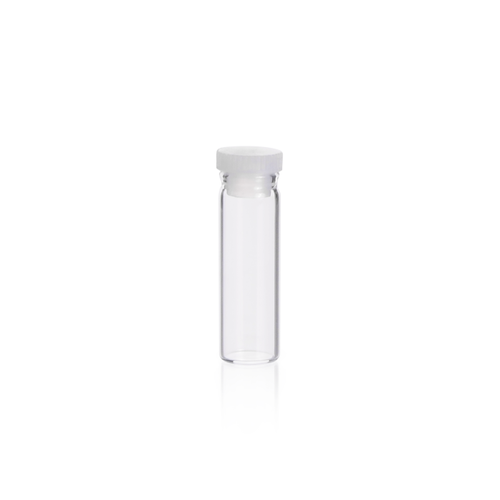
Technical overview: 4 mL clear sample vial with attached closed-top closure
The KIMBLE® 60940A-4 is a clear 4 mL / 1 dram laboratory sample vial made from 3.3-expansion borosilicate glass tubing. It is supplied with a closed-top white urea cap using a PTFE-faced white rubber liner. Vials are packed in corrugated trays with partitions, 144 complete assemblies per manufacturer case.
DWK specifies a 13-425 thread finish, 15 mm outside diameter, and 45 mm height on its current product page. Its glassware catalog describes the 3.3-expansion tubing as low extractable and conforming to USP Type I and ASTM E438 Type I, Class A material requirements.
The manufacturer also states that 60940A-4 complies with EPA 600-series methods. For laboratory use, the exact method requirements, cleanliness, sample and closure compatibility, and any mandated certificate still need confirmation.
Critical selection rule: This is the white urea / PTFE-faced white rubber version. Do not substitute specifications for PTFE-faced LDPE foam, plain rubber, silicone septa, or open-top injection caps. The 4 mL capacity is nominal, not a calibrated measuring tolerance.
Confirmed SKU specifications
- Manufacturer: DWK Life Sciences
- Brand: KIMBLE®
- Manufacturer SKU: 60940A-4
- Product: Clear sample vial, screw-thread, attached cap
- Nominal Volume: 4 mL
- Commercial Dram Size: 1 dram
- Glass: Clear, 3.3-expansion borosilicate
- Glass Classification: USP Type I; ASTM E438 Type I, Class A, per manufacturer catalog
- Outside Diameter: 15 mm on current SKU page
- Height: 45 mm on current SKU page
- Thread / GPI Finish: 13-425
- Cap: Closed-top, white urea, attached
- Cap Liner: PTFE-faced white rubber
- Rubber Backing Chemistry: Not specified in current individual product record
- Manufacturer Method Reference: 60940A-4 complies with EPA 600-series methods
- Case Quantity: 144 capped vials
- Protective Packaging: Corrugated partitioned trays
- Supplier Purchase Unit: CS (case)
- Supplied Sterility: Not stated
- Certified Pre-Cleaning: Not established for supplied units
- Individual Volumetric Calibration: Not specified
- Closure Leak / Pressure Rating: Not specified
The current DWK product page is the primary source for nominal dimensions, closure, and case size. General glass and liner references are supporting technical guidance, not finished-product certificates.
Borosilicate 3.3 glass: material standards and practical limitations
The vial is formed from 3.3-expansion borosilicate glass tubing, a low-thermal-expansion laboratory glass family. DWK's glass specification guide identifies this material as USP Type I and ASTM E438 Type I, Class A. These classifications describe the glass material rather than a finished sample-container cleanliness certificate.
DWK's technical material guide describes high resistance to water, many acids, salts, and organic solvents. It also identifies important glass compatibility exceptions, including hydrofluoric acid, hot concentrated phosphoric acid, and strong alkaline solutions. Chemical suitability also depends on concentration, temperature, and exposure duration.
- Confirmed Glass Type: 3.3-expansion borosilicate; not soda-lime.
- USP Type I: Manufacturer's glass classification; not a sterile-ready product designation.
- ASTM E438 Type I, Class A: Manufacturer catalog designation for this glass family.
- General Material Advantage: Relatively low thermal expansion and broad chemical durability.
- Compatibility Exceptions: Hydrofluoric acid, hot concentrated phosphoric acid, and strong alkalis.
- Complete Assembly: The cap and rubber liner may have narrower chemical and thermal limits than the glass.
Material qualification: General borosilicate glass thermal properties do not establish a validated autoclave cycle, pressure rating, cryogenic qualification, or allowable thermal shock for the complete capped vial.
Review DWK Glass Types & Properties
EPA 600-series methods: manufacturer statement and laboratory qualification
DWK specifically identifies 60940A-4 as complying with EPA 600-series methods. This is a manufacturer product-family statement associated with the 4 mL vial. The current product page does not enumerate every method number, analyte, sample medium, preservation condition, or laboratory reporting requirement.
For regulated environmental testing, suitability is determined by the particular method and how the complete container is prepared and used. Environmental sampling requirements can involve container materials, extraction solvents, cleanliness, sample preservation, headspace, holding time, blanks, and sealing procedures.
- Identify the method: Use the exact EPA method number and edition or governing laboratory SOP.
- Confirm capacity: Verify that a nominal 4 mL vial is acceptable for the planned sample quantity.
- Confirm glass and closure: Review borosilicate glass, PTFE facing, rubber backing, and white urea cap.
- Confirm cleanliness: Determine whether method-specific washing, baking, solvent rinsing, or certified pre-cleaning is required.
- Review sample preservation: Follow method-defined reagents, temperature, light protection, and holding time.
- Qualify container blanks: Apply required laboratory contamination and analyte-recovery controls.
- Verify closure integrity: Evaluate leakage or volatile analyte retention when applicable.
Compliance distinction: Manufacturer-referenced EPA 600-series compatibility is not an EPA-issued product certification, proof of lot-specific analytical cleanliness, or permission to use this vial for every EPA sampling method.
13-425 screw finish and included white urea cap
The neck uses a 13-425 screw-thread finish. The manufacturer supplies an attached, closed-top white urea cap with a PTFE-faced white rubber liner. Because the original closure is supplied, buyers do not need to source a separate initial cap for each vial.
The complete thread specification matters. A cap with a similar diameter but different finish may not engage the thread or compress the liner correctly. Replacement cap compatibility should be verified by the entire 13-425 designation, cap depth, sealing geometry, and liner requirements.
- Thread: 13-425.
- Cap Body: White urea.
- Cap Top: Closed / solid; not an open-top septum access cap.
- Attachment: Cap is supplied screwed onto the vial, not permanently tethered.
- Liner: PTFE-faced white rubber.
- Needle Access: No pre-slit septum or validated piercing function is established.
- Application Torque: No SKU-specific numerical torque published.
- Seal Performance: No universal airtight, hermetic, or leakproof rating published.
Closure selection: A 13-425 screw cap with the wrong liner is not necessarily an acceptable substitute. Confirm both thread finish and exact chemical-contact interface.
PTFE-faced white rubber liner: construction and compatibility
The 60940A-4 liner is explicitly described by DWK as PTFE-faced white rubber. The sample-facing PTFE layer provides a chemical barrier at the closure interface, while the elastomer backing can provide resilience when properly compressed against the vial rim.
PTFE-faced rubber must not be confused with PTFE-faced LDPE foam. DWK sells both material families, but they have different backing construction and different solvent, temperature, and compression behavior. The exact white rubber formulation is not stated on the 60940A-4 page; general descriptions of other rubber formulations should not be assigned to this product without confirmation.
- Facing Material: PTFE (polytetrafluoroethylene).
- Backing: White rubber; exact composition not SKU-verified.
- Facing Function: Primary chemical-contact interface when the cap is applied correctly.
- Backing Function: Resilience and compression against the vial rim.
- Exposure Risks: Edge exposure, contact with cap materials, damaged facing, and vapor contact may affect compatibility.
- Not Established: Specific liner thickness, rubber durometer, compression set, extractables limits, or leak rate.
Liner identity: Use the manufacturer-confirmed PTFE-faced white rubber construction. An LDPE-foam-backed PTFE liner is a different closure material and should not be substituted without qualification.
DWK Closure Liner Guide
Chemical compatibility of the complete vial assembly
The assembled vial contains multiple distinct materials: borosilicate glass, a PTFE-facing layer, white rubber backing, and a white urea cap. Compatibility must account for every material that can contact the contents or sample vapors.
- Glass: Broad chemical durability; evaluate strong alkalis and known glass-corrosive reagents.
- PTFE Facing: Broad resistance but not a guarantee for the full assembled container.
- Rubber Backing: Confirm exact material resistance, particularly for solvents and prolonged exposure.
- Urea Cap: Consider splashing, vapor contact, and cleaning-agent exposure.
- Sample Conditions: Concentration, temperature, contact time, and storage orientation matter.
- Analytical Results: Consider sample adsorption, leachables, and contamination according to method requirements.
A PTFE facing does not establish universal solvent-proof, vapor-tight, or zero-extractable performance. Test the actual vial-and-cap combination when the sample chemistry or required detection limit makes container effects critical.
4 mL nominal capacity, physical fit, and dimensional differences
DWK lists a 4 mL / 1 dram size, 15 mm outside diameter, and 45 mm height on the current product page. These are container specifications and do not define a calibrated graduated measuring device.
DWK's glassware catalog displays a 47 mm height for the same SKU, while the current product page displays 45 mm. Use the current manufacturer value for this listing; confirm an actual sample or drawing when equipment tolerances are tight.
- Nominal Capacity: 4 mL; not certified brimful capacity.
- Dram Size: 1 dram commercial designation; not a separate calibration.
- Current Outside Diameter: 15 mm.
- Current Height: 45 mm.
- Historical Catalog Height: 47 mm; discrepancy remains unresolved.
- Mouth Internal Diameter: Not specified by the reviewed SKU page.
- Fill Line / Tolerance: No calibrated marking or accuracy specified.
- Autosampler / Rack Compatibility: Requires the instrument's approved vial geometry and closure specifications.
Equipment-fit checkpoint: Do not claim universal autosampler compatibility because the vial has a 13-425 finish. Confirm cap height, vial profile, instrument geometry, and needle-access requirements.
Sterility, cleaning, and sample-container preparation
The manufacturer describes clear sample vials supplied with caps attached and packaged in corrugated partitioned trays. This is not evidence that the vials are sterile, pre-cleaned to any particular analytical method, or depyrogenated. EPA-method usage may require additional container preparation or documented blanks.
- Inspect: Reject chips, cracks, scratches, damaged rims, and visibly contaminated glass.
- Inspect closure: Verify the PTFE facing is present, intact, and correctly seated.
- Follow method: Perform any prescribed solvent rinsing, washing, blank testing, or clean-container preparation.
- Assess cleaners: Confirm glass, rubber, and urea cap compatibility with cleaning chemicals.
- Protect contact surfaces: Avoid introducing contamination after cleaning or during cap removal.
- Document preparation: Record batch and preparation information when required for data defensibility.
The current 60940A-4 record does not provide quantitative residual contaminants, extractables, endotoxin, particulate counts, or individual certificates. Request product-specific documentation where these matter.
Temperature, autoclaving, pressure, and light exposure
3.3-expansion borosilicate glass has favorable general thermal properties, but the completed 60940A-4 container includes a urea cap and rubber-backed liner. No product-specific validated autoclave cycle, maximum temperature, pressure rating, or vacuum rating is published for the assembled container.
Avoid heating a tightly closed vial in a way that could develop pressure. Do not apply generic glass thermal limits to the cap and liner. The vial is clear, with no product-specific amber or UV-protective rating; qualify a light-protective container or secondary covering when samples require it.
Do not infer: Sterility from glass composition; autoclavability from a general glass technical guide; leakproofness from a PTFE-faced liner; or light stability from a clear bottle.
KIMBLE 60940A family: verified sizes and thread finishes
The related 60940A sample vials share the general clear-borosilicate / attached-white-urea-cap construction, but their sizes and thread finishes differ. The following capacities and thread finishes are supported by current DWK SKU pages and the manufacturer's glassware catalog.
| SKU | Capacity | Thread | Case |
|---|
| 60940A-2 | 2 mL | 8-425 | 144 |
| 60940A-4 | 4 mL | 13-425 | 144 |
| 60940A-8 | 8 mL | 15-425 | 144 |
| 60940A-12 | 12 mL | 15-425 | 144 |
| 60940A-16 | 16 mL | 18-400 | 144 |
| 60940A-24 | 24 mL | 20-400 | 144 |
Related products are separate catalog items. In addition to size, confirm the exact cap material and liner before substitution. The specific EPA 600-series method statement is attributed by DWK to 60940A-4, not automatically to every other capacity.
Different cap constructions: do not substitute by vial size alone
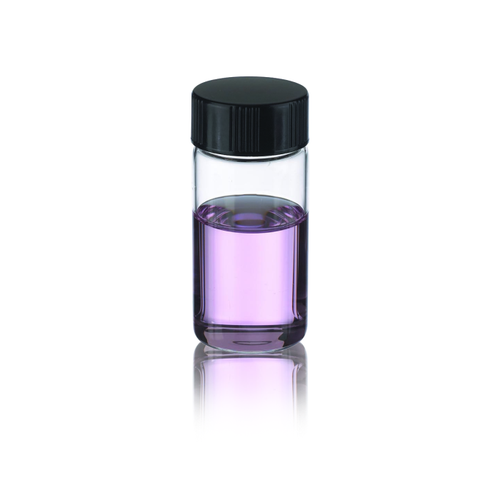
DWK also catalogs related borosilicate sample vials with different cap and liner combinations. For example, some comparable 4 mL vials use black phenolic caps with rubber or PTFE-faced rubber liners. Others use open-top closures and septa for needle access. These are different assemblies even when dimensions or nominal capacity look similar.
- 60940A-4: White urea closed-top, PTFE-faced white rubber liner; this product.
- 60811B-1: Related 4 mL borosilicate vial with attached black phenolic cap and PTFE-faced white rubber liner (separate SKU).
- 60811D-1: Related 4 mL borosilicate vial with black phenolic cap and plain white rubber liner (separate SKU).
- Open-top septum assemblies: Different cap access and liner/septum configuration; do not substitute for a closed-top cap without qualification.
Selection principle: The complete manufacturer SKU determines the required cap/liner assembly. Matching 4 mL and 13-425 alone does not ensure equivalent sample-contact materials or handling properties.
Packaging, receiving, and inspection checklist
DWK specifies corrugated trays with partitions and 144 capped vials per case. Partitioning helps organize and protect the glass, but packaging alone does not establish individual sterile wrapping or validated sample-container cleaning.
- Confirm product 60940A-4 against the purchase order.
- Verify 4 mL / 1 dram nominal size, 15 mm OD, and current 45 mm height.
- Confirm 13-425 thread and attached white urea closed-top caps.
- Verify PTFE-faced white rubber liners; do not accept foam-backed material by assumption.
- Count 144 vial-and-cap assemblies per case.
- Check corrugated partitions and packaging for broken glass or shipping damage.
- Inspect glass bodies, rims, threads, caps, and liner faces for defects.
- Determine method-specific cleaning, traceability, and blank testing before release.
- Accept, quarantine, or reject according to laboratory receiving criteria.
Empty-vial storage, packaging protection, and sample holding conditions
Store unused vials in a protected location, keeping corrugated partitions intact where appropriate. Prevent impacts, scratches, and contamination of the glass rims or closure liners. Check the product and package condition before each use.
Empty-vial supplier handling is classified at room temperature. The storage conditions and holding times of a filled sample must follow its own chemistry, applicable method, and laboratory SOP; they cannot be determined from the shipping classification of empty glassware.
Technical FAQs
What is KIMBLE 60940A-4?
A 4 mL clear borosilicate screw-thread sample vial with a closed-top white urea cap and PTFE-faced white rubber liner, 144 per case.
Are caps included?
Yes. The manufacturer supplies them attached to the vials.
Is the glass USP Type I?
Yes. DWK describes 3.3-expansion borosilicate glass conforming to USP Type I and ASTM E438 Type I, Class A.
What is the vial's thread finish?
13-425. Use the complete thread designation for replacement closure selection.
What is the height?
45 mm on DWK's current product page. A manufacturer catalog lists 47 mm, so verify physical fit where tolerances are tight.
What liner is supplied?
PTFE-faced white rubber, as specified by DWK. It is not PTFE-faced LDPE foam.
Is the liner solid PTFE?
No. PTFE is a facing on a white rubber backing.
Does this vial comply with EPA 600-series methods?
DWK explicitly makes this claim for 60940A-4. Verify the precise method's sample-container requirements and current edition before use.
Are the vials pre-cleaned or sterile?
Neither status is established by the reviewed product listing.
Can the capped vial be autoclaved?
A validated autoclave cycle is not established for the complete urea-cap and PTFE-faced rubber-lined assembly.
Is 4 mL a certified fill volume?
No. It is nominal capacity; no calibrated volumetric tolerance or brimful capacity is provided.
Will the vial fit any autosampler?
No universal autosampler fit is established. The closed-top cap is not a specified pierceable septum assembly.
How many units are in the case?
144 capped vials in corrugated partitioned trays.
Does MTS mean immediate shipment?
No. Made to Stock is a supplier classification. Request current availability from SOSCleanroom.
Why source KIMBLE sample vials through SOSCleanroom?
- Exact SKU identification: Confirm the required 4 mL, 13-425 vial with white urea and PTFE-faced rubber liner.
- Sample container sourcing: Obtain specialty laboratory vials and related consumables through one purchasing contact.
- Method documentation support: Request current manufacturer glass, closure, and EPA-method supporting information as available.
- Packaging clarity: Confirm the manufacturer case of 144 complete assemblies.
- Customer service: Request a formal quotation, current inventory, or alternatives where appropriate.
Manufacturer technical guidance
These are manufacturer educational resources, not competing purchasing pages. General material descriptions do not replace current product-specific certificates or the laboratory's method-specific validation.
Questions about KIMBLE 60940A-4? SOSCleanroom can assist with exact SKU selection, 13-425 cap configuration, manufacturer documentation, case quantities, and sourcing.
Email Sales@SOSsupply.com or call (214) 340-8574 to request current pricing and availability.
Last updated: October 29, 2026
© 2026 Specialty Optical Systems, Inc. (dba SOSCleanroom). All rights reserved.