The Technical Vault
By SOSCleanroom
DWK SKU 844004
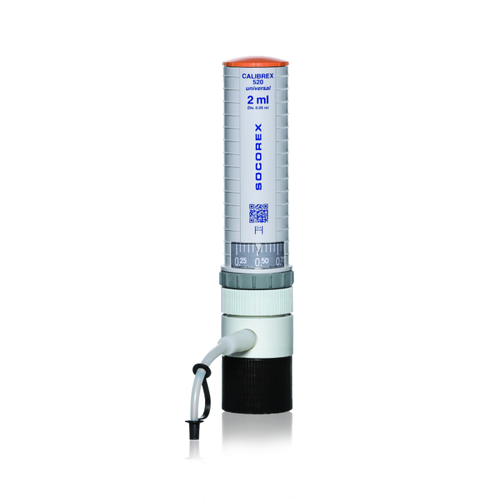
CALIBREX Universal 520
1–10 mL
0.25 mL Steps
32 mm Base
28/40/45 mm Adapters
Autoclave 121°C
1/Case
CALIBREX Universal 520: selecting the correct dispensing range, fluid path, and laboratory method
The SOCOREX® CALIBREX™ Universal 520 is a manually operated, adjustable-volume bottle-top dispenser. DWK catalog number 844004 identifies the 1–10 mL configuration with 0.25 mL graduation intervals.
This instrument is designed for repeated dispensing of measured liquid volumes from compatible laboratory reagent bottles. Its operation combines a mechanically selected volume setting, a plunger-and-barrel measuring system, and inlet and outlet valves that control liquid movement during filling and dispensing.
Correct performance depends on selecting the appropriate bottle connection, confirming reagent compatibility, eliminating air from the fluid path, operating the plunger smoothly, and maintaining volumetric accuracy through routine verification and calibration where necessary.
Operations takeaway: The CALIBREX 520 should be treated as a volumetric measuring instrument, not simply a reagent-transfer accessory. Volume-setting increments, systematic error, repeatability, fluid compatibility, calibration status, and bottle stability all affect whether the instrument is suitable for a controlled laboratory method.
Specifications (SKU controls for RFQs, SOPs, and receiving)
- Instrument brand: SOCOREX®
- Product family: CALIBREX™ Universal 520
- DWK Life Sciences SKU: 844004
- Instrument type: Manual adjustable-volume bottle-top dispenser
- Volume range: 1–10 mL
- Graduation / division: 0.25 mL
- Volume-setting mechanism: Rotating adjustment wheel with numerical display and click-stop positions
- Calibration system: Factory calibrated, with user-accessible adjustment
- Nominal base thread: 32 mm
- Other DWK-listed finishes: GPI 33-400 and 33-430; verify actual fit
- Supplied adapters: 28, 40, and 45 mm polypropylene
- Feed tube: 300 mm PTFE
- Delivery jet assembly: PTFE/ETFE
- Barrel: Borosilicate glass
- Plunger: PFA-coated glass
- Fluid-contact body: ETFE
- Valve bodies: Ceramic
- Valve balls: Pyrex glass
- Valve springs: Platinum-iridium
- Barrel plate: PTFE
- Operating temperature: 15–40°C (60–105°F)
- Autoclave processing: 121°C for 20 minutes, fully assembled, following manufacturer instructions
- Manufacturer warranty: Two years, subject to conditions
- Supplied documentation: QC certificate and Quick Guide, as identified by Socorex
- Package quantity: One dispenser per case
- Reagent bottle: Not included
Important distinction: The 0.25 mL graduation describes the selectable dispense-volume steps. It does not describe volumetric accuracy, repeatability, or the much smaller increments available through the instrument's calibration-adjustment mechanism.
Volumetric performance: inaccuracy and imprecision across the 1–10 mL range
Socorex publishes separate volumetric performance figures for each CALIBREX Universal 520 measuring range. For the manufacturer's 1–10 mL, 0.25 mL-division model, the specified inaccuracy and imprecision vary according to the selected volume.
The table below reproduces the manufacturer's stated performance thresholds for the 1–10 mL model. These are manufacturer performance specifications obtained under defined test conditions, not a guarantee for every reagent or laboratory environment.
| Performance parameter |
Minimum volume |
Mid-range volume |
Maximum volume |
| Inaccuracy (E%) |
< ±1.5% |
< ±1.1% |
< ±0.6% |
| Imprecision (CV%) |
< 0.5% |
< 0.35% |
< 0.1% |
Manufacturer test conditions: Socorex states that these performance values are obtained using bidistilled water at a controlled temperature between 20 and 25°C, with temperature stability of approximately ±0.5°C, in accordance with the referenced ISO 8655 testing approach.
Inaccuracy (E%): Describes systematic deviation between the mean delivered volume and the intended volume, expressed as a percentage.
Imprecision (CV%): Describes the relative variability of repeated measurements, expressed as a coefficient of variation. Lower CV values indicate better repeatability under the stated test conditions.
Quality-system guidance: Do not quote the maximum-volume ±0.6% inaccuracy threshold as the guaranteed accuracy throughout the entire 1–10 mL range. The specified relative error is larger at lower dispensing volumes. Establish acceptance limits using the intended working volume and actual verification results.
How a CALIBREX bottle-top dispenser measures and delivers liquid
The CALIBREX Universal 520 uses a positive-displacement plunger-and-barrel arrangement. During the filling stroke, the plunger rises and liquid is drawn from the reagent bottle through the feed tube and inlet valve into the measuring barrel.
During the dispensing stroke, the plunger moves downward and liquid is delivered through the outlet valve and delivery jet. The selected displacement determines the nominal volume dispensed.
- Volume selection: The operator chooses a volume using the click-stop adjustment wheel.
- Filling: Raising the plunger draws liquid into the borosilicate measuring barrel.
- Valve operation: The internal inlet and outlet valves direct fluid movement through the instrument.
- Dispensing: Depressing the plunger delivers the measured liquid through the dispensing jet.
- Repeat operation: The instrument can be refilled and operated again after completion of the dispensing stroke.
The presence of air bubbles, damaged valves, crystallized residues, or an improperly seated connection can affect volumetric performance. The dispenser should therefore be primed and inspected before measured dispensing begins.
Fluid-contact material construction and chemical-resistance design
Socorex identifies multiple fluid-contact materials for the CALIBREX Universal 520. The instrument is not constructed entirely from one polymer or glass type. Compatibility must be assessed against the materials that can contact the selected reagent.
| Instrument component |
Manufacturer-listed material |
| Feed tube | PTFE |
| Intake valve | Ceramic |
| Valve balls | Pyrex glass |
| Valve springs | Platinum-iridium |
| Measuring barrel | Borosilicate glass |
| Barrel plate | PTFE |
| Plunger | PFA-coated glass |
| Dispenser body | ETFE |
| Delivery jet assembly | PTFE/ETFE |
PTFE, PFA, and ETFE belong to the fluoropolymer family, while ceramic and borosilicate glass provide additional material characteristics relevant to laboratory reagent handling. The manufacturer's chemical-resistance chart considers the dispenser as a system rather than assuming that every component performs identically.
Material compatibility rule: The presence of a PFA-coated plunger or PTFE feed tube does not mean the entire instrument is universally compatible with every chemical. Verify the complete fluid path and refer to the chemical-resistance chart for the CALIBREX 520 model.
Chemical compatibility: interpreting the Socorex resistance chart
Socorex publishes a dedicated chemical-resistance chart for the CALIBREX 520 and related instruments. The chart lists chemical substances and assigns relative resistance classifications to the specific dispenser models.
The manufacturer's rating legend uses ++ for good resistance and + for acceptable resistance. A blank entry should not be interpreted as an affirmative compatibility approval.
Examples from the Socorex CALIBREX 520 chemical-resistance chart:
- Ethanol: ++ (good resistance)
- Isopropanol: ++ (good resistance)
- Methanol: ++ (good resistance)
- Dimethyl sulfoxide (DMSO): ++ (good resistance)
- Hydrogen peroxide: ++ (good resistance)
- Dimethylformamide (DMF): + (acceptable resistance)
These examples summarize published manufacturer chart entries. They are not a universal chemical exposure guarantee and do not replace the full chart or the manufacturer's safety instructions. The actual concentration, reagent formulation, operating conditions, exposure time, and applicable laboratory safety requirements remain important.
Manufacturer warning: Socorex advises against leaving the dispenser permanently mounted on bottles containing concentrated strong acids because their vapors may damage the instrument over time. The instructions also caution about long-term storage with volatile solvents and crystallizing reagents.
Chemical selection checkpoint: Check the exact chemical and concentration against the current Socorex chart before dispensing. Some chemicals have model- or volume-specific limitations. Do not infer compatibility from a similar chemical, a different CALIBREX series, or the resistance of an individual material alone.
View Socorex CALIBREX 520 Chemical Resistance Chart (PDF)
Bottle-neck compatibility, base threads, and supplied adapters
The CALIBREX Universal 520 has a nominal 32 mm base connection. Socorex supplies three polypropylene bottle-neck adapters for 28, 40, and 45 mm connections.
DWK's product listing additionally identifies compatibility with GPI 33-400 and 33-430 thread finishes. These statements should be applied to the specific bottle-neck geometry rather than interpreted as universal compatibility with all similarly sized laboratory bottles.
| Connection |
Manufacturer information |
| 32 mm | Standard dispenser base connection |
| 28 mm | Supplied polypropylene adapter |
| 40 mm | Supplied polypropylene adapter |
| 45 mm | Supplied polypropylene adapter |
| GPI 33-400 | Additional compatibility identified by DWK; confirm bottle fit |
| GPI 33-430 | Additional compatibility identified by DWK; confirm bottle fit |
Socorex offers additional bottle-neck adapters separately. Those optional sizes should not be assumed to be included with manufacturer part number 844004.
Installation and stability: Confirm that the dispenser is securely mounted and the assembled bottle remains stable during operation. Socorex recommends an appropriate support when the selected bottle does not provide sufficient stability. Bottle compatibility is not established by nominal diameter alone.
The Solid Calibration System and 0.25 mL volume-setting increments
The CALIBREX Universal 520 uses the Socorex Solid Calibration System. Its calibrated setting positions allow the operator to select a volume using the adjustment wheel and read the selected value in a numerical display window.
The 0.25 mL graduation of this model establishes the spacing between the adjustable dispense-volume settings. The click-stop mechanism helps prevent the wheel from unintentionally changing position during repeated operation.
- Volume range: 1–10 mL
- Graduation interval: 0.25 mL
- Volume input: Rotating setting wheel
- Display: Numerical viewing window
- Setting retention: Mechanical click-stop arrangement
- Display orientation: The manufacturer's instructions describe four selectable viewing positions, adjusted through the approved maintenance procedure.
When repositioning the display, the operating manual requires the instrument to be purged and free from liquid. Do not remove or reposition components while the dispenser contains an uncontrolled hazardous reagent.
In-laboratory calibration and gravimetric verification
Socorex identifies the CALIBREX Universal 520 as factory calibrated. The instrument also incorporates an adjustment mechanism for in-laboratory recalibration when measurement results fall outside the manufacturer's specifications or when operating conditions require a different calibration.
The operating instructions describe gravimetric calibration using an analytical balance. In this approach, dispensed liquid mass is measured and converted into volume using an appropriate density correction and testing procedure.
- Prepare the instrument: Clean, prime, and inspect the dispenser using an appropriate calibration liquid.
- Control conditions: Record relevant temperature and other calibration conditions.
- Select the test volume: Use the volumes required by the applicable manufacturer guidance and laboratory procedure.
- Dispense and weigh: Collect repeated dispenses and determine the delivered volume using an approved gravimetric method.
- Evaluate error: Compare the results with the applicable inaccuracy and imprecision limits.
- Adjust if needed: Follow the manufacturer's calibration procedure rather than changing the volume-setting mechanism arbitrarily.
- Reverify and document: Confirm performance after adjustment and retain any required calibration records.
The Socorex operating manual identifies an adjustment value of approximately 0.01 mL per calibration click for its 1–10 mL model, designated 520.010. This is distinct from the 0.25 mL selectable volume-setting increment.
Calibration-control note: Factory calibration does not replace periodic verification where required by a laboratory quality system. Socorex also recommends verification or recalibration after replacement of certain measurement-related parts. Use the official operating instructions for the complete adjustment procedure.
Best-practice setup, priming, dispensing, and shutdown
The following sequence summarizes the practical operating controls described by Socorex. The full manufacturer operating manual and site-specific laboratory SOP remain the governing instructions.
- Inspect the equipment: Confirm that the dispenser is clean, complete, undamaged, and appropriate for the reagent.
- Prepare the feed tube: Install the tube, adjusting its length to the selected bottle as directed.
- Attach the delivery jet: Secure the dispensing jet without excessive force.
- Mount the instrument: Use the correct bottle adapter and ensure that the assembled bottle is stable.
- Set the volume: Select the required value using the adjustment wheel and display.
- Prime the system: Remove the delivery-jet stopper and operate the plunger to eliminate air from the fluid path.
- Dispense the reagent: Raise the plunger to fill the barrel and lower it smoothly to deliver the selected volume.
- Maintain control: Keep the delivery jet directed away from people and use suitable receiving containers.
- Finish the work: Purge and rinse the dispenser when required, especially after crystallizing or aggressive reagents.
- Protect the instrument: Replace the delivery-jet stopper and follow the manufacturer's storage and maintenance guidance.
Safe-operation rule: Never force a blocked plunger, direct the delivery jet toward a person, or operate an unstable bottle-and-dispenser assembly. Socorex also specifies precautions against electrostatic discharge when dispensing flammable liquids.
Autoclave processing: 121°C, 20 minutes, fully assembled
Socorex identifies the CALIBREX Universal 520 as designed for repeated autoclave processing at 121°C for 20 minutes while fully assembled. The manufacturer provides specific preparation and handling instructions for this procedure.
- Prepare the dispenser: Thoroughly purge and rinse the instrument before processing.
- Place it correctly: Position the fully assembled instrument horizontally inside the autoclave.
- Avoid metal contact: Follow the manufacturer's instruction to avoid direct contact between the dispenser and metal surfaces.
- Apply the approved cycle: The manual describes 121°C for 20 minutes; follow the validated facility procedure and equipment requirements.
- Cool and dry: Allow the dispenser to dry and return to room temperature before use.
- Inspect connections: Verify that all components are securely connected after processing.
- Verify performance: Check instrument operation and calibration as required by the laboratory's quality program.
The manufacturer states that repeated autoclaving may cause changes in material color. It also notes that correct autoclave processing and the resulting sterility are the responsibility of the user.
Sterility distinction: The ability to autoclave a dispenser does not mean it is supplied sterile. Nor does a published autoclave procedure replace facility validation of the actual load, preparation, sterilization, and release process. Do not process a dispenser containing an incompatible reagent.
Cleaning, disassembly, and preventive maintenance
The CALIBREX Universal 520 is designed for relatively straightforward maintenance. Socorex states that regular cleaning helps prevent crystallized residues, valve problems, and plunger movement issues that can reduce dispensing performance.
The operating instructions identify the plunger, measuring barrel, and valve components as important cleaning and inspection points. The manufacturer describes disassembly and cleaning methods, including suitable detergent solutions and ultrasonic cleaning of valve components when necessary.
- Before disassembly: Purge and rinse the instrument to remove residual reagent.
- Plunger movement: Never force a seized plunger; this can damage the glass measuring barrel.
- Valve inspection: Examine valves and valve balls for deposits that could impair fluid movement or sealing.
- Cleaning solutions: Use compatible laboratory cleaning materials as described by Socorex.
- Damaged components: Replace with appropriate original spare parts.
- Reassembly: Check that all connections are secure and the instrument operates correctly.
- Calibration after service: Verify performance and recalibrate when a replaced component or the quality procedure requires it.
Maintenance warning: Crystallizing solutions can cause plunger seizure when the dispenser is stored without proper rinsing. Concentrated strong-acid vapors can also reduce instrument service life. Follow the manufacturer's chemical guidance and avoid using force to separate stuck components.
Comparing the three DWK-listed CALIBREX Universal 520 configurations
DWK lists three adjustable-volume CALIBREX Universal 520 models. The published differences are their dispensing ranges and graduation intervals.
| DWK SKU |
Dispensing range |
Graduation |
Quantity |
| 844000 |
0.25–2 mL |
0.05 mL |
1 |
| 844002 |
1–5 mL |
0.1 mL |
1 |
| 844004 |
1–10 mL |
0.25 mL |
1 |
Select the instrument according to the volume range and resolution required by the laboratory method. A larger maximum volume is not automatically preferable when the procedure regularly uses smaller volumes that require finer adjustments.
Universal 520 vs. Organo 525 vs. Solutae 530
Socorex offers additional CALIBREX dispenser families with different fluid-path materials, adjustment mechanisms, and reagent-handling characteristics.
| Feature |
Universal 520 |
Organo 525 |
Solutae 530 |
| Volume-setting system |
Setting ring and display window |
Sliding cursor and double scale |
Sliding cursor and double scale |
| Plunger construction |
PFA-coated glass |
Ground glass |
PFA-coated |
| Manufacturer application positioning |
General-purpose reagent handling |
Organic-solvent applications |
Acids, bases, and salt solutions |
These are product-family distinctions, not automatic compatibility approvals. Compare specific model dimensions, chemical-resistance data, volume ranges, and accuracy specifications before selecting a different dispenser.
Cleanroom suitability and controlled laboratory applications
The CALIBREX Universal 520 may be evaluated for use in controlled laboratory environments when the dispensing method, materials, preparation, and cleaning practices meet the facility's requirements.
However, the reviewed manufacturer product specifications do not assign the instrument an ISO 14644 cleanroom classification or establish that it is supplied sterile, cleanroom processed, or suitable for every aseptic dispensing operation.
- Material introduction: Follow the facility's approved transfer and cleaning procedures.
- Fluid-contact suitability: Evaluate material compatibility, extractables, and sample-integrity requirements where relevant.
- Sterile procedures: Validate the preparation, sterilization, assembly, and handling process before aseptic use.
- Environmental controls: Follow applicable local procedures for handling bottles, equipment, and liquid-transfer accessories.
- Documentation: Maintain equipment identification, calibration status, processing records, and approved SOPs where required.
Qualification boundary: Manufacturer-listed autoclavability and chemical resistance do not establish a sterile barrier, endotoxin limit, particulate classification, or validated pharmaceutical dispensing application. These claims require separate product and process evidence.
Safety limitations and when additional qualification is required
- Hazardous reagents: Follow the applicable chemical safety data sheet, laboratory protective-equipment requirements, and operating instructions.
- Concentrated strong acids: Manufacturer instructions caution that vapors can damage the dispenser during prolonged exposure.
- Volatile solvents: Avoid unnecessary long-term exposure and product loss through evaporation.
- Crystallizing liquids: Purge and rinse carefully to prevent seized components.
- Flammable liquids: Use appropriate controls to prevent electrostatic discharge.
- Blocked plungers: Never apply force because the glass measuring barrel can break.
- Unstable bottles: Use an appropriate support and verify the bottle-dispenser connection before operation.
- Volume accuracy: Do not apply maximum-volume performance values to every volume setting.
- Temperature limits: The 15–40°C operating range is distinct from the 121°C autoclave-processing condition.
- Supplied sterility: Do not assume the dispenser is delivered sterile or validated for aseptic filling.
Receiving, installation, and acceptance checklist
A controlled purchasing and equipment-qualification program should verify instrument identity and included components before the dispenser is placed into service.
- Verify catalog number: Match DWK SKU 844004 to the purchase order.
- Verify volume range: Confirm 1–10 mL and 0.25 mL increments.
- Inspect packaging: Check for damage or evidence of mishandling.
- Confirm included adapters: Verify the 28, 40, and 45 mm polypropylene adapters.
- Confirm feed tube and jet: Check that the 300 mm feed tube and dispensing jet are present.
- Review documentation: Retain the included QC certificate, Quick Guide, and any required quality records.
- Inspect the instrument: Look for damaged glass, loose connections, or damaged components.
- Qualify the bottle: Verify compatible neck finish and sufficient stability.
- Check calibration status: Complete the laboratory's incoming volumetric verification when required.
- Release to service: Document any required qualification and equipment-identification information.
Technical FAQs
What is the dispensing range of DWK 844004?
The dispenser is adjustable from 1 to 10 mL in 0.25 mL increments.
Does a 0.25 mL graduation mean the instrument is accurate to 0.25 mL?
No. Graduation describes the volume-setting interval. Inaccuracy and imprecision are separate performance characteristics with manufacturer specifications that vary across the dispensing range.
What accuracy does Socorex publish at 10 mL?
For the 1–10 mL model, Socorex publishes maximum-volume inaccuracy below ±0.6% and imprecision below 0.1% CV under its stated test conditions. Different values apply at lower settings.
Which bottle-neck adapters are included?
Socorex specifies three polypropylene adapters for 28, 40, and 45 mm bottle necks, along with a nominal 32 mm base connection.
Does the dispenser fit a 33-400 or 33-430 bottle?
DWK identifies compatibility with GPI 33-400 and 33-430 finishes. Verify the actual bottle-neck geometry and connection before ordering or installing the dispenser.
Does it include a reagent bottle?
No. The package is identified as one dispenser with a feed tube, delivery jet, supplied adapters, QC certificate, and Quick Guide. Select the appropriate reagent bottle separately.
What is the plunger material?
Socorex identifies the plunger as glass with a PFA coating. The measuring barrel is borosilicate glass.
Can the CALIBREX Universal 520 be calibrated in the laboratory?
Yes. It is factory calibrated and includes a user-adjustable calibration mechanism. Socorex describes gravimetric verification and adjustment in the operating instructions.
What is the operating-temperature range?
The operating instructions specify 15–40°C (60–105°F). This is separate from the higher temperature used during autoclave processing.
Can the dispenser be autoclaved fully assembled?
Yes. The Socorex operating instructions describe processing at 121°C for 20 minutes, fully assembled, after appropriate purging and rinsing, followed by cooling, drying, and inspection.
Is the dispenser supplied sterile?
A supplied-sterile designation is not established in the reviewed product records. Autoclavability alone does not prove supplied sterility.
Is the instrument compatible with every laboratory reagent?
No. The manufacturer publishes a dedicated chemical-resistance chart. Review the exact reagent, concentration, and operating conditions before use.
Can I leave the dispenser mounted on a bottle of concentrated acid?
Socorex warns that concentrated strong-acid vapors can damage the instrument over time and recommends against leaving the dispenser permanently mounted on such bottles. Follow the specific reagent-handling guidance.
What if the plunger becomes difficult to move?
Do not force the plunger. Residues or crystallization may cause binding, and excessive force can damage the glass barrel. Follow the manufacturer's cleaning and troubleshooting instructions.
What is the manufacturer's warranty?
Socorex and DWK identify a two-year manufacturer warranty, subject to the applicable warranty conditions and exclusions.
Manufacturer documentation and technical references
These documents provide technical information directly from the instrument manufacturer. The DWK product record identifies the distributor catalog number, dispensing range, graduation, package quantity, bottle connections, and manufacturer-listed features. For regulated methods, obtain any additional equipment-specific certificates required by the facility's quality program.
Why purchase SOCOREX CALIBREX laboratory dispensers from SOSCleanroom?
- Exact catalog-number sourcing: Confirm DWK 844004 to distinguish the 1–10 mL model from smaller-volume CALIBREX 520 configurations.
- Instrument selection support: Our team can assist with manufacturer specifications, bottle-adapter questions, and ordering requirements.
- Documentation assistance: SOSCleanroom can help customers identify available manufacturer operating instructions, chemical-resistance charts, and equipment documentation.
- Centralized purchasing: Source laboratory equipment and related critical-environment supplies through Specialty Optical Systems, Inc.
- Responsive customer service: Contact our team directly for quotations, availability, and purchasing assistance.
If you have any questions please email us at Sales@SOSsupply.com or give us a call at (214) 340-8574.
For additional product guidance, use the SOSCleanroom AI ChatBot or contact our team for manufacturer documentation assistance.
Technical insight: A reliable dispensing method depends on matching instrument range and resolution to the required volume, verifying chemical compatibility, maintaining the fluid path, and controlling volumetric performance through appropriate calibration and inspection.
Last updated: October 26, 2026
© 2026 SOSCleanroom. All rights reserved.