The Technical Vault
By SOSCleanroom
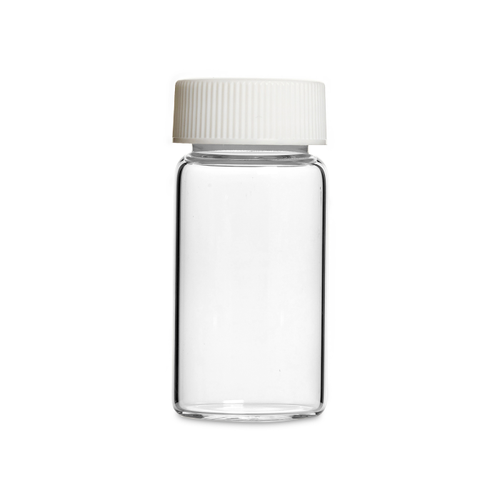
WHEATON 986541
20 mL
Borosilicate Glass
22-400 Thread
White PP Cap
Metal Foil/Pulp
28 x 61 mm Capped
Non-Sterile
Not Autoclavable
500/Case
WHEATON 986541: understanding the glass, cap, and foil/pulp liner
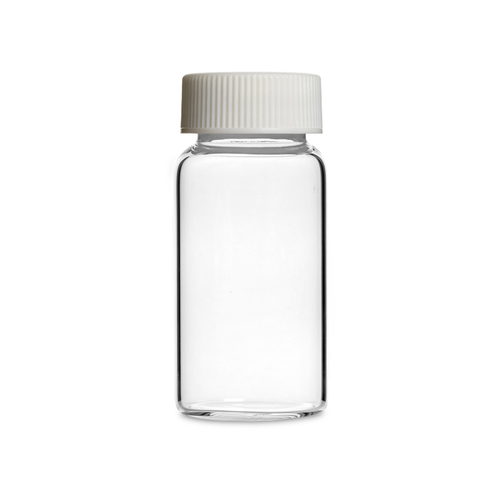
WHEATON® 986541 is a 20 mL clear borosilicate glass liquid scintillation vial with a white polypropylene 22-400 screw cap attached to the vial and a metal foil/pulp liner. DWK specifies a 28 mm outside diameter, 57 mm glass-vial height, and 61 mm height including its cap.
The glass scintillation family is described as providing consistent, low background counts and high UV transmission. The manufacturer's product record explicitly identifies 986541 as non-sterile and not autoclavable, with no marking spot. One case contains 500 vials with specified caps.
Compared with WHEATON 986540, the critical difference is the liner chemistry: 986541 uses metal foil bonded to pulp board, while 986540 uses foamed polyethylene. The two liners have different chemical resistance characteristics, so choosing between them should be based on the actual scintillation cocktail or sample formulation.
Operations takeaway: Control the entire purchased assembly: 20 mL clear borosilicate glass, 22-400 attached white PP cap, metal foil/pulp liner, 28 x 61 mm capped dimensions, non-sterile, not autoclavable, and 500 units per case. A change in liner, thread, or cap-packing arrangement changes the required manufacturer SKU.
Exact-SKU specifications for purchasing, SOPs, and receiving
- Manufacturer / brand: DWK Life Sciences / WHEATON®
- Catalog number: 986541
- Product category: Glass liquid scintillation vial with attached screw cap
- Nominal capacity: 20 mL
- Vial material: Clear borosilicate glass, in Type I tubing product family
- Glass color: Clear
- Outside diameter: 28 mm
- Uncapped height: 57 mm
- Overall height including cap: 61 mm
- Thread / closure size: 22-400
- Cap included: Yes; manufacturer-designated as attached to vial
- Cap material: Polypropylene (PP)
- Cap color: White
- Liner: Metal foil / pulp
- General liner composition: Aluminum foil bonded to pulp board
- Marking spot: No
- Sterile: Non-sterile
- Autoclavable: Not autoclavable
- Manufacturer-described scintillation characteristics: Consistent low background counts and high UV transmission
- Purchase unit: Case
- Case quantity: 500
- Numerical count rate / UV transmission: No SKU-specific figures confirmed
- Calibrated liquid volume: No tolerance specified; nominal capacity only
- Packaging trays or inner count: Not established in current exact-SKU DWK specification
- Instrument compatibility listing: Not established; verify instrument-specific requirements
- Country of origin, carton dimensions, shipping weight: Not verified in reviewed SKU information
Specification boundary: The 61 mm measurement includes the manufacturer's specified cap. The 20 mL rating is not a calibrated fill measurement, and an attached 22-400 closure is not automatically a certified leakproof or pressure-resistant seal.
Metal foil/pulp liner: composition and resistance characteristics
DWK's Closure Liner Guide identifies its Pulp / Metal Foil construction as aluminum foil bonded to pulp board. This liner construction differs from polyethylene foam, foil/cork, polyethylene-cone, PTFE-faced, and linerless closure systems.
The manufacturer lists good barrier properties and good resistance to hydrocarbons, oils, ketones, and alcohols. The same guide expressly states that the foil/pulp liner is not good for acids or alkalis. These statements are general materials guidance, not a controlled application-specific compatibility certificate.
| Liner characteristic |
DWK general material guidance |
| Construction | Aluminum foil bonded to pulp board |
| Barrier properties | Good |
| Hydrocarbons and oils | Good resistance described |
| Ketones and alcohols | Good resistance described |
| Acids and alkalis | Not good; avoid assuming suitability |
| Specific cocktail approval | Not established; testing recommended |
Critical compatibility warning: A foil/pulp liner should not be promoted as universally solvent-proof, PTFE-equivalent, acid-resistant, or alkali-resistant. Check the exact scintillation cocktail and sample formulation, including mixtures, concentration, exposure duration, temperature, and sealing requirements.
Read DWK's Closure Liner Guide
986541 foil/pulp versus 986540 foamed PE liner
Both WHEATON 986541 and 986540 use clear 20 mL borosilicate glass vials with white polypropylene 22-400 caps attached. The defining difference is the liner material and its general chemical resistance.
| Feature |
986541 |
986540 |
| Liner | Metal foil/pulp | Foamed polyethylene |
| General construction | Aluminum foil bonded to pulp board | PE foam core with solid PE layers |
| Hydrocarbon exposure | Good general resistance | Poor resistance noted |
| Acids / alkalis | Not good | General resistance noted; evaluate exact chemical |
| Vial / cap geometry | 28 x 61 mm capped; 22-400 | 28 x 61 mm capped; 22-400 |
| Sterility / autoclave | Non-sterile / not autoclavable | Non-sterile / not autoclavable |
This table summarizes the manufacturer's general liner guidance. It does not rank the performance of finished closures under any specific solvent mixture, and it does not establish an absolute leak rate, seal life, or test result for either assembly.
Liquid scintillation counting: vial selection and method performance
Liquid scintillation counting (LSC) measures appropriate radioactive samples by detecting light generated in a suitable scintillation cocktail. The vial and closure interact with the overall analytical system through sample containment, optical properties, background behavior, and instrument loading geometry.
DWK describes glass scintillation vials as having consistent, low background counts and high UV transmission. These qualitative manufacturer descriptions are relevant to liquid scintillation methods, but actual detection performance depends on the counter, cocktail, radionuclide, sample matrix, quench, and operating settings.
- Background control: Perform the method's blank and instrument background measurements.
- Optical properties: Use the manufacturer's qualitative high-UV-transmission description without inventing a spectral curve or percentage.
- Cocktail compatibility: Qualify all three materials: borosilicate glass, PP cap, and foil/pulp liner.
- Counting efficiency: Establish through instrument calibration, standards, and applicable method QC.
- Loading geometry: Verify the capped vial fits the instrument sample holder and operates correctly.
- Sample identification: The vial has no marking spot; use a suitable labeling process.
Analytical boundary: The vial does not independently establish isotope-specific counting efficiency, detection limit, background in counts per minute, quench correction, or scintillation cocktail compatibility. Those are properties of the complete validated analytical method.
Borosilicate glass and WHEATON low-potassium material heritage
DWK lists the vial material as borosilicate glass and describes the glass scintillation family as converted from Type I borosilicate glass tubing. WHEATON's historical manufacturer guide identifies its glass scintillation line as using WHEATON 180 low-potassium borosilicate, with references to USP Type I and ASTM E438 Type I, Class A requirements.
Low potassium is relevant because natural potassium contains potassium-40, a radionuclide that may contribute to background in sensitive counting systems. DWK does not provide a product-specific numerical potassium limit or a certified background count rate for 986541 in the reviewed public specifications.
Borosilicate glass offers useful resistance to many common laboratory chemicals, but its resistance is not universal. Hydrofluoric acid, certain strongly alkaline solutions, and other aggressive conditions can attack glass. Its compatibility with the foil/pulp liner must be evaluated independently.
Certification distinction: Historical material descriptions are not a current certificate for an individual manufacturing lot. Request relevant current DWK documentation when the laboratory requires traceability, material conformity, or a specific analytical purity specification.
Vial geometry and counter compatibility
The current manufacturer specification distinguishes between 57 mm vial height and 61 mm total height including the cap. The 28 mm diameter and 22-400 thread identify this configuration for procurement and instrument-fit assessment.
| Dimension | Significance |
|---|
| 20 mL nominal volume | Capacity classification; not a calibrated fill or suggested cocktail amount |
| 28 mm diameter | Vial rack, holder, and carousel compatibility |
| 57 mm uncapped height | Glass-vial height reference |
| 61 mm capped height | Instrument clearance with the included cap |
| 22-400 finish | Defines matched cap thread; not a seal-performance rating |
Instrument-fit rule: Verify the complete capped-vial dimensions and closure geometry against the specific counter manufacturer's accepted vial format. Identical nominal capacities do not guarantee interchangeability.
Closure seal, vapor handling, and aluminum foil/pulp limitations
The included white polypropylene screw cap is part of the manufacturer-defined vial assembly. A metal foil/pulp liner provides a sealing surface, but liner material resistance is not equivalent to a certified leakproof seal. Performance depends on the assembled neck finish, liner compression, cap condition, solution, temperature, and handling.
When a sample or scintillation cocktail contains volatile solvents, use the laboratory's prescribed ventilation, secondary containment, spill-response, and waste-management procedures. Do not assume that a foil-backed liner renders the vial vapor-tight, explosion-resistant, pressure-rated, or suitable for transport in an inverted orientation.
- Inspect the glass threads, cap threads, and liner for visible damage or contamination.
- Use the approved method for closing vials; do not invent a cap torque specification.
- Confirm that the sample is compatible with aluminum foil/pulp as well as polypropylene.
- Do not assume the foil/pulp liner has PTFE, cork, or plastic foam properties.
- Apply validated containment controls when hazardous or radioactive samples are present.
Related WHEATON 20 mL scintillation vial configurations
WHEATON's manufacturer guide distinguishes cap materials, liner types, thread finishes, and whether caps are attached or packed separately. Select the exact configuration rather than substituting based only on 20 mL capacity.
| WHEATON SKU | Cap / liner | Thread / packaging |
|---|
| 986541 | White PP / metal foil-pulp | 22-400, attached |
| 986540 | White PP / foamed PE | 22-400, attached |
| 986532 | No cap supplied | 22-400, uncapped |
| 986581 | White PP / metal foil-pulp | 22-400, caps packed separately |
| 986542 | White urea / metal foil-cork | 22-400, attached |
| 986546 | White urea / PE cone | 22-400, attached |
| 986561 | White PP / metal foil-pulp | 24-400, attached |
The manufacturer guide lists the glass configurations above as 20 mL, 500 per case. Only 986541 is the specific attached-cap 22-400 metal foil/pulp configuration addressed on this page.
Substitution control: 986541 and 986581 share cap and liner materials but differ in whether caps are attached to the vials or packaged separately. 986561 is a different 24-400 finish. These distinctions affect purchasing, receiving, and laboratory setup.
Non-sterile and not autoclavable: exact product limitations
DWK explicitly lists WHEATON 986541 as non-sterile and not autoclavable. These SKU-level restrictions apply to the manufacturer-supplied vial-and-cap configuration and should not be overridden by generic descriptions of the thermal resistance of borosilicate glass.
The cap is polypropylene and the liner includes aluminum foil and pulp board. Do not assume those closure materials are suitable for a glassware autoclave or dry-heat cycle. No alternate validated sterilization procedure was found in the reviewed 986541 specification.
- Product sterile status: Non-sterile; not supplied as a sterile item.
- Autoclavability: Manufacturer says not autoclavable.
- Separate glass properties: Type I glass temperature tolerance does not qualify the finished capped unit.
- Cleaning: Use a procedure appropriate to glass, PP, foil/pulp, and any contaminants.
- Sterile-process requirements: Seek a separately qualified alternative with current supporting documentation.
Processing warning: Do not autoclave WHEATON 986541. If a procedure proposes removal and separate processing of bare glass, request written manufacturer guidance and qualify the process before implementation.
Recommended preparation, use, and analytical QC checklist
- Identify the SKU: Verify 986541, 20 mL, attached white PP 22-400 cap with metal foil/pulp liner.
- Check quantity: Confirm the expected case of 500 units.
- Inspect components: Check glass, thread, cap, and liner for defects.
- Verify instrument compatibility: Confirm 28 mm diameter and 61 mm capped height.
- Review sample chemistry: Qualify the sample and cocktail against borosilicate glass, PP, and foil/pulp.
- Set the working fill: Use method-defined sample/cocktail volumes and headspace; do not fill to nominal volume by default.
- Apply approved closure handling: Do not invent a cap torque or assume a tested leakproof seal.
- Identify the sample: Apply approved labels or barcodes; there is no manufacturer marking spot.
- Perform QC: Use method blanks, standards, background checks, and quench controls as required.
- Manage hazardous material: Follow laboratory chemical, radiation, and waste protocols.
- Do not autoclave: The finished manufacturer product is specifically not autoclavable.
- Maintain records: Preserve manufacturer, lot, sample, and instrument traceability as applicable.
Controlled laboratory environments, cleanliness, and sample handling
WHEATON 986541 may be evaluated for controlled analytical laboratories when the product materials, packaging, cleaning procedures, and sample-handling processes meet facility requirements. However, the reviewed exact-SKU data does not identify a product-specific ISO cleanroom class, low-particle certificate, sterile packaging, endotoxin limit, or validated DNase/RNase-free specification.
For sensitive analysis, control the cleanliness of the vial exterior, prevent cross-contamination, verify reagent blanks, and document the receiving and sample-identification procedure. If chemical or radioactive contamination is possible, follow the facility's authorized preparation and disposal methods.
Cleanroom qualification note: Type I glass-family material claims and liquid scintillation suitability do not establish that this non-sterile, non-autoclavable assembly is qualified for aseptic processing or an ISO-classified environment without facility-specific evaluation.
Glassware cleaning, inspection, and reuse boundaries
DWK advises prompt glassware washing, avoidance of abrasive brushes and hard implements, thorough rinsing, and inspection for chips, cracks, or scratches. For 986541, any permitted cleaning or reuse process must also consider the polypropylene cap, pulp-backed foil liner, and the substances previously held by the vial.
- Determine whether the laboratory method permits reuse or requires disposal after use.
- Assess chemical, radiological, and biological contamination before handling.
- Use approved compatible cleaning agents and appropriate protective controls.
- Avoid scratching, chipping, or forceful cleaning of the glass neck and walls.
- Rinse as required to remove residues; use required water purity.
- Inspect the vial and closure for damage or degradation.
- Do not autoclave; verify any proposed alternate processing independently.
- Return to use only if the complete item meets the method's acceptance criteria.
Important unsupported assumptions
- Not sterile: The manufacturer's designation is non-sterile.
- Not autoclavable: No steam-cycle claim should be made.
- Not PTFE-lined: The specified liner is metal foil/pulp, not PTFE or foil/cork.
- Not universal acid/base compatible: DWK specifically warns against acids and alkalis for this liner.
- Not certified leakproof: Good liner barrier properties do not establish a leak rate or vapor-tight seal.
- Not a volumetric device: The 20 mL capacity is nominal.
- Not universally instrument compatible: Verify complete geometry.
- No marking spot: Do not advertise a writable vial patch.
- No quantified low-background guarantee: The manufacturer description is qualitative.
- No SKU-specific UV spectrum: Do not assign a percent transmission or cutoff wavelength.
- No verified lot-specific certification: Request current documentation if required.
- No confirmed inner packaging quantity: Do not assert a five-tray configuration for 986541 without current manufacturer confirmation.
- Not radioactive-material transport packaging: Ordinary vial case packaging is not a certified shipping system.
Technical FAQs
What is WHEATON 986541?
A 20 mL clear borosilicate glass liquid scintillation vial with an attached white PP 22-400 cap and metal foil/pulp liner.
Are caps supplied attached to the vials?
Yes. DWK's exact-SKU product title and WHEATON's manufacturer guide describe caps attached to vials.
What are the dimensions?
28 mm diameter, 57 mm vial height without cap, and 61 mm assembled height including cap.
What is the liner made of?
DWK describes its pulp/metal foil liner material as aluminum foil bonded to pulp board.
Is the liner PTFE-faced?
No PTFE facing is specified. The manufacturer identifies metal foil/pulp, a different construction.
What chemicals does foil/pulp generally resist?
DWK lists good general resistance to hydrocarbons, oils, ketones, and alcohols. Actual product compatibility requires testing.
Is the liner suitable for acids or alkalis?
DWK's general liner guide expressly says foil/pulp is not good for acids or alkalis.
How is 986541 different from 986540?
986541 uses metal foil/pulp; 986540 uses foamed polyethylene. Both are 22-400, attached-cap, 20 mL glass vials.
What is the difference between 986541 and 986581?
986541 has caps attached to vials, while 986581 specifies caps packaged separately. Both use white PP 22-400 caps and foil/pulp liners.
How does 986541 differ from 986561?
986561 has a 24-400 cap thread; 986541 uses 22-400.
Is 986541 sterile?
No. DWK identifies the finished product as non-sterile.
Can 986541 be autoclaved?
No. DWK explicitly lists this SKU as not autoclavable.
Does it have a marking spot?
No. A marking spot is not included.
Are low background and UV transmission quantified?
DWK describes consistent low background and high UV transmission, but no numerical SKU-specific values were found.
How many vials come in one case?
500 vials with their specified caps and liners.
Manufacturer technical references
These manufacturer technical pages provide material-level guidance and do not override the explicit non-sterile and not autoclavable status of WHEATON 986541. No manufacturer product-detail pages, catalogs, or shopping pages are linked.
For quotations and product questions, email Sales@SOSsupply.com or call (214) 340-8574.
SOSCleanroom can help confirm exact-SKU vial and cap configuration, material compatibility references, case quantities, and applicable manufacturer documentation.
Technical insight: Liquid scintillation vial performance depends on glass properties, counting method, sample chemistry, instrument dimensions, and the complete cap-and-liner assembly. Metal foil/pulp and foamed PE liners have different chemical limitations.
Last updated: October 27, 2026
© 2026 Specialty Optical Systems, Inc. (dba SOSCleanroom). All rights reserved.