The Technical Vault
By SOSCleanroom
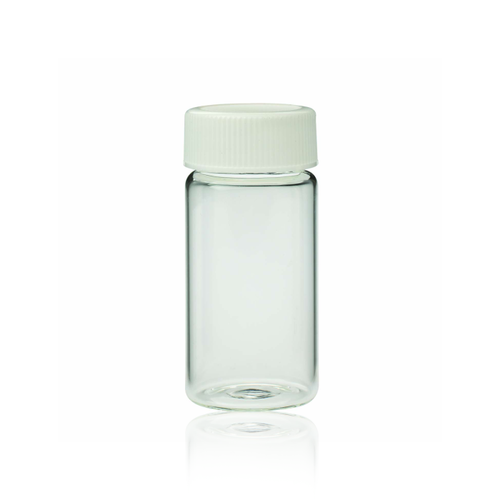
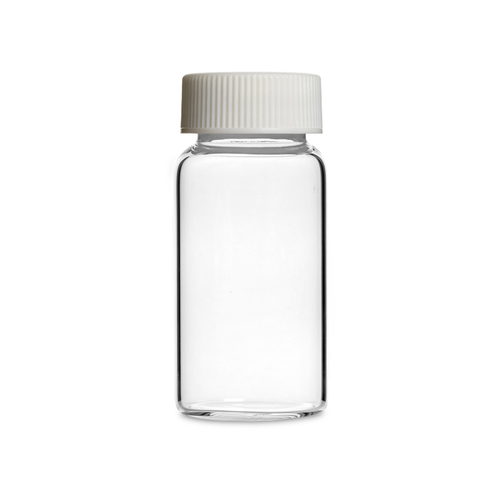
WHEATON 986700
20 mL
White HDPE
22-400
White PP Cap
Foamed PE Liner
27 x 61 mm Capped
Non-Sterile
500/Case
WHEATON 986700: Exact-SKU Technical Overview
WHEATON® 986700 is a 20 mL white HDPE plastic liquid scintillation vial supplied with a white polypropylene (PP) 22-400 screw cap attached to the vial and a foamed polyethylene liner. DWK specifies a 27 mm diameter, 57 mm vial height without cap, and 61 mm overall capped height.
The manufacturer explicitly identifies non-sterile presentation, no marking spot, and a 500-count case. Its exact product page does not include an autoclavability field. In separate general plastic-material guidance, DWK identifies HDPE and LDPE as not autoclavable; do not autoclave this assembled product without qualification.
The product family contains glass, PET, and HDPE variants. Its shared marketing statement about consistent low background counts and high UV transmission should not be represented as a measured optical characteristic of the exact white HDPE 986700 vial. Obtain method-specific optical and counting acceptance data.
Key selection: 986700 is white HDPE, 27 mm diameter, 22-400 white PP cap, foamed PE liner, caps attached, 500/case. Unlike 986540, it is not a clear 28 mm borosilicate glass vial. A white HDPE vial and a clear PET vial are also separate configurations.
Exact-SKU Specifications for Purchasing, Receiving, and SOPs
- Manufacturer: DWK Life Sciences
- Brand: WHEATON®
- Manufacturer SKU: 986700
- Product type: HDPE liquid scintillation vial with attached screw cap
- Nominal capacity: 20 mL
- Vial material: High-density polyethylene (HDPE)
- Vial color: White
- Diameter: 27 mm
- Height without cap: 57 mm
- Height including cap: 61 mm
- Thread finish: 22-400
- Cap included: Yes, attached to vial
- Cap material: Polypropylene (PP)
- Cap color: White
- Liner: Foamed polyethylene (PE foam)
- General liner construction: Three-ply foamed and solid LDPE, per DWK Closure Liner Guide
- Marking spot: No
- Sterility: Non-sterile
- Autoclavability: Not listed on exact-SKU page; general DWK plastics guide lists HDPE and LDPE as non-autoclavable
- Case quantity: 500 vials with attached caps
- Validated optical transmission / background: Not specified for this white HDPE SKU
- Certified leakproof or vapor-tight rating: Not supplied
- Instrument compatibility: Confirm with the intended scintillation counter
- Inner packaging and case weight: Not confirmed in current DWK exact-SKU specifications
- Country of origin: Not verified
Documentation boundary: These exact-SKU measurements and materials come from DWK. The 986700 specification does not certify a leak rate, optical transmission, background counts, instrument fit, or a sterilization procedure.
HDPE Vial Material: White Plastic vs. Glass and PET
High-density polyethylene (HDPE) is a polymer used for laboratory containers. DWK distinguishes it from PET and Type I borosilicate glass in the same liquid scintillation vial family. 986700 has a white HDPE body, not transparent glass or clear PET.
DWK's separate Typical Properties of Plastics reference lists HDPE, LDPE, and polypropylene with different rigidity, permeability, temperature, and processing characteristics. Those values are generic material data; do not convert them into exact 986700 thermal, purity, gas-barrier, optical, radiation-background, or chemical-compatibility specifications.
For use in liquid scintillation counting, laboratory validation should consider container wall/color effects, the instrument's vial settings, sample/cocktail behavior, recovery, and background. A glass-vial method should not automatically be transferred to white HDPE without checking the validated instrument conditions.
| Selection point | WHEATON 986700 | Why it matters |
|---|
| Body polymer/color | White HDPE | Different optical and chemical behavior from clear glass or PET |
| Diameter | 27 mm | Different from 28 mm glass-vial variant |
| Capped height | 61 mm | Verify counter, tray, carousel, and rack clearance |
| Neck finish | 22-400 | Cap and liner must match the vial |
| Optical transmission | No exact-SKU percentage verified | Do not reuse clear-glass UV claims |
| Background count | No exact-SKU result verified | Run method-appropriate blanks and background controls |
| Autoclave suitability | Exact field absent; HDPE/LDPE generally not autoclavable | Do not heat process without manufacturer qualification |
Glass-family claim caution: The shared DWK product-family language references high UV transmission and low background. For white HDPE, neither a measured UV-transmission value nor a guaranteed counting background for SKU 986700 has been established.
Foamed PE Liner: Three-Ply Construction and Practical Limitations
DWK identifies the closure liner as foamed polyethylene (PE foam). Its Closure Liner Guide describes a one-piece, three-ply coextruded liner comprising a foamed low-density polyethylene core sandwiched between solid clear PE layers. The construction provides a compressible sealing interface under the specified white polypropylene screw cap.
The same guide describes good general resistance to several chemicals, including certain acids, alkalis, alcohols, oils, and aqueous products, but specifically says poor resistance to hydrocarbon solvents. This warning is material to any laboratory using hydrocarbon-containing scintillation cocktails.
| Liner property | DWK general guidance |
|---|
| Exact 986700 liner | Foamed polyethylene |
| General polymer | Low-density polyethylene (LDPE) |
| Liner build | Three-ply, foamed core between solid PE layers |
| Sealing interface | Compressible liner within threaded PP cap |
| General resistance | Broad use; evaluate each chemical formulation |
| Hydrocarbon solvents | Poor resistance stated by manufacturer |
| PTFE facing | None specified for this SKU |
| Certified leakage/evaporation | No SKU-specific numerical result established |
These material descriptions do not establish a specific 986700 pressure rating, cap torque, leak rate, vapor barrier, or universal suitability for all scintillation mixtures. DWK recommends application-specific liner testing.
Important distinction: Do not transfer properties of a PTFE-faced foam liner, polyethylene disc, polyethylene cone, or foil-backed liner to this plain foamed PE design. Test the HDPE vial + PP cap + foamed-PE liner as a complete assembly.
Chemical Compatibility: Evaluate the Entire Assembly
A scintillation vial can contact the sample, cocktail, volatile solvent vapors, and cleaning materials. For 986700, the relevant materials are white HDPE (vial), polypropylene (cap), and foamed LDPE (liner). The weakest compatible component and exposure conditions may determine suitability.
| Sample or exposure | Application qualification |
|---|
| Distilled water and aqueous standards | Check sample purity, pH, storage time, and material acceptance |
| Buffers, salts, and acids/bases | Check actual formulation; broad material resistance is not approval for every concentration |
| Hydrocarbon scintillation cocktails | DWK warns foamed PE has poor hydrocarbon-solvent resistance; verify or select qualified alternative |
| Other organic scintillation cocktails | Review every solvent and additive against HDPE, PP, and liner |
| Alcohol-containing solutions | General PE-foam resistance exists; still verify exact contact conditions |
| Volatile or flammable mixtures | Consider vapor contact, evaporation, ventilation, and secondary containment |
| Trace-sensitive or low-count samples | Validate blanks, adsorption or extractables, background, and recovery |
| Cleaning/disinfection chemicals | Confirm process compatibility with all three material components |
DWK's Chemical Resistance of Plastics technical guidance advises choosing polymers based on the exact chemical and warns that mixtures or multi-material products require more careful evaluation. Neither a generic HDPE resistance statement nor the foam-liner guide constitutes an exact approved chemical list for 986700.
Do not assume solvent compatibility: Hydrocarbon solvent exposure is an explicit point of concern for the foamed PE liner. Chemical resistance, vapor containment, and analytical background must be qualified independently.
Autoclavability and Sterility: What the Manufacturer Actually States
The exact 986700 product specification confirms non-sterile but does not display an autoclavability field. It would be inaccurate to state that the SKU page explicitly designates the finished vial "not autoclavable."
DWK's separate Typical Properties of Plastics reference lists HDPE and LDPE as not autoclavable. Since 986700 includes an HDPE vial and a foamed-LDPE liner, the assembled item should not be autoclaved without current, product-specific manufacturer authorization. The generic table lists polypropylene separately, but a cap's material characteristics do not qualify the complete multi-polymer assembly.
| Question | Evidence / recommended practice |
|---|
| Is the received item sterile? | No. Exact 986700 product page: non-sterile. |
| Is SKU-level autoclavability published? | No field in the current reviewed 986700 product page. |
| Is HDPE generally autoclavable? | DWK plastics properties guide: No. |
| Is LDPE generally autoclavable? | DWK plastics properties guide: No. |
| May we sterilize it with a specific cycle? | No approved SKU-specific method established; request written DWK confirmation. |
| May a generic radiation or gas sterilization listing be used as authorization? | No. Material-level table is not a validated processed-product claim. |
Processing warning: Do not autoclave the 986700 assembly. Do not infer a 121°C steam process, sterile-ready packaging, gamma-sterilized supply, or another validated sterilization method from generic plastic data.
Liquid Scintillation Counting with White HDPE
Liquid scintillation counting (LSC) measures selected radioactive samples after energy is transferred to a scintillation cocktail and light is detected by a suitable instrument. The scintillation vial, sample matrix, cocktail, counting geometry, and optical path can affect the measurement.
DWK's family-level description includes "consistent and low" background and "high" ultraviolet transmission, but the family contains different container materials and colors. No SKU-specific UV-transmission spectrum, numerical background rate, radionuclide counting efficiency, or instrument compatibility list was established for the white HDPE 986700 variant.
- Check container acceptance: The counter and method must accept the white 27 mm HDPE format.
- Confirm the cocktail: Chemical compatibility is required for HDPE, PP, and PE foam.
- Measure blanks and standards: Do not assume the same background as clear glass.
- Use quench and efficiency controls: Follow the validated radionuclide and instrument method.
- Verify fill level and headspace: 20 mL is nominal capacity, not a fixed recommended working fill.
- Account for identification: No marking spot is supplied; use approved labels or barcodes.
Measurement boundary: White HDPE is a product material/color identification, not a guarantee of any specific counting efficiency, light collection, UV transmission, or radioactivity background. Confirm instrument suitability through method qualification.
Dimensions, 22-400 Cap Engagement, and Equipment Fit
DWK lists 27 mm diameter and 57 mm height without cap for 986700. The total height with its attached screw cap is 61 mm. Its 22-400 neck finish must be matched with the corresponding cap.
| Specification | Published value | Selection implication |
|---|
| Capacity | 20 mL nominal | Use method-approved working fill |
| Diameter | 27 mm | Check vial rack and counter carrier |
| Uncapped height | 57 mm | Body dimension |
| Capped height | 61 mm | Overall instrument clearance |
| Thread | 22-400 | Not interchangeable with 24-400 caps |
| Vial color | White | Check instrument and measurement method |
| Marking spot | No | Apply separate sample identification |
The 27 mm diameter is 1 mm different from the manufacturer-listed 28 mm diameter of the 20 mL borosilicate glass SKU 986540. This published difference matters for fit checks but does not by itself quantify manufacturing tolerances or guarantee equipment compatibility.
Closure note: A correctly named 22-400 finish is necessary for proper cap selection but not sufficient to establish a certified leakproof or vapor-tight seal.
Related WHEATON Liquid Scintillation Vials: Material and Closure Selection
The WHEATON Vial Guide identifies several related 20 mL configurations. Use the exact part number, body material, cap polymer, liner, and dimensions rather than assuming similar-looking scintillation vials are direct replacements.
| SKU | Vial and color | 22-400 cap / liner | Capped size |
|---|
| 986700 | White HDPE | White PP / foamed PE | 27 x 61 mm |
| 986701 | White HDPE | White PP / metal foil-pulp | 27 x 61 mm |
| 986702 | White HDPE | White urea / metal foil-cork | 27 x 61 mm |
| 986704 | White HDPE | Linerless closure (verify cap-body details) | 27 x 61 mm |
| 986706 | White HDPE | White urea / PE cone | 27 x 61 mm |
| 986730 | Clear PET | White PP / foamed PE | 27 x 61 mm |
| 986540 | Clear borosilicate glass | White PP / foamed PE | 28 x 61 mm |
All variants shown use an attached-cap configuration and are identified at 500 per case in the manufacturer vial guide. Do not assume identical chemical compatibility, optical characteristics, background results, or approved counting-instrument settings across HDPE, PET, and glass.
Substitution priority: 986701 changes the liner to foil/pulp; 986702 changes both cap and liner to urea/foil-cork; 986730 changes the vial to clear PET; and 986540 changes it to clear borosilicate glass with a 28 mm diameter.
Case Packaging, Receiving, and Traceability
DWK lists 500 vials with attached caps per case and identifies the product as non-sterile. A third-party listing describes individual-cell trays of 100, but this subdivision was not confirmed in the reviewed current DWK exact-SKU record and is therefore not included as a manufacturer-certified packing specification.
- Confirm the purchase order names 986700, not the PET or glass variant.
- Verify white HDPE body color and 27 mm diameter.
- Confirm white PP 22-400 attached cap and foamed polyethylene liner.
- Inspect cartons, vial necks, threads, caps, and liners for shipping damage.
- Record applicable manufacturer lot numbers and receiving documentation.
- Request confirmation if a laboratory requires a particular inner-tray or cleanroom packaging arrangement.
- Do not assume the item is sterile or furnished with extra replacement caps.
Sample Preparation, Labeling, and Laboratory QC Checklist
- Identify the correct SKU: WHEATON 986700, 20 mL white HDPE, 22-400 PP/foamed-PE attached cap.
- Inspect the vial: Check body, neck, liner and cap for damage or contamination.
- Verify method material: Confirm the instrument accepts white HDPE.
- Check cocktail chemistry: Screen hydrocarbon solvents and other ingredients against all three materials.
- Check cap fit: Use approved 22-400 closure handling; test for leaks where necessary.
- Fill per method: Use the validated sample-to-cocktail ratio and headspace.
- Apply identification: The vial has no manufacturer marking spot.
- Run counting QC: Include required blanks, calibration standards, quench and background checks.
- Maintain containment: Use appropriate radiation, chemical, ventilation, and waste precautions.
- Do not autoclave: Generic DWK HDPE and LDPE guidance lists these materials as non-autoclavable.
- Retain traceability: Document lot, sample, instrument, and method acceptance records.
Cleaning, Storage, and Reuse Considerations
Reusing a scintillation vial can create background, contamination, cross-sample carryover, and chemical-compatibility issues. The exact 986700 product page does not define a universal cleaning or reuse cycle. Follow the analytical method and safety rules, especially for vials containing radioactive or hazardous samples.
- Determine whether the method permits reuse rather than single-use disposal.
- Evaluate prior cocktail and sample contamination before handling.
- Select cleaning and rinsing agents compatible with HDPE, PP, and PE foam.
- Avoid abrasive tools, mechanical deformation, excessive heat, and unapproved sterilization.
- Inspect polymer body, threads, cap, and liner before any permitted reuse.
- Check analytical blanks and carryover when the method requires it.
- Maintain suitable storage, labeling, secondary containment, and waste handling.
Processing limitation: The manufacturer's plastics data lists HDPE/LDPE as non-autoclavable. No 986700-specific validated cleaning, disinfection, depyrogenation, or sterilization program was established.
Controlled Environments and Unsupported Certifications
The current product page identifies 986700 as non-sterile. No specific ISO 14644 product cleanliness classification, cleanroom-ready double bagging, validated endotoxin limit, DNase/RNase-free status, certified particle shedding limit, or sterile barrier packaging was confirmed.
An HDPE polymer type or liquid scintillation product family does not alone establish suitability for pharmaceutical aseptic processing, USP <797> compounding, or other controlled work. Follow facility qualification and manufacturer documentation procedures.
Regulatory caution: No certification for medical use, food contact, hazardous-material shipment, radiation transport, sterility, or ISO cleanroom presentation is claimed for this exact SKU.
Key Limitations: Claims Not Established for 986700
- Not glass or PET: The 986700 body is white HDPE.
- Not 28 mm: The listed diameter is 27 mm.
- Not 24-400: Its thread finish is 22-400.
- Not a urea cap: Its specified cap is white polypropylene.
- Not a foil or PTFE liner: Its specified liner is foamed polyethylene.
- Not sterile: DWK explicitly lists non-sterile.
- No exact-SKU autoclavability field: General HDPE/LDPE technical guidance states not autoclavable.
- No generic glass-equivalent optics: White HDPE has no verified SKU-specific UV transmission rating.
- No numerical LSC background or counting-efficiency certification: Method validation required.
- No universal solvent compatibility: Foamed PE has poor resistance to hydrocarbons.
- No certified leakproof, vapor-tight or pressure-rated seal: Application testing required.
- No calibrated fill accuracy: 20 mL is nominal capacity.
- No marking spot: Use appropriate sample labeling.
- No verified current manufacturer inner-tray subdivision, weight, or origin: Confirm when required.
Technical FAQs
What is WHEATON 986700? A white 20 mL HDPE liquid scintillation vial with attached white polypropylene 22-400 cap and foamed PE liner.
Is 986700 a glass vial? No. The exact vial material is high-density polyethylene (HDPE), not borosilicate glass or PET.
What color is the vial? White, as specified in the manufacturer record.
What is the vial diameter? 27 mm, rather than 28 mm for the related clear-glass 986540.
What is its height? 57 mm without cap and 61 mm including cap.
Are the caps attached? Yes. Manufacturer title specifies caps attached to the vials.
What is the cap made of? White polypropylene (PP).
What liner is supplied? Foamed polyethylene, distinct from foil/pulp, foil/cork, disc, and cone liners.
Is the liner PTFE-faced? No PTFE facing is specified for this SKU.
Can the foam liner be used with hydrocarbon solvents? DWK warns that foamed PE has poor resistance to hydrocarbon solvents; qualify the actual formulation.
Is WHEATON 986700 sterile? No. DWK explicitly lists non-sterile.
Is 986700 autoclavable? The exact product page omits the autoclavability field. DWK general plastics data lists HDPE and LDPE as non-autoclavable, so do not autoclave without product-specific authorization.
Does 986700 provide high UV transmission? No 986700-specific UV transmission value was verified. The shared family claim must not be transferred from clear glass to white HDPE.
Is background counting performance guaranteed? No exact numerical background or detection-efficiency result was established for this SKU.
Will it fit any scintillation counter? No universal compatibility is established. Verify the 27 x 61 mm capped geometry and white HDPE acceptance.
Is the closure leakproof? No certified exact-SKU leakage or vapor-tight rating was established. Test when required.
Is the capacity a calibrated 20 mL? No calibrated volume tolerance was established; follow method-defined sample and cocktail volumes.
Does it have a marking spot? No. Use approved labeling or barcoding.
How is 986700 different from 986701? Both are white HDPE with PP 22-400 caps, but 986701 uses a metal foil/pulp liner.
How is 986700 different from 986730? 986730 uses clear PET instead of white HDPE while retaining a PP/foam PE 22-400 closure.
How is 986700 different from 986540? 986540 is clear borosilicate glass with a published 28 mm diameter; 986700 is white HDPE and 27 mm.
How many vials come in a case? 500 vials with their attached caps.
Technical insight: WHEATON 986700 combines a white HDPE vial, a PP screw cap, and a foamed PE liner. Counter fit and optical performance, solvent compatibility, liner sealing, and processing suitability are separate qualification questions.
For WHEATON 986700 pricing, availability, or technical documentation, email Sales@SOSsupply.com or call (214) 340-8574.
Page last updated: October 28, 2026
© 2026 Specialty Optical Systems, Inc. (dba SOSCleanroom). All rights reserved.