The Technical Vault By SOSCleanroom
Certified Reference Materials | Carbonate Buffer Chemistry | NIST Traceability | ISO/IEC 17025 & ISO 17034 | Laboratory pH Calibration
RICCA VeriSpec® RV160000-500A: Certified pH 10.00 Buffer Chemistry, Calibration, Measurement Uncertainty & NIST Traceability
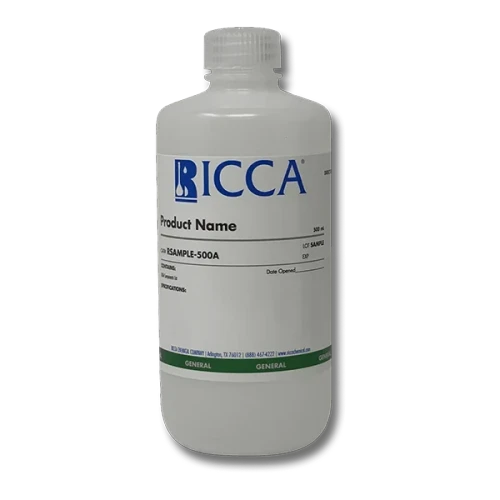
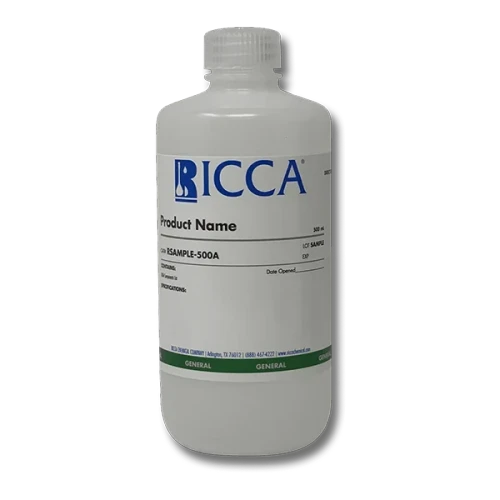
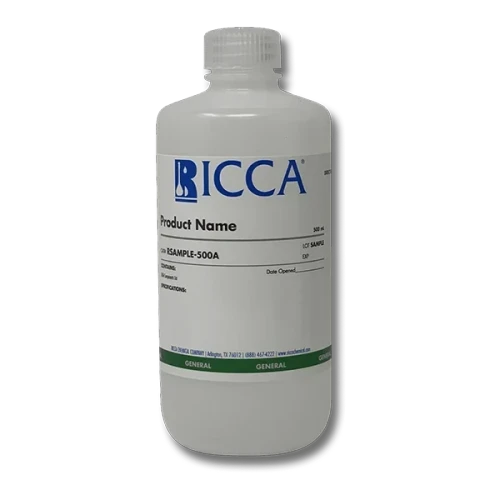
RICCA Chemical Company VeriSpec® RV160000-500A is a colorless, carbonate-based Certified Reference Material (CRM) with a nominal pH of 10.00 at 25°C. Supplied as one 500 mL natural polyethylene bottle, the product supports pH meter calibration, electrode verification, and analytical method validation in laboratories requiring traceable reference values and documented uncertainty.
RICCA's certified-value specification is pH 10.00 ± 0.01 at 25°C. The manufacturer Certificate of Analysis for example lot 16050525 reports a certified value of pH 10.007 with expanded measurement uncertainty of 0.025 pH unit (k=2). The certificate also documents NIST reference materials, accredited testing, storage requirements, and the manufacturer's specific handling instructions.
Technical Takeaway: RV160000-500A is a carbonate/bicarbonate pH 10.00 Certified Reference Material with an 18-month unopened shelf life. Unlike the preceding RICCA pH 4.00 and 7.00 products, this alkaline formulation requires particular attention to air exposure, carbon dioxide contamination, and its manufacturer-documented increase in certified-value uncertainty of 0.0012 pH unit per bottle opening.
1. Understanding pH Measurement and Alkaline Reference Buffers
pH is a logarithmic quantity related to the activity of hydrogen ions in aqueous solutions. Accurate pH measurement is essential in chemical analysis, pharmaceutical quality control, biotechnology, water treatment, environmental testing, and manufacturing process control.
Electrochemical pH meters determine pH through electrode response and instrument calibration. A reliable calibration requires known reference values, appropriate electrode condition, correct temperature settings, and suitable buffer-handling techniques.
A pH 10.00 reference provides an alkaline calibration point for procedures requiring measurements above neutral pH. Depending on the instrument and sample range, it may be combined with pH 7.00 or other appropriate reference solutions.
Measurement Principle: A certified pH reference establishes a traceable calibration input, but it does not independently guarantee the accuracy of a completed instrument calibration or subsequent sample measurement.
2. Verified Product Specifications
- Manufacturer: RICCA Chemical Company
- Product Line: VeriSpec®
- Product Name: Buffer, Certified Reference Material, pH 10.00
- Manufacturer Product Number: RV160000
- Manufacturer Part Number: RV160000-500A
- Reference Classification: Certified Reference Material (CRM)
- Nominal pH: 10.00 at 25°C
- Manufacturer Certification Specification: 10.00 ± 0.01 pH at 25°C
- Certified-Value Range: 9.990-10.010 at 25°C
- Example Lot Certified pH: 10.007 at 25°C (lot 16050525)
- Example Lot Expanded Uncertainty: 0.025 pH unit
- Coverage Factor: k=2
- Certified Reference Temperature: 25°C
- Manufacturer Test Methods: SQCP027 and SQCP033
- NIST Reference Materials: SRM 186-I-g, 186-II-g, and 191d
- Testing Accreditation: ISO/IEC 17025
- Reference Material Producer Accreditation: ISO 17034
- Principal Buffer Chemistry: Sodium carbonate and sodium bicarbonate
- Additional Ingredients: Water, sodium hydroxide, proprietary preservative
- Physical State: Liquid
- Appearance: Colorless
- SDS-Reported Relative Density: 1.0
- Water Solubility: Miscible
- Container: Natural polyethylene bottle
- Package Volume: 500 mL
- Purchase Quantity: One (1) bottle
- Unopened Shelf Life: 18 months
- Recommended Storage: 15-30°C (59-86°F)
- Intended Use: pH meter calibration and analytical method validation
- GHS Classification: Not classified as hazardous
- DOT/IATA Transportation: Not regulated
Lot-Specific Qualification: The pH 10.007 result and 0.025 pH uncertainty above are documented for manufacturer lot 16050525. They must not be assigned to a different manufacturing lot without its own matching certificate.
3. Chemical Composition and Carbonate/Bicarbonate Buffer Chemistry
The RICCA RV160000 Safety Data Sheet identifies the following components of the aqueous formulation:
- Water: CAS 7732-18-5; 99.04% by weight
- Sodium Carbonate: CAS 497-19-8; 0.53% by weight
- Sodium Bicarbonate: CAS 144-55-8; 0.40% by weight
- Sodium Hydroxide: CAS 1310-73-2; less than 0.1% by weight
- Proprietary Preservative: Less than 0.1% by weight
The manufacturer CoA identifies ACS-grade sodium carbonate and sodium bicarbonate, reagent-grade sodium hydroxide prepared from ACS-grade material, and water meeting ACS/ASTM/USP/EP reagent-grade designations.
The principal buffer system involves the chemical equilibrium between bicarbonate ions (HCO3-) and carbonate ions (CO3 2-). These components help establish and maintain an alkaline pH within the buffering capability of the formulation.
Sodium hydroxide is an additional formulation component, while the proprietary preservative is separately identified by RICCA. The exact preservative identity is not disclosed in the reviewed SDS.
Chemical Qualification: SDS composition percentages support chemical identification and safety review. They do not constitute a certified preparation recipe or establish equivalence between a laboratory-prepared carbonate buffer and the characterized VeriSpec® CRM.
4. Certified Reference Material Status and ISO Accreditation
A Certified Reference Material is accompanied by documentation identifying assigned property values, associated measurement uncertainty, and metrological traceability. This documentation provides a technical basis for qualifying the reference material within an approved laboratory measurement program.
RICCA's RV160000 certification identifies production and testing under ISO/IEC 17025 and ISO 17034 accreditation.
- ISO/IEC 17025: International requirements for testing and calibration laboratory competence.
- ISO 17034: International requirements for reference material producer competence.
- Example Lot Testing Location: Arlington, Texas.
- ANAB Laboratory Accreditation: Certificate L2387, as identified for example lot 16050525.
- ANAB Reference Material Producer Accreditation: Certificate AR-3140, as identified for example lot 16050525.
- Independent Verification: A second qualified chemist confirms the certified pH value.
- Homogeneity Controls: Manufacturer procedures support consistent reference material composition.
- Batch Traceability: Production records document raw-material sourcing, preparation, and testing.
RICCA's example lot certificate also refers to ISO 33401 for reference-material certificate and accompanying documentation content.
Accreditation Note: Accreditation supports the manufacturer's certified reference material production process. The user must still evaluate the actual assigned pH, uncertainty, temperature, and suitability of the CRM for the specific calibration procedure.
5. Certified pH, Acceptance Range and Measurement Uncertainty
RICCA identifies a nominal certified pH of 10.00 ± 0.01 at 25°C. This establishes the manufacturer's specified range of pH 9.990-10.010 at the certification temperature.
The genuine Certificate of Analysis for lot 16050525, manufactured May 8, 2026, reports the following values:
- Manufacturing Lot: 16050525
- Manufacture Date: May 8, 2026
- Manufacturer Expiration: October 2027
- Assigned Certified pH: 10.007 at 25°C
- Expanded Measurement Uncertainty: 0.025 pH unit
- Coverage Factor: k=2
- Manufacturer Test Methods: SQCP027 and SQCP033
- NIST References: SRM 186-I-g, 186-II-g, and 191d
Certified-Value Specification vs. Uncertainty: The manufacturer's ±0.01 pH specification identifies its acceptable certified-value range. The expanded measurement uncertainty describes uncertainty associated with characterizing the pH value. These figures are not interchangeable.
RICCA calculates expanded uncertainty using a coverage factor of two, based on its combined uncertainty evaluation. Under the manufacturer's stated normal-distribution model, this corresponds to approximately 95% coverage.
Calibration Qualification: A laboratory should evaluate the certified pH value and associated uncertainty within the overall instrument calibration and measurement uncertainty budget. The manufacturer's pH specification alone is not a guarantee of total instrument measurement accuracy.
6. NIST Traceability and Manufacturer Measurement Methods
RICCA identifies National Institute of Standards and Technology Standard Reference Materials 186-I-g, 186-II-g, and 191d in the RV160000 certification documentation.
These reference materials support a documented chain of comparisons establishing traceability of the assigned pH value. The manufacturer identifies methods SQCP027 and SQCP033 for pH characterization and certification.
The example certificate describes laboratory controls covering volumetric glassware, analytical balances, thermometers, temperature probes, and reference material testing. Its uncertainty evaluation follows the Guide to the Expression of Uncertainty in Measurement (GUM).
- Confirm that the certificate matches the actual bottle lot.
- Identify the assigned pH and certified reference temperature.
- Review the stated expanded uncertainty and coverage factor.
- Verify the manufacturer-listed NIST reference materials.
- Check the stated analytical test methods.
- Evaluate reference suitability for the instrument and calibration range.
- Retain supporting certification records when required.
Traceability Distinction: NIST traceability does not mean NIST separately tested or certified each commercial RICCA bottle. It refers to the documented measurement chain used in assigning the reference-material property value.
7. Temperature Effects and Manufacturer pH Reference Table
The pH of carbonate buffers changes with temperature because chemical equilibria and pH measurement response depend on thermal conditions.
RICCA certifies the RV160000 pH value at 25°C only. Other temperature-dependent values are calculated reference values rather than independently measured and certified results for each production lot.
The manufacturer's published nominal temperature reference table is:
- 0°C: pH 10.31
- 5°C: pH 10.23
- 10°C: pH 10.17
- 15°C: pH 10.11
- 20°C: pH 10.05
- 25°C: pH 10.00
- 30°C: pH 9.95
- 35°C: pH 9.91
- 40°C: pH 9.87
- 50°C: pH 9.81
RICCA states that these values at temperatures other than 25°C are accurate to ±0.05 pH unit at their respective temperatures. The values are calculated and are not separately measured for each manufacturing lot.
Automatic temperature compensation on a pH meter does not eliminate the need to select the appropriate buffer value at the measurement temperature. Temperature compensation and actual buffer pH variation are related but distinct considerations.
Calibration Warning: Use the actual certified lot pH at 25°C when the laboratory procedure requires a certified measurement condition. Treat manufacturer-calculated values at other temperatures according to their separately stated accuracy limitations.
8. Correct pH Meter Calibration Procedure
The following procedure incorporates RICCA's manufacturer handling instructions. The instrument manufacturer's calibration instructions and the laboratory's approved standard operating procedure govern the final process.
- Confirm product identity: Verify RV160000-500A, 500 mL bottle configuration, and actual manufacturing lot.
- Review certification: Confirm certified pH, expanded uncertainty, expiration date, and reference temperature.
- Inspect the CRM: Check the bottle, closure, appearance, and any receiving deviations.
- Mix thoroughly: Invert the original bottle before use to maintain the manufacturer's intended homogeneity.
- Prepare equipment: Inspect the pH electrode and instrument according to maintenance instructions.
- Dispense a rinse portion: Use one fresh aliquot to rinse the electrode.
- Dispense a calibration portion: Use a separate fresh aliquot for instrument calibration.
- Control temperature: Apply the certified 25°C value or a qualified temperature-specific reference procedure.
- Perform calibration: Follow the instrument's calibration sequence and required acceptance criteria.
- Evaluate results: Review electrode slope, offset, stabilization, and other instrument parameters as applicable.
- Document the process: Record reference-material lot, assigned pH, temperature, instrument, and calibration outcome.
- Discard used portions: Do not return used or dispensed buffer to the original bottle.
- Close and store: Keep the original container tightly closed at the recommended storage temperature.
Calibration Design: A single alkaline reference does not replace a complete calibration procedure. Select additional buffers according to the intended pH range, measurement uncertainty requirements, and instrument manufacturer instructions.
9. Carbon Dioxide Exposure and Alkaline Buffer Stability
Alkaline carbonate buffers are sensitive to the exchange of carbon dioxide with surrounding air. Dissolved atmospheric CO2 participates in the carbonate/bicarbonate equilibrium and can alter the pH of an exposed solution.
The extent of any effect depends on air exposure, solution composition, temperature, surface area, and handling conditions. The manufacturer does not assign a universal rate of pH change for an open bottle under ordinary laboratory conditions.
For calibration applications requiring a certified pH value, unnecessary air exposure should be avoided and fresh aliquots should be used.
- Minimize opening time: Close the original bottle promptly after dispensing.
- Use fresh aliquots: Avoid prolonged storage of dispensed calibration portions.
- Prevent cross-contamination: Never insert contaminated electrodes or pipettes into the stock bottle.
- Avoid chemical fumes: Keep the bottle away from nearby acids, bases, and other contaminating vapors.
- Control handling: Follow manufacturer instructions and applicable laboratory procedures.
- Protect certification integrity: Assess any suspect reference-material deterioration before calibration use.
Technical Distinction: The sensitivity of carbonate buffers to atmospheric CO2 is a general chemical consideration. It does not establish an independently measured contamination rate or a particular product-specific expiration interval after opening.
10. Bottle Opening and Manufacturer-Documented Measurement Uncertainty
RICCA's certificate for RV160000 identifies a specific handling-related measurement uncertainty consideration.
Manufacturer Statement: Each opening of the RV160000 bottle increases the uncertainty of the certified value by 0.0012 pH unit.
This statement concerns the uncertainty associated with the certified pH value. It does not mean the measured pH necessarily changes by 0.0012 every time the cap is removed.
The manufacturer does not establish a universal number of permitted openings or an automatic post-opening expiration date from this statement alone.
- Minimize unnecessary bottle opening.
- Dispense only the quantity needed for immediate use.
- Maintain closure and handling integrity.
- Apply laboratory procedures for documenting reference-material use.
- Evaluate the manufacturer's uncertainty statement when assessing reference suitability.
- Do not substitute the uncertainty statements associated with other RICCA buffer formulations.
Metrology Note: Consult the certificate applicable to the received lot and the laboratory's approved uncertainty-evaluation procedure before calculating or applying a revised expanded uncertainty after multiple openings.
11. Storage, Shelf Life and Stability
RICCA specifies 15-30°C (59-86°F) as the recommended storage temperature and an 18-month unopened shelf life for RV160000-500A.
The manufacturer recommends keeping the bottle tightly closed and away from acid or base fumes. The SDS directs users to protect the solution from freezing and physical damage.
- Recommended Storage Temperature: 15-30°C
- Original Container: 500 mL natural polyethylene bottle
- Closure: Keep tightly closed when not dispensing
- Freezing: Protect from freezing
- Physical Protection: Avoid leakage, impact damage, and bottle puncture
- Chemical Incompatibilities: Avoid acids, as identified by the SDS
- Contamination Prevention: Keep the bottle away from contaminating laboratory fumes
- Expiration: Follow the assigned expiration date for the actual received lot
- In-Use Control: Apply the laboratory's approved procedures after opening
For example, RICCA lot 16050525 was manufactured May 8, 2026 and has an expiration designation of October 2027. These dates belong specifically to that production lot.
Shelf-Life Limitation: The 18-month shelf life applies to unopened containers. It does not authorize 18 months of unrestricted use after opening or override uncertainty and contamination controls required for certified references.
12. Chemical Safety and Transportation Classification
RICCA's RV160000 Safety Data Sheet identifies this finished buffer as not classified as hazardous under the referenced GHS criteria.
- GHS Classification: Not classified as hazardous
- GHS Signal Word: None required
- GHS Hazard Pictograms: None required
- DOT Ground Transportation: Not regulated
- IATA Air Transportation: Not regulated
- Canadian TDG Transportation: Not regulated
- Eye Protection: Safety glasses or goggles
- Hand Protection: Chemical-resistant gloves
- Ventilation: Normal room ventilation identified as adequate
- Physical State: Colorless liquid
- SDS-Reported pH: Approximately 10
- Relative Density: Approximately 1.0
- Flammability: Not considered a fire or explosion hazard
- Possible Contact Effects: Slight skin or eye irritation
The absence of a GHS hazard classification does not eliminate standard chemical laboratory precautions. The solution contains alkaline buffering components and should be handled under the facility's approved chemical hygiene procedures.
Safety Notice: Review the current SDS for complete first-aid, handling, chemical incompatibility, spill-response, and disposal information. The reviewed Canadian English SDS is dated May 4, 2026.
13. Laboratory Quality Documentation and Audit Readiness
Certified pH reference materials should be incorporated into laboratory measurement programs through documented qualification, traceability, and use controls.
- Lot-Specific Certificate of Analysis: Documents the assigned pH value, uncertainty, temperature, and reference materials.
- Manufacturer Identification: Confirms RV160000-500A and its 500 mL package configuration.
- NIST Traceability: Identifies the supporting measurement references and traceability chain.
- Accreditation Records: Support assessment of reference material producer and testing competence.
- Measurement Uncertainty: Provides information necessary to evaluate suitability for the intended pH measurement.
- Expiration Control: Confirms the actual lot-specific manufacturer expiration.
- Temperature Control: Defines the conditions supporting the certified pH value.
- Opening Records: Address the manufacturer's documented uncertainty increase associated with bottle opening.
- Instrument Calibration Records: Connect the reference material to specific calibration events.
- Safety Data Sheet: Provides composition and handling requirements.
- Laboratory Change Control: Supports documented evaluation of buffer substitutions or changed calibration procedures.
The RICCA certificate for lot 16050525 provides an actual certified pH value and expiration date. It is valid evidence for that production lot but does not establish the certification of other supplied bottles.
Audit Point: Match the manufacturing lot printed on the received bottle to the applicable certificate before using its certified value, uncertainty, and expiration information in laboratory records.
14. VeriSpec® Buffer Selection and Related Products
RICCA RV160000-500A: Colorless VeriSpec® pH 10.00 Certified Reference Material, 500 mL natural polyethylene bottle. Carbonate/bicarbonate formulation with an 18-month unopened shelf life.
RICCA RV160000-1A: The 1-liter natural polyethylene configuration of the same RV160000 colorless pH 10.00 CRM product family.
RICCA RV160100-500A: Separately identified VeriSpec® pH 10.00 blue color-coded CRM in a 500 mL bottle. Confirm product-specific documentation before substitution.
RICCA RV155000-500A: Colorless VeriSpec® pH 7.00 CRM using a phosphate buffer system, commonly selected for neutral calibration reference requirements.
RICCA RV150000-500A: Colorless VeriSpec® pH 4.00 CRM using potassium hydrogen phthalate, intended for acidic pH calibration reference requirements.
Other Alkaline Buffers: pH 9.00, pH 10.00, and higher-pH references may differ in chemistry, certified value, temperature dependence, uncertainty, and shelf life.
Selection Principle: Choose reference buffers according to the instrument calibration method, anticipated sample pH, certified reference value, reported uncertainty, temperature, and laboratory quality requirements. Similar nominal pH values do not establish complete material equivalence.
15. Frequently Asked Technical Questions
What is the pH specification of RV160000-500A?
RICCA specifies pH 10.00 ± 0.01 at 25°C, corresponding to a certified-value range of 9.990-10.010.
Is this a Certified Reference Material?
Yes. RICCA identifies RV160000 as a VeriSpec® CRM manufactured and tested under ISO/IEC 17025 and ISO 17034 accreditation.
What was the certified pH for example lot 16050525?
RICCA reports an assigned value of pH 10.007 at 25°C. This result applies specifically to lot 16050525.
What is the expanded measurement uncertainty?
The example certificate reports 0.025 pH unit with coverage factor k=2. Review the actual supplied lot certificate for the applicable value.
Why is uncertainty different from the ±0.01 pH specification?
The product specification describes the manufacturer's allowable certified-value range. Expanded uncertainty describes uncertainty associated with the measurement used to assign the value. They must be evaluated separately.
What NIST reference materials support the certification?
RICCA identifies NIST SRM 186-I-g, 186-II-g, and 191d.
What chemicals make up this pH 10.00 buffer?
The main buffer components are sodium carbonate and sodium bicarbonate. The SDS also identifies water, a small amount of sodium hydroxide, and a proprietary preservative.
Is this the blue color-coded pH 10.00 buffer?
No. RV160000 is the colorless formulation. RICCA identifies RV160100 separately as a blue color-coded pH 10.00 VeriSpec® buffer.
Why can atmospheric carbon dioxide affect the buffer?
Dissolved carbon dioxide participates in carbonate/bicarbonate equilibria and can alter pH. Minimize air exposure and use fresh calibration aliquots.
Is the certified pH 10.00 valid at all temperatures?
No. RICCA certifies the pH at 25°C only. Values at other temperatures are calculated and are stated to be accurate to ±0.05 pH unit.
What is the nominal pH at 20°C?
The manufacturer's calculated temperature table lists pH 10.05 at 20°C.
What is the nominal pH at 30°C?
The manufacturer's calculated temperature table lists pH 9.95 at 30°C.
Does opening the bottle affect the certified value?
RICCA states that each bottle opening increases the uncertainty of the certified value by 0.0012 pH unit. This is an uncertainty statement, not a guaranteed pH shift.
Should the bottle be mixed before use?
Yes. RICCA instructs users to mix thoroughly by inversion before each use.
Can this buffer be diluted?
No. The manufacturer instructs users not to dilute the certified reference material.
Can unused buffer be returned to the original bottle?
No. Returning dispensed buffer can introduce contamination and compromise the reference material.
What is the unopened shelf life?
RICCA specifies 18 months for RV160000-500A. Verify the assigned expiration date for the actual manufacturing lot.
How should the CRM be stored?
Recommended storage is 15-30°C. Keep the bottle tightly closed, protect from freezing and physical damage, and avoid acid or base fumes.
Can the buffer be used in a multipoint pH calibration?
Yes, where a pH 10.00 reference is appropriate for the instrument and method. Additional reference values may be needed to complete the calibration.
Is the product hazardous for transportation?
The reviewed SDS lists the solution as not regulated under DOT, IATA, and Canadian TDG dangerous-goods requirements.
Is this product sterile or ISO cleanroom-certified?
The manufacturer documentation reviewed does not establish sterility or qualification for a specific ISO cleanroom classification. Any controlled-environment use requires facility evaluation.
Can the example lot certificate be used for every RV160000 bottle?
No. Certified pH, uncertainty, and expiration data must be verified against the certificate matching the actual manufacturing lot received.
16. Manufacturer Documentation and Technical References
RICCA VeriSpec® RV160000 Certificate of Analysis - Example Lot 16050525:
View Manufacturer Lot-Specific Certificate (PDF)
RICCA RV160000 Safety Data Sheet:
View Manufacturer Safety Data Sheet (PDF)
RICCA RV160000 Product Quality Compliance Summary:
View Manufacturer Quality Compliance Summary (PDF)
SOSCleanroom Product Listing:
RICCA RV160000-500A VeriSpec® pH 10.00 Buffer, 500 mL
Relevant Standards and References: ISO/IEC 17025, ISO 17034, ISO 33401, NIST SRM 186-I-g, NIST SRM 186-II-g, NIST SRM 191d, and RICCA methods SQCP027 and SQCP033, as identified by the manufacturer.
Documentation Note: Example manufacturing lot 16050525 was produced May 8, 2026 and carries an October 2027 expiration designation. Its certificate reports an assigned pH of 10.007 at 25°C and expanded uncertainty of 0.025 pH unit. These records support the example lot and must not be represented as the current certificate for an unidentified future shipment.
Why Source RICCA VeriSpec® Reference Materials Through SOSCleanroom?
- Accurate Reference Selection: Source the correct colorless pH 10.00 CRM using its complete manufacturer part number.
- Calibration Material Selection: Identify pH 4.00, 7.00, 10.00, and other reference values for compatible laboratory instruments.
- Manufacturer Documentation: Request applicable lot-specific certificates, product specifications, and Safety Data Sheets.
- Controlled Procurement: Maintain consistent manufacturer product identification for approved repeat purchasing.
- Laboratory Quality Support: Source certified buffers alongside analytical reagents and other laboratory consumables.
- Technical Product Identification: Distinguish colorless and color-coded buffers, certification levels, and package configurations.
For certified pH reference materials and manufacturer documentation assistance, contact Sales@SOSsupply.com or call 800-443-7101.
The Technical Vault By SOSCleanroom | Information reviewed October 13, 2026
© 2026 Specialty Optical Systems, Inc. (dba SOSCleanroom). All rights reserved.