The Technical Vault By SOSCleanroom
Certified Reference Materials | KCl Conductivity Standards | ISO 17025 / ISO 17034 | NIST Traceability | Laboratory Metrology
RICCA VeriSpec® RV588510-500A: Certified 10 µS/cm Conductivity Standard, Calibration, Uncertainty & NIST Traceability
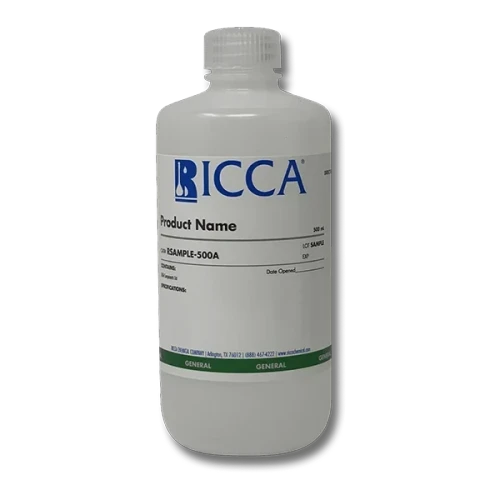
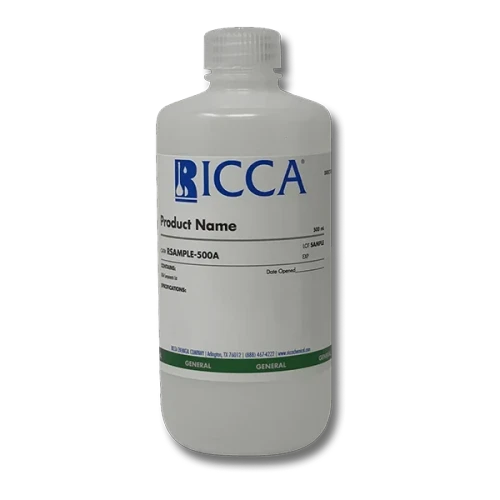
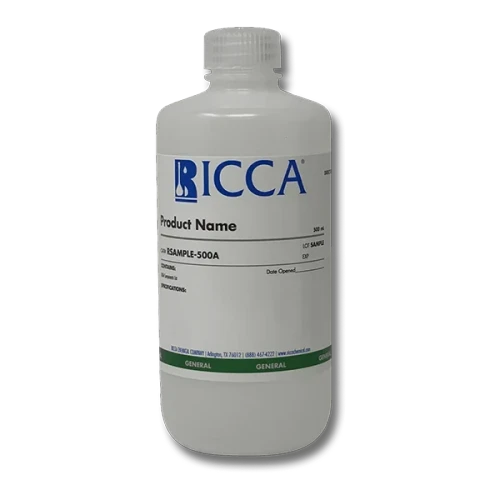
RICCA Chemical Company VeriSpec® RV588510-500A is a potassium chloride Certified Reference Material (CRM) designed for conductivity meter calibration, analytical method validation, and measurement quality assurance. The solution has a nominal conductivity of 10 µS/cm at 25°C and is supplied in a 500 mL natural polyethylene bottle.
RICCA's Product Specification identifies a certified-value range of 9.97-10.03 µS/cm, expanded measurement uncertainty of 0.26 µS/cm (k=2), NIST SRM 999 traceability, and manufacture and testing under ISO/IEC 17025 and ISO 17034 accreditation. This Technical Vault explains how these characteristics relate to calibration, low-conductivity measurement, standard handling, reference material qualification, and laboratory documentation.
Technical Takeaway: VeriSpec® RV588510-500A is a certified reference material, not merely an uncharacterized conductivity solution. Its traceable conductivity value, published measurement uncertainty, accredited production, and prescribed 25°C calibration conditions are essential to proper use. The actual lot certificate must be reviewed before incorporating the standard into a controlled measurement process.
1. Electrical Conductivity and the Role of a Reference Standard
Electrical conductivity describes the ability of a material to conduct electric current. In aqueous solutions, conductivity arises primarily from dissolved ions capable of transporting electrical charge.
Potassium chloride (KCl) dissociates into potassium ions (K+) and chloride ions (Cl-) in water. These dissolved ions contribute to the conductivity measured by a suitable conductivity instrument.
Conductivity is conventionally expressed in siemens per centimeter (S/cm), millisiemens per centimeter (mS/cm), or microsiemens per centimeter (µS/cm). At low ionic concentrations, microsiemens per centimeter provides a useful measurement scale.
Measurement Principle: The conductivity of an aqueous solution depends on its ionic composition, concentration, and temperature. A certified conductivity reference provides a documented value against which compatible instruments and procedures can be assessed.
2. Verified Product Specifications
- Manufacturer: RICCA Chemical Company
- Product Line: VeriSpec®
- Reference Material: Potassium Chloride Conductivity Standard
- Product Number: RV588510
- Manufacturer Part Number: RV588510-500A
- Classification: Certified Reference Material (CRM)
- Nominal Conductivity: 10 µS/cm at 25°C
- Manufacturer Certified-Value Range: 9.97-10.03 µS/cm
- Expanded Measurement Uncertainty: 0.26 µS/cm
- Coverage Factor: k=2
- Reference Temperature: 25°C
- NIST Reference Material: SRM 999
- Manufacturer Test Methods: SQCP031 and SQCP033
- Testing Accreditation: ISO/IEC 17025
- Reference Material Producer Accreditation: ISO 17034
- Physical State: Liquid
- Appearance: Colorless
- Solution Components: Water and potassium chloride
- Container: Natural polyethylene bottle
- Volume: 500 mL
- Purchase Quantity: One (1) 500 mL bottle
- Unopened Shelf Life: 12 months
- Recommended Storage: 15-30°C (59-86°F)
- GHS Classification: Not classified as hazardous
- DOT/IATA Transportation: Not regulated
Certification Control: The publicly available specification lists a SAMPLE manufacturing lot. Its reported range and uncertainty describe the product specification; actual lot-specific certification information must be obtained from the documentation associated with the purchased bottle.
3. Chemical Composition and CAS Identification
The RICCA RV588510 Safety Data Sheet identifies the following components:
- Water: CAS 7732-18-5; reported as 100.00% by weight after rounding.
- Potassium Chloride: CAS 7447-40-7; less than 0.1% by weight.
RICCA identifies the water as ACS/ASTM/USP/EP grade and the potassium chloride as ACS grade in its Product Specification.
The low potassium chloride concentration establishes an ionic environment suitable for the specified conductivity value. Small changes in dissolved ionic contamination can have a measurable impact on a low-conductivity reference solution.
Composition Note: The SDS reports rounded values for chemical safety identification. The stated 100.00% water and less-than-0.1% KCl entries do not establish an exact gravimetric formulation. The finished standard should be identified by its RICCA product number and applicable certification.
4. Certified Reference Material Classification and Accreditation
A Certified Reference Material is a reference material accompanied by documentation that establishes specified property values, associated measurement uncertainty, and metrological traceability.
RICCA VeriSpec® RV588510 is manufactured and tested within the scope of the manufacturer's stated ISO/IEC 17025 and ISO 17034 accreditations.
- ISO/IEC 17025: Requirements for the competence of testing and calibration laboratories.
- ISO 17034: Requirements for the competence of reference material producers.
- ANAB Laboratory Accreditation: Certificate L2387.
- ANAB Reference Material Producer Accreditation: Certificate AR-3140.
- Independent Confirmation: RICCA states that a second qualified chemist independently confirms the certified conductivity value.
- Production Records: Manufacturer batch records document raw-material traceability and testing history.
The manufacturer also states that the solution is prepared using controlled procedures and is evaluated for homogeneity. Its reference material documentation identifies defined manufacturing and measurement processes.
Accreditation Qualification: The manufacturer's accreditation supports confidence in the reference material production and testing process. It does not eliminate the need for the user to evaluate the actual certified value and uncertainty for a specific measurement application.
5. Certified Conductivity Value, Measurement Uncertainty and NIST Traceability
RICCA specifies conductivity measurement at 25°C using manufacturer test methods SQCP031 and SQCP033. The published Product Specification lists a conductivity certified-value range of 9.97-10.03 µS/cm.
The same documentation reports an expanded uncertainty of 0.26 µS/cm using a coverage factor of k=2. Under the manufacturer's stated normal-distribution model, this corresponds to approximately 95% coverage.
- Nominal Conductivity: 10 µS/cm
- Published Certified-Value Range: 9.97-10.03 µS/cm
- Published Expanded Uncertainty: 0.26 µS/cm
- Coverage Factor: k=2
- Reference Temperature: 25°C
- Traceability Reference: NIST SRM 999
- Measurement Methods: SQCP031 and SQCP033
Certified-Value Range vs. Uncertainty: The 9.97-10.03 µS/cm specification and 0.26 µS/cm uncertainty describe different aspects of the reference material. The uncertainty is not the manufacturer's product acceptance range and should not be used as a substitute for a calibration tolerance.
RICCA describes NIST traceability through an unbroken chain of comparisons involving SRM 999. Its uncertainty evaluation references the Guide to the Expression of Uncertainty in Measurement (GUM).
Metrology Review: The published expanded uncertainty is larger than the half-width of the manufacturer's certified-value range. Laboratories should evaluate both quantities using the applicable measurement uncertainty budget and decision rule, rather than assuming that the narrow specification is the complete uncertainty of a measurement.
6. Temperature Control and Conductivity Calibration
Conductivity depends strongly on temperature because the mobility of ions in solution changes with temperature. This relationship is particularly important when measuring low-conductivity standards.
RICCA specifically instructs users that all calibrations using RV588510 should be conducted at 25°C. The standard's certified conductivity is referenced to this temperature.
- Use an instrument appropriate for low-conductivity measurement.
- Confirm the required conductivity cell or probe configuration.
- Condition the standard and measurement equipment to 25°C.
- Verify that instrument temperature settings are appropriate.
- Follow the manufacturer's calibration procedure and approved laboratory SOP.
- Use the actual certified conductivity value from the applicable lot certificate.
- Record the measurement temperature and instrument response where required.
Temperature Compensation Warning: Automatic temperature compensation is not a substitute for RICCA's explicit 25°C calibration instruction. Any alternative approach must be evaluated and authorized through the applicable method and quality system.
7. Manufacturer Instructions for Correct CRM Use
RICCA's Product Specification provides specific handling instructions for this Certified Reference Material. These instructions should be incorporated into laboratory use procedures where applicable.
- Confirm product identity: Verify RV588510-500A and the corresponding lot-specific certification.
- Check expiration: Use the manufacturer-assigned expiration date and applicable laboratory release requirements.
- Mix thoroughly: Invert the container prior to each use to maintain the intended homogeneity.
- Do not dilute: Use the certified reference material directly at its supplied concentration.
- Do not pipet from the stock bottle: Follow manufacturer handling instructions to protect the original reference material.
- Do not return unused liquid: Prevent contamination of the stock container.
- Keep tightly closed: Minimize exposure when the bottle is not in use.
- Control temperature: Perform calibration at 25°C.
- Prevent ionic contamination: Keep away from acid, base, and other fumes capable of altering conductivity.
- Document the measurement: Maintain calibration and reference material records under the approved laboratory quality system.
Handling Priority: Manufacturer instructions take precedence over generic laboratory habits. Do not dilute the CRM, measure at an unsupported temperature, or introduce contamination through repeated contact with the stock solution.
8. Low-Conductivity Contamination Prevention
Low-conductivity standards can be affected by small additions of dissolved ions. Contaminated measurement cells, sample residues, unsuitable containers, prolonged atmospheric exposure, and ionic fumes can shift the apparent conductivity of a reference solution.
Atmospheric carbon dioxide can dissolve into water and alter ionic equilibrium. Contamination from salts, acids, bases, and cleaning residues may also affect measurement performance.
- Clean measurement equipment: Prepare conductivity cells according to the instrument manufacturer's procedure.
- Use suitable vessels: Avoid containers that can introduce ionic residues.
- Minimize air exposure: Keep the CRM bottle closed except when dispensing.
- Prevent carryover: Do not introduce test-sample residues into fresh reference material.
- Control surrounding conditions: Avoid acid, base, or contaminating chemical fumes.
- Use separate portions: Do not return previously dispensed reference solution to the stock bottle.
- Inspect the cell: Check for damage, deposits, bubbles, and other conditions affecting electrical measurements.
Measurement Integrity: Contamination control is essential for reference material integrity. The laboratory must maintain conditions that do not compromise the value assigned to the certified solution.
9. Storage, Shelf Life and Stability
RICCA specifies a recommended storage temperature of 15-30°C (59-86°F) and a 12-month unopened shelf life for RV588510-500A.
The manufacturer directs users to keep the container tightly closed, protect the solution from freezing and physical damage, and avoid storage near fumes from acids, bases, or other ion-producing substances.
- Recommended Temperature: 15-30°C
- Container: Original natural polyethylene bottle
- Closure: Keep securely closed when not dispensing
- Freezing: Protect from freezing
- Physical Protection: Prevent damage or leakage
- Environmental Exposure: Avoid acid, base, or other ionic fumes
- Expiration: Follow manufacturer lot-specific dating
- In-Use Controls: Follow applicable laboratory procedures after opening
Shelf-Life Limitation: The 12-month shelf life applies to an unopened container. This does not establish a 12-month use period after opening or authorize use beyond the expiration date assigned to the actual lot.
10. Calibration Applications and Analytical Method Compatibility
RICCA identifies RV588510 for conductivity meter calibration and analytical method validation. The standard can be used in procedures requiring an appropriate 10 µS/cm CRM, provided the complete instrument and method requirements are met.
Conductivity measurement may be part of laboratory water-quality programs, analytical equipment qualification, environmental testing, and regulated pharmaceutical laboratory procedures.
For applications involving USP <645> Water Conductivity or other compendial procedures, laboratory personnel must evaluate the current chapter, instrument performance requirements, calibration requirements, and applicable measurement approach.
- Confirm the required conductivity reference value.
- Verify the instrument's calibration range and cell suitability.
- Review the actual lot-certified value and uncertainty.
- Apply the manufacturer's required 25°C conditions.
- Confirm that the instrument and method accept this reference material.
- Document calibration or verification acceptance criteria.
- Maintain complete records for laboratory quality review.
Compendial Limitation: CRM designation, ISO accreditation, and NIST traceability do not automatically establish compliance with USP <645> or another analytical method. Compliance depends on the complete approved testing procedure.
11. Safety and Transportation Classification
RICCA's RV588510 Safety Data Sheet identifies the VeriSpec® KCl conductivity solution as not classified as hazardous under GHS. The SDS describes the product as non-flammable and non-corrosive under its documented conditions.
- GHS Classification: Not classified as hazardous
- GHS Signal Word: None required
- GHS Pictograms: None required
- DOT Ground Transportation: Not regulated
- IATA Air Transportation: Not regulated
- Canadian TDG: Not regulated
- Eye Protection: Safety glasses or goggles
- Hand Protection: Chemical-resistant gloves
- Ventilation: Normal room ventilation identified as adequate
- SDS-Reported pH: Approximately 7
Although the solution is not classified as hazardous, the SDS identifies possible mild eye and skin irritation. Standard laboratory chemical hygiene practices remain appropriate.
Safety Notice: Review the current manufacturer SDS before use. The referenced RV588510 Safety Data Sheet lists a revision date of May 3, 2023. Verify that the revision remains applicable to the product received.
12. Quality Documentation and Audit Readiness
For regulated laboratories, the reference material's documentation must support its use in the applicable measurement system. RICCA's published documents provide product-level certification information and safety data, while the actual bottle's lot documentation provides material-specific records.
- Product Specification: Identifies certified-value criteria, methods, uncertainty, accreditation, traceability, and package configuration.
- Lot-Specific Certificate: Establishes the assigned value and supporting information for the actual manufacturing lot.
- Measurement Uncertainty: Supports calibration suitability and uncertainty-budget evaluation.
- NIST Traceability: Documents the reference chain used by the manufacturer.
- Accreditation: Confirms the applicable manufacturer testing and CRM production framework.
- Safety Data Sheet: Provides composition, handling, and transport information.
- Lot Traceability: Connects the used standard to calibration and analytical records.
- Expiration Control: Confirms the usable dating of the specific bottle.
- Measurement Records: Document temperature, instrument identification, observed results, and applicable acceptance criteria.
The publicly available RICCA document displays Lot Number: SAMPLE and manufacture and expiration dates as N/A. It is a representative product specification and not the certificate identifying a purchased manufacturing lot.
Audit Point: Obtain the actual lot-specific documentation when required. A certified reference material should be evaluated using its assigned value, uncertainty, traceability, and relevant laboratory acceptance criteria rather than nominal conductivity alone.
13. Conductivity Standard Selection and Product Differences
RICCA VeriSpec® RV588510-500A: Potassium chloride CRM with nominal conductivity of 10 µS/cm at 25°C, 500 mL natural polyethylene bottle, and published ISO/IEC 17025 and ISO 17034 accreditation.
RICCA Sodium Chloride R2236020-500A: A separate 5 µS/cm sodium chloride conductivity standard. The different nominal conductivity and reference formulation mean it is not a direct substitute.
RICCA VeriSpec® RV588700-500A: Potassium chloride conductivity CRM with a nominal value of 100 µS/cm at 25°C, supplied in a 500 mL bottle.
RICCA VeriSpec® RV588801-500A: Potassium chloride conductivity CRM with a nominal value of 1,000 µS/cm at 25°C, supplied in a 500 mL bottle.
Conductivity vs. TDS Standards: Conductivity measures ionic electrical transport. Total dissolved solids measurements or calculations require additional assumptions about solution composition and are not automatically interchangeable with a specified conductivity reference.
Selection Principle: Choose a certified reference material based on the required conductivity, reference temperature, matrix, certified value, measurement uncertainty, instrument range, and analytical method.
14. Frequently Asked Technical Questions
What is the conductivity of RICCA RV588510-500A?
The nominal value is 10 µS/cm at 25°C. The manufacturer publishes a certified-value range of 9.97-10.03 µS/cm.
Is this a Certified Reference Material?
Yes. RICCA identifies the VeriSpec® RV588510 product as a CRM manufactured and tested under ISO/IEC 17025 and ISO 17034 accreditation.
Is it NIST-traceable?
The manufacturer documents traceability to NIST SRM 999 through its stated measurement chain.
What measurement uncertainty applies?
RICCA publishes an expanded uncertainty of 0.26 µS/cm with coverage factor k=2. Review the actual lot certificate for applicable certification information.
Why is the uncertainty larger than the certified-value specification width?
The certified-value range and expanded measurement uncertainty describe different metrological quantities. Laboratories should evaluate them separately when establishing calibration suitability and uncertainty budgets.
At what temperature should calibration be performed?
RICCA specifies 25°C for all calibrations performed with this reference material.
Can I dilute the solution?
No. The manufacturer specifically instructs users to use the CRM directly, without dilution.
Should the bottle be mixed before use?
Yes. RICCA directs users to mix thoroughly by inversion before each use.
Can unused standard be returned to the bottle?
No. RICCA instructs users not to return unused liquid or pipet directly from the original container.
What is the shelf life?
The manufacturer specifies 12 months for unopened containers. Confirm the actual expiration date assigned to the purchased lot.
How should RV588510-500A be stored?
Recommended storage is 15-30°C. Keep tightly closed and protect against freezing, damage, and contamination from ionic fumes.
Does the product qualify for every USP conductivity procedure?
No. Determine suitability under the current method requirements, including instrument and calibration criteria.
Is the solution classified as hazardous?
The referenced RICCA SDS does not classify the product as hazardous under GHS and lists DOT and IATA transportation as not regulated.
Is this solution sterile or ISO cleanroom-certified?
No sterile or ISO cleanroom classification has been established in the reviewed product documentation. Facility qualification is required before controlled-environment use where applicable.
Is the manufacturer Product Specification a lot-specific CoA?
No. The public document contains a SAMPLE lot identifier. Obtain the actual certificate corresponding to the received manufacturing lot for required certification records.
15. Manufacturer Documentation and Technical References
RICCA VeriSpec® RV588510 Product Specification:
View Manufacturer CRM Product Specification (PDF)
RICCA VeriSpec® RV588510 Safety Data Sheet:
View Manufacturer Safety Data Sheet (PDF)
SOSCleanroom Product Listing:
RICCA RV588510-500A VeriSpec® Conductivity Standard, 500 mL
Accreditation and Traceability References: ISO/IEC 17025, ISO 17034, ANAB certificates L2387 and AR-3140, NIST SRM 999, and manufacturer methods SQCP031 and SQCP033, as identified by RICCA.
Documentation Note: The manufacturer Product Specification identifies certified-value criteria, expanded uncertainty, metrological traceability, accredited production, intended use, handling instructions, and the RV588510-500A package configuration. Verify current revisions and obtain the actual lot certificate when required for calibration records.
Why Source RICCA VeriSpec® Reference Materials Through SOSCleanroom?
- Accurate Product Identification: Source the correct certified reference material using its full manufacturer part number.
- Reference Material Selection: Choose appropriate conductivity values and package configurations for laboratory requirements.
- Technical Documentation: Assistance identifying manufacturer specifications, safety documents, and applicable certification records.
- Laboratory Quality Support: Maintain consistent approved reagent identification for calibration and quality-control programs.
- Controlled Procurement: Purchase conductivity standards alongside other laboratory and controlled-environment supplies.
For certified reference material sourcing and manufacturer documentation assistance, contact Sales@SOSsupply.com or call 800-443-7101.
The Technical Vault By SOSCleanroom | Information reviewed October 12, 2026
© 2026 Specialty Optical Systems, Inc. (dba SOSCleanroom). All rights reserved.