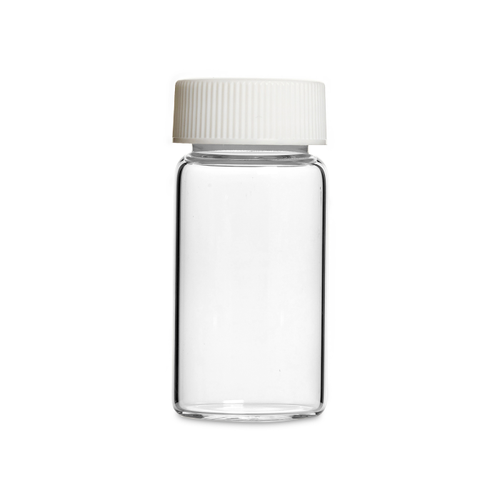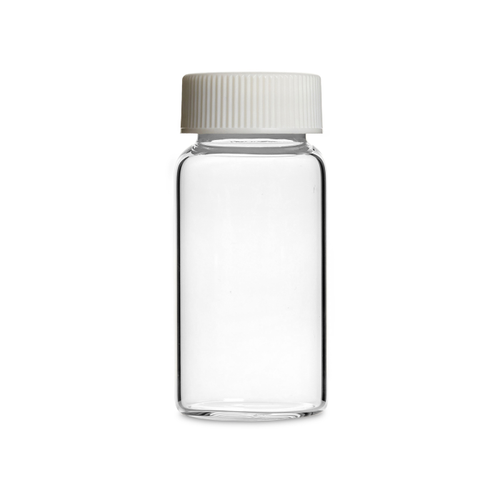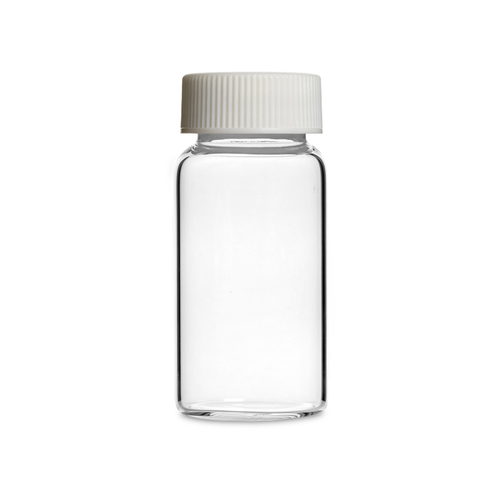
Copy of DWK 986560 WHEATON Liquid Scintillation Vials, Borosilicate Glass, 24-400 White PP Caps Attached to Vials, Foamed Polyethylene Liner, 24-400, 20 mL

$385.03
SKU: 986560 CASE 7 - 10 Business Days
(No reviews yet)
Availability:
7 - 10 Business Days
Shipping:
Calculated at Checkout

WHEATON® 986560 Glass Liquid Scintillation Vials - 20 mL, 24-400 White PP Caps, Foamed PE Liners, 500/Case

WHEATON® 986560 Liquid Scintillation Vials from DWK Life Sciences are 20 mL clear borosilicate glass vials supplied with white polypropylene (PP) 24-400 screw caps attached to the vials. Each cap features a foamed polyethylene (PE) liner. This manufacturer-specified combination supports liquid scintillation counting and compatible laboratory sample-handling applications.

Each vial measures 28 mm in diameter and 57 mm high without its cap. The overall height, including the attached cap, is 61 mm. DWK specifies a 24-400 screw-thread finish, making this a different closure configuration from WHEATON 986540, which uses a 22-400 thread.

DWK describes its glass liquid scintillation vial family as offering consistent, low background counts and high ultraviolet (UV) transmission. The manufacturer identifies borosilicate glass for this SKU and describes its glass scintillation vial range as converted from Type I borosilicate glass tubing. These properties are relevant to scintillation counting methods in which vial material, sample composition, and optical detection influence analytical performance.

The supplied white polypropylene cap and foamed polyethylene liner provide a defined closure combination. DWK's technical liner guidance describes foamed PE as a compressible, three-ply construction incorporating solid and foamed low-density polyethylene. It is intended for a broad range of general laboratory applications, but DWK specifically identifies poor resistance to hydrocarbon solvents. The selected scintillation cocktail and sample formulation must therefore be evaluated for compatibility.

WHEATON 986560 is designated non-sterile and not autoclavable. It has no marking spot and is supplied in a case of 500 vials with attached caps. The 20 mL capacity is nominal, not a calibrated measuring tolerance or a prescribed working fill volume.

Ordering note: WHEATON part number 986560 is the 24-400 version of the 20 mL clear borosilicate glass scintillation vial, with an attached white polypropylene cap and foamed polyethylene liner. Each case contains 500 capped vials. This product is non-sterile and not autoclavable. Scintillation cocktails, counters, and storage accessories are not included.

Specifications:
  • Manufacturer: DWK Life Sciences
  • Brand: WHEATON®
  • Manufacturer part number: 986560
  • Product type: Glass liquid scintillation vial with attached screw cap
  • Nominal capacity: 20 mL
  • Vial material: Clear borosilicate glass
  • Glass family: Type I borosilicate glass tubing
  • Vial diameter: 28 mm
  • Vial height without cap: 57 mm
  • Overall height including cap: 61 mm
  • Neck and closure finish: 24-400
  • Cap included: Yes, attached to vial
  • Cap material: Polypropylene (PP)
  • Cap color: White
  • Cap liner: Foamed polyethylene (PE foam)
  • General liner construction: Three-ply foamed and solid LDPE, per DWK liner guidance
  • Marking spot: No
  • Sterile: Non-sterile
  • Autoclavable: No
  • Scintillation background: Manufacturer-described consistent and low counts
  • Optical characteristic: Manufacturer-described high UV transmission
  • Primary application: Liquid scintillation counting
  • Purchase unit: Case
  • Quantity per case: 500 vials with caps
  • Numerical counting background: Not specified in reviewed SKU information
  • UV transmission percentage: Not specified in reviewed SKU information
  • Calibrated volume tolerance: Not established
  • Instrument compatibility: Verify with intended counting instrument
  • Shipping weight and carton dimensions: Not verified
Why the Foamed Polyethylene Liner Matters

The foamed polyethylene liner is an important part of the WHEATON 986560 configuration. DWK describes its PE foam liner as a three-ply coextruded material, with a compressible polyethylene foam core between solid clear polyethylene layers.

This construction provides a compressible sealing surface when used with the manufacturer's white polypropylene screw cap. DWK identifies broad general resistance to acids, alkalis, solvents, alcohols, oils, and aqueous products, but specifically notes poor resistance to hydrocarbon solvents.

Because liquid scintillation cocktails may contain organic solvents, the laboratory should verify that the entire glass vial, polypropylene cap, and foamed PE liner is compatible with the intended formulation. Evaluate solvent concentration, vapor exposure, storage duration, and temperature before use.

Important compatibility limitation: Foamed polyethylene is not PTFE-faced polyethylene. Do not assume PTFE-level chemical resistance, universal solvent compatibility, a certified vapor-tight seal, or guaranteed leakproof performance. DWK recommends testing closure liners for the intended application.

24-400 vs. 22-400: Why the Thread Finish Matters

WHEATON 986560 uses a 24-400 thread finish. This is the primary difference between 986560 and WHEATON 986540, which uses 22-400. Both products have 20 mL borosilicate glass vials, white polypropylene caps, foamed PE liners, and the same published 28 mm diameter and 61 mm capped height.

A 24-400 closure must not be substituted with a 22-400 cap. The neck finish and cap must match to obtain the intended thread engagement and liner contact. Even a correctly matched screw cap does not independently certify leakproof or vapor-tight containment.

About the Manufacturer:

WHEATON®, a DWK Life Sciences brand, provides laboratory glassware, sample containers, liquid scintillation vials, and associated closures. Its scintillation-vial range includes multiple glass and plastic vial materials, cap sizes, liner constructions, and cap-packing arrangements. Selecting the exact manufacturer catalog number helps ensure that the supplied container matches laboratory purchasing and method requirements.

WHEATON 986560 Features:
  • 20 mL clear borosilicate glass scintillation vial
  • Manufactured within WHEATON's Type I borosilicate glass vial family
  • 28 mm diameter and 57 mm uncapped height
  • 61 mm overall height including cap
  • 24-400 screw-thread finish
  • White polypropylene screw cap attached to each vial
  • Foamed polyethylene closure liner
  • Three-ply foam and solid LDPE liner construction
  • Manufacturer-described consistent low scintillation background
  • Manufacturer-described high UV transmission
  • No marking spot
  • Non-sterile and not autoclavable
  • 500 vials with caps per case
WHEATON 986560 Benefits:
  • Complete vial-and-cap configuration: The specified 24-400 white PP cap and foamed PE liner are included.
  • Scintillation-focused glass: WHEATON identifies low background and high UV transmission as glass-vial family characteristics.
  • Compressible liner: Foamed polyethylene offers a conformable sealing surface within the screw-cap assembly.
  • Defined dimensions: Published 28 mm diameter and 61 mm capped height support instrument-fit checks.
  • Specific thread identification: The 24-400 finish helps distinguish the product from otherwise similar 22-400 versions.
  • Clear material selection: Borosilicate glass, polypropylene, and foamed PE are explicitly identified.
  • Case-scale purchasing: 500-count cases support laboratory replenishment programs.
Common Applications:
  • Liquid scintillation counting (LSC) with compatible instruments
  • Radiolabeled research sample analysis
  • Biochemical and life-sciences tracer studies
  • Environmental testing under appropriate scintillation methods
  • Laboratory analytical and quality-control procedures
  • Sample handling requiring a 20 mL borosilicate glass vial
  • Laboratory methods specifying a 24-400 polypropylene/foamed PE closure
  • Compatible sample storage when the complete assembly is qualified

These are potential applications, not certifications of compatibility with a particular radionuclide, scintillation cocktail, counting instrument, or regulated analytical method.

Best-Practice Use:
  • Confirm SKU: Verify WHEATON 986560 and the 24-400 thread finish.
  • Inspect components: Check the glass, threads, cap, and liner for damage.
  • Verify chemical compatibility: Evaluate the actual cocktail and sample against glass, PP, and foamed PE.
  • Check instrument fit: Confirm the 28 mm diameter and 61 mm capped height.
  • Use method-defined volumes: Follow the approved sample and cocktail volumes, not nominal vial capacity.
  • Apply closure correctly: Follow the laboratory's approved capping procedure.
  • Label appropriately: The vial has no marking spot.
  • Perform analytical QC: Use required blanks, standards, and instrument checks.
  • Follow safety procedures: Apply chemical, radiological, and waste-handling controls.
  • Do not autoclave: DWK explicitly lists WHEATON 986560 as not autoclavable.
Selection Notes: 986560 vs. Related WHEATON Vials
  • 986560: 20 mL glass, 24-400 white PP attached cap, foamed PE liner, 500/case.
  • 986540: 20 mL glass, white PP attached cap, foamed PE liner, but 22-400 thread.
  • 986561: 20 mL glass, 24-400 white PP attached cap, but metal foil/pulp liner.
  • 986562: 20 mL glass, 24-400 white urea cap, with metal foil/cork liner.
  • 986568: 20 mL glass, 24-400 white urea cap, with polyethylene disc liner.
  • 986590: 20 mL glass, 24-400 white PP cap, foamed PE liner, with caps packaged separately.
  • 986532: 20 mL glass, 22-400 thread, no caps included.

Substitution rule: Identical nominal volume or overall height does not mean identical thread finish, closure material, liner resistance, or cap-packing arrangement.

Manufacturer Technical Documentation:

Closure Liner Guide: DWK foamed polyethylene liner properties and selection guidance — Construction, chemical compatibility, and testing considerations.

Glass Types & Properties: DWK borosilicate glass technical information — Glass classification and general material properties.

Care & Maintenance of Laboratory Glassware: DWK glassware care and inspection guidance.

General Glassware Cleaning Advice: DWK laboratory glassware cleaning guidance — General material guidance, not approval to autoclave this SKU.

Why Order WHEATON 986560 From SOSCleanroom?
  • Exact-SKU sourcing: Specify the correct 24-400 glass vial with its attached polypropylene cap and foamed PE liner.
  • Product comparison: Get assistance distinguishing 22-400 and 24-400 thread finishes and alternative liners.
  • Manufacturer documentation: Request applicable technical information and certificates.
  • Centralized purchasing: Source laboratory glassware and critical-environment consumables through Specialty Optical Systems, Inc.
  • Responsive service: Contact SOSCleanroom for quotations, availability, and order assistance.

Technical note: The Technical Vault contains additional details about foamed PE construction, solvent compatibility, the 24-400 closure, liquid scintillation counting, and related WHEATON configurations.

For pricing, availability, or questions, email Sales@SOSsupply.com or call (214) 340-8574.

Product page updated: October 27, 2026

© 2026 Specialty Optical Systems, Inc. (dba SOSCleanroom). All rights reserved.

The Technical Vault By SOSCleanroom
WHEATON 986560 20 mL Borosilicate Glass 24-400 Thread White PP Cap Foamed PE Liner 28 x 61 mm Capped Non-Sterile Not Autoclavable 500/Case

WHEATON 986560: Technical Overview and Exact Configuration

WHEATON® 986560 is a 20 mL clear borosilicate glass liquid scintillation vial equipped with an attached white polypropylene 24-400 screw cap and a foamed polyethylene liner. DWK specifies a 28 mm vial diameter, 57 mm height without cap, and 61 mm overall height with cap.

The manufacturer's glass scintillation vial family is described as offering consistent low background counts and high ultraviolet transmission. The exact finished product is designated non-sterile and not autoclavable, has no marking spot, and is supplied in cases of 500.

A critical selection characteristic is the 24-400 screw-thread finish. WHEATON 986540 uses a 22-400 thread with the same named glass, cap, and liner materials. The two thread formats must not be treated as interchangeable.

Operations takeaway: Specify 986560, 20 mL borosilicate glass, 28 x 57 mm uncapped / 28 x 61 mm capped, 24-400 white PP cap attached, foamed PE liner, 500 per case. This exact SKU is non-sterile and not autoclavable. Confirm compatibility of the foamed PE liner with any hydrocarbon-containing scintillation cocktail.


Exact-SKU Specifications for Purchasing, SOPs, and Receiving
  • Manufacturer / brand: DWK Life Sciences / WHEATON®
  • Catalog number: 986560
  • Product: Glass liquid scintillation vial with attached screw cap
  • Nominal capacity: 20 mL
  • Vial material: Clear borosilicate glass
  • Product-family description: Type I borosilicate glass tubing
  • Outside diameter: 28 mm
  • Vial height excluding cap: 57 mm
  • Overall height including cap: 61 mm
  • Thread / closure finish: 24-400
  • Cap included: Yes, attached to vial
  • Cap material: Polypropylene (PP)
  • Cap color: White
  • Liner material: Foamed polyethylene
  • General liner construction: Coextruded foamed and solid LDPE layers
  • Marking spot: No
  • Supplied sterile: Non-sterile
  • Autoclavable: Not autoclavable
  • Scintillation background: Manufacturer-described low and consistent counts
  • Optical characteristics: Manufacturer-described high UV transmission
  • Primary application: Liquid scintillation counting
  • Purchase unit: Case
  • Case quantity: 500 vials with caps
  • Numerical counting background: Not established in reviewed SKU record
  • UV transmission percentage: Not established in reviewed SKU record
  • Specific instrument compatibility: Must be confirmed for the intended counter
  • Calibrated volume tolerance: Not provided
  • Certified leak rate / vapor-tight rating: Not provided
  • Country of origin: Not verified
  • Shipping weight / carton dimensions: Not verified
  • Inner trays or packing subdivisions: Not confirmed for this exact SKU

Specification boundary: The 20 mL capacity is nominal. The 61 mm dimension includes the specified cap, and the 24-400 finish identifies a thread configuration rather than a guaranteed leakproof seal.


Foamed Polyethylene Liner: Construction and Sealing Function

DWK's Closure Liner Guide describes foamed polyethylene (PE foam) as a one-piece, three-ply coextruded liner consisting of both foamed and solid low-density polyethylene. A compressible foam core is positioned between solid clear PE layers.

This design provides a compressible sealing interface between the cap and vial finish. It is a different material from PTFE-faced PE foam, metal foil/pulp, metal foil/cork, flat PE discs, and polyethylene cones.

Liner attribute Manufacturer-supported description
Liner name Foamed Polyethylene (PE Foam)
Material family Low-density polyethylene (LDPE)
Construction Three-ply coextruded liner
Foam layer Compressible PE foam core
Outer layers Solid clear PE layers
General chemical resistance DWK describes broad general-purpose resistance
Hydrocarbon solvents DWK identifies poor resistance
PTFE facing Not specified for this product
Certified leak rate Not established for the finished assembly

DWK describes broad general-purpose chemical resistance for foamed PE, including several acid, alkali, solvent, alcohol, oil, and aqueous exposure categories. However, the manufacturer's specific warning regarding hydrocarbon solvents must be considered when selecting a scintillation cocktail.

Critical material warning: Foamed PE is not PTFE-lined and should not be represented as chemically inert. Confirm the selected scintillation cocktail and sample formulation with the manufacturer and qualify the complete vial-and-cap system for its intended use.


Chemical Compatibility: Glass, Polypropylene, and Foamed PE

A liquid scintillation vial may contact aqueous samples, organic scintillation cocktails, solvent vapors, acids, bases, and analytical reagents. Compatibility should be evaluated across the entire assembly: borosilicate glass vial, polypropylene screw cap, and foamed PE liner.

Exposure Compatibility considerations
Aqueous samples and buffers Assess pH, concentration, sample recovery, and liner suitability
Alcohol-containing solutions General PE foam resistance is described; verify exact alcohol and conditions
Organic scintillation cocktails Evaluate all solvent constituents against glass, PP, and foamed PE
Hydrocarbon solvent mixtures DWK identifies poor resistance of foamed PE to hydrocarbon solvents
Acidic or alkaline samples Assess concentration, temperature, glass durability, and polymer compatibility
Hydrofluoric acid or strong alkalis May attack borosilicate glass; select suitable materials instead
Volatile solvent vapors Assess vapor exposure, cap integrity, ventilation, and containment
Trace-sensitive analytical samples Perform blanks, assess extractables, and verify analytical recovery

This table is a compatibility-review framework rather than a certified chemical-resistance chart for the exact 986560 assembly. Exposure time, temperature, concentration, and physical handling can affect performance.

Scintillation cocktail selection: Some formulations contain hydrocarbon-based components. A foamed PE liner should not be assumed compatible with such formulations. Review the cocktail safety data sheet and confirm liner resistance and sealing performance before routine use.


24-400 vs. 22-400: Thread Finish and Closure Selection

The 24-400 closure finish is one of the most important identifiers for WHEATON 986560. The similar WHEATON 986540 uses a 22-400 thread finish. Although both have 20 mL glass vials and the same published outside dimensions, their neck and screw-cap configurations differ.

Feature 986560 986540
Thread finish 24-400 22-400
Nominal capacity 20 mL 20 mL
Vial material Borosilicate glass Borosilicate glass
Cap material White PP White PP
Liner Foamed PE Foamed PE
Overall capped dimensions 28 x 61 mm 28 x 61 mm
Case quantity 500 500

Thread compatibility warning: Do not use a 22-400 cap on a 24-400 vial or substitute the entire 22-400 vial configuration without confirming instrument and laboratory requirements. Thread size and sealing geometry are product-specific.


Liquid Scintillation Counting: Background, Glass, and Optical Properties

Liquid scintillation counting (LSC) is an analytical method used to measure appropriate radioactive samples. The sample is combined with a suitable scintillation cocktail, and energy deposited by radioactive emissions produces light that can be detected by the counting instrument.

A scintillation vial is part of the measurement system. The glass material, geometry, sample composition, cocktail, background contribution, and instrument settings can all influence the result.

DWK describes its glass liquid scintillation vials as providing consistent low background counts and high UV transmission. WHEATON's historical glass-vial documentation also discusses low-potassium borosilicate materials. Naturally occurring potassium contains potassium-40, which can contribute to background in sensitive radioactive measurements.

  • Background: Verify with method blanks and the counting instrument's background measurements.
  • UV transmission: Manufacturer-described as high, without a numerical transmission curve for this SKU.
  • Counting efficiency: Depends on sample, radionuclide, cocktail, counter, and method conditions.
  • Quench correction: Follow the applicable laboratory procedure.
  • Sample volume: Use the method-defined sample-to-cocktail ratio and headspace.
  • Instrument fit: Confirm the complete capped-vial geometry and accepted material.

Analytical performance boundary: The vial does not independently establish isotope-specific detection efficiency, minimum detectable activity, a numerical count-rate limit, or compatibility with every scintillation counter.


Borosilicate Glass: Material Properties and Selection Considerations

DWK specifies borosilicate glass for WHEATON 986560 and describes its glass scintillation vial range as converted from Type I borosilicate glass tubing. This material family is used in laboratory applications where chemical durability and optical properties are important.

Borosilicate glass generally offers useful resistance to many common chemicals. However, resistance is not universal: hydrofluoric acid and certain strongly alkaline solutions can attack glass. The actual sample compatibility must be evaluated independently of the foamed PE liner's limitations.

  • Current exact-SKU material: Borosilicate glass.
  • Family manufacturing description: Type I borosilicate glass tubing.
  • Historical low-potassium context: Relevant to WHEATON scintillation glass literature, not an exact certified potassium concentration for 986560.
  • Lot-specific material certification: Request from DWK if required by the laboratory.
  • Complete assembly: Chemical and thermal suitability depends on the cap and liner as well as glass.

The product-family description does not itself provide a current lot certificate, glass composition assay, or exact material purity statement for 986560.


Vial Dimensions and Counting-Instrument Fit

The manufacturer provides separate uncapped and capped heights for 986560. The 57 mm height describes the vial without its cap; 61 mm is the total assembled height. These measurements should be checked against the counting instrument's sample holder, carousel, or loading mechanism.

Dimension / feature Practical significance
20 mL nominal capacity Vial size classification; not a calibrated volume
28 mm outside diameter Instrument holder and rack compatibility
57 mm height Uncapped vial dimension
61 mm overall height Assembled vial-and-cap clearance
24-400 thread Required cap/neck finish
No marking spot Use suitable sample labels or barcodes

Instrument-fit checkpoint: The dimensions are manufacturer specifications, not a guarantee of compatibility with every liquid scintillation counter. Confirm vial and cap clearance with the instrument manufacturer.


Related WHEATON 20 mL Scintillation Vial Configurations

DWK's WHEATON Vial Guide distinguishes the following glass configurations by thread finish, closure material, liner, and cap presentation.

WHEATON SKU Cap / liner Thread Cap presentation
986560 White PP / foamed PE 24-400 Attached
986540 White PP / foamed PE 22-400 Attached
986561 White PP / metal foil-pulp 24-400 Attached
986562 White urea / metal foil-cork 24-400 Attached
986568 White urea / polyethylene disc 24-400 Attached
986590 White PP / foamed PE 24-400 Caps separately packed
986532 No cap 22-400 Uncapped

The listed glass scintillation vial configurations have a nominal 20 mL capacity and are listed in the manufacturer's vial guide at 500 per case. Their material and closure differences still require individual qualification.

Procurement distinction: 986560 and 986590 share the same named 24-400 glass/PP/foamed-PE configuration, but the caps are attached for 986560 and packaged separately for 986590. WHEATON 986540 is the otherwise similar 22-400 version.


Non-Sterile and Not Autoclavable: Manufacturer Restrictions

DWK explicitly specifies WHEATON 986560 as non-sterile and not autoclavable. These are exact-SKU restrictions that apply to the completed vial-and-cap configuration, not merely to the liner material.

Although borosilicate glass can have useful thermal resistance, the complete manufacturer assembly includes a polypropylene cap and foamed polyethylene liner. The thermal behavior of bare glass does not qualify the assembled container for steam sterilization.

  • Supplied sterile: No; manufacturer states non-sterile.
  • Autoclavable: No; manufacturer states not autoclavable.
  • Validated steam cycle: No 986560 cycle established.
  • Dry-heat processing: No SKU-specific validated cycle established.
  • Polymer components: Must be evaluated independently of the glass.
  • Sterile laboratory requirements: Select a separately qualified alternative when necessary.

Do not autoclave WHEATON 986560. General glassware sterilization advice does not override the manufacturer's specific non-autoclavable designation for this finished product.


Closure Handling, Seal Integrity, and Solvent Vapor Control

The foamed PE liner provides a compressible sealing interface, but actual sealing performance depends on the cap, vial finish, liner condition, sample chemistry, and closure application. The exact 986560 specification does not establish a certified leak rate, vapor-tight performance, or numerical cap-torque requirement.

  • Inspect the glass neck and thread for cracks, chips, or residue.
  • Inspect the polypropylene cap and foam liner for visible defects.
  • Use the correct 24-400 cap configuration.
  • Follow laboratory-approved cap application procedures.
  • Do not invent a tightening torque or assume a certified leakproof seal.
  • Consider vapor exposure and evaporation when using organic cocktails.
  • Use applicable ventilation and secondary containment.
  • Follow facility procedures for hazardous and radioactive samples.

Recommended Laboratory Preparation and QC Checklist
  1. Verify product identity: Confirm WHEATON 986560, 24-400, white PP cap, and foamed PE liner.
  2. Confirm case quantity: Verify 500 vials with attached caps.
  3. Inspect components: Check for glass damage and cap or liner defects.
  4. Validate material exposure: Check the sample and scintillation cocktail against glass, polypropylene, and foamed PE.
  5. Check instrument fit: Verify the 28 mm diameter and 61 mm assembled height.
  6. Set the working volume: Use the analytical method's sample and cocktail amounts.
  7. Close appropriately: Follow the laboratory's approved capping procedure.
  8. Label samples: Use appropriate external identification; no marking spot is supplied.
  9. Perform analytical QC: Run blanks, standards, and instrument controls.
  10. Handle hazardous material: Apply radiation safety, chemical, and waste procedures.
  11. Do not autoclave: The exact finished SKU is not autoclavable.
  12. Maintain traceability: Retain applicable lot, sample, and instrument records.

Cleaning, Inspection, and Reuse Considerations

DWK provides general technical guidance on cleaning and maintaining laboratory glassware. For WHEATON 986560, cleaning and reuse procedures must also consider the polypropylene cap, PE foam liner, and substances previously held in the vial.

  • Determine whether the analytical method permits reuse.
  • Assess chemical, radioactive, or biological contamination before handling.
  • Use cleaning agents compatible with all assembly materials.
  • Avoid abrasive tools and impacts that damage glass surfaces or threads.
  • Rinse and dry according to the method's requirements.
  • Inspect glass, cap, and liner before reuse.
  • Perform background and carryover controls if analytical reuse is permitted.
  • Do not autoclave the product.

A previously used scintillation vial may contain chemical or radiological contamination. Reuse must follow approved laboratory procedures; the manufacturer product specifications do not establish universal cleaning or reuse acceptance criteria.


Controlled Laboratory and Cleanroom Qualification

WHEATON 986560 may be evaluated for appropriate laboratory environments, but the manufacturer explicitly identifies it as non-sterile. The reviewed SKU information does not establish an ISO 14644 cleanroom class, certified sterile packaging, validated endotoxin limit, DNase/RNase-free status, or a specific particle-release specification.

Qualification boundary: Borosilicate glass material properties and liquid scintillation suitability do not automatically qualify this product for sterile compounding, aseptic processing, or a particular cleanroom classification.


Important Limitations and Unsupported Assumptions
  • Not sterile: Manufacturer specifically lists non-sterile.
  • Not autoclavable: Manufacturer specifically lists not autoclavable.
  • Not a 22-400 vial: The required finish is 24-400.
  • Not PTFE-lined: The specified liner is foamed polyethylene.
  • Not universally solvent resistant: Foamed PE has poor resistance to hydrocarbon solvents.
  • Not certified leakproof: No exact-SKU leakage or vapor-tight rating is provided.
  • Not a calibrated volumetric device: 20 mL is nominal.
  • Not universally counter compatible: Verify instrument fit.
  • No marking spot: Use appropriate sample identification.
  • No numerical background guarantee: Manufacturer's statement is qualitative.
  • No exact UV transmission curve: Do not assign an unsupported percentage.
  • No exact lot-specific potassium specification: Historical low-potassium context is not a current certificate.
  • No verified inner package breakdown: Confirm special packing requirements with the manufacturer.
  • No certified hazardous-material shipping approval: Ordinary vial packaging is not a transport certification.

Technical FAQs

What is WHEATON 986560?

A 20 mL clear borosilicate glass liquid scintillation vial with an attached white polypropylene 24-400 cap and foamed polyethylene liner.

Are caps included?

Yes. DWK identifies caps attached to the vials, with 500 units per case.

What thread size does 986560 use?

24-400. It is not the same as the 22-400 finish on WHEATON 986540.

What is the difference between 986560 and 986540?

986560 uses 24-400; 986540 uses 22-400. Both use borosilicate glass, white polypropylene caps, and foamed PE liners.

What is the difference between 986560 and 986561?

Both are 24-400 glass vials with white polypropylene caps, but 986560 uses foamed PE while 986561 uses a metal foil/pulp liner.

What is the difference between 986560 and 986590?

986560 has caps attached to the vials; 986590 has the same named cap and liner configuration with caps packaged separately.

What is the foamed PE liner made of?

DWK describes a three-ply coextruded construction with a foam core between solid clear LDPE layers.

Is the liner PTFE-faced?

No PTFE facing is specified. Foamed PE and PTFE-faced foamed PE are different liner types.

Is the liner compatible with hydrocarbon solvents?

DWK's general liner guide reports poor resistance of foamed PE to hydrocarbon solvents. Confirm the particular sample and scintillation cocktail before use.

Is the closure guaranteed leakproof?

No SKU-specific leakproof, vapor-tight, or pressure rating was established. Test the complete closure for the intended application.

Are these vials sterile?

No. DWK lists 986560 as non-sterile.

Can WHEATON 986560 be autoclaved?

No. DWK explicitly lists this exact SKU as not autoclavable.

What are the vial dimensions?

28 mm diameter, 57 mm high without the cap, and 61 mm high including the cap.

Is 20 mL a calibrated measuring volume?

No calibrated accuracy is specified. Use the working volume required by the analytical method.

Does the vial have a marking spot?

No. Use an identification method compatible with the instrument and laboratory workflow.

Are background counts and UV transmission quantified?

DWK describes low, consistent background counts and high UV transmission, but no exact numeric values were established for 986560.

Will 986560 fit every scintillation counter?

Not automatically. Verify the 28 mm diameter, 61 mm capped height, and instrument-specific carrier requirements.

How many vials come in a case?

500 vials with their specified caps and liners.


Manufacturer Technical References

These resources are manufacturer technical-information pages rather than product-detail, catalog, or purchasing pages. General technical information does not override WHEATON 986560's exact-SKU non-sterile and not autoclavable designations.


For quotations or product questions, email Sales@SOSsupply.com or call (214) 340-8574. SOSCleanroom can help confirm WHEATON vial configurations, thread finishes, closure materials, case quantities, and applicable DWK manufacturer documentation. Technical insight: Liquid scintillation vial selection depends on instrument geometry, background performance, sample chemistry, and the complete vial-and-closure system. A 24-400 screw cap and foamed PE liner require qualification for the intended application. Last updated: October 27, 2026 © 2026 Specialty Optical Systems, Inc. (dba SOSCleanroom). All rights reserved.