The Technical Vault
By SOSCleanroom
20 mL
Type I Borosilicate
28 × 60 mm
24-400 Screw Cap
14B Rubber Liner
Caps Attached
72/Case
WHEATON 225288: Glass Selection and Closure Compatibility
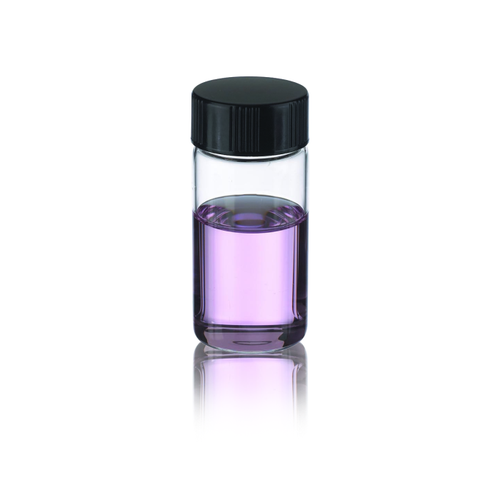
The WHEATON® LAB FILE® 225288
is a 20 mL clear borosilicate glass
sample vial supplied with an attached
24-400 black phenolic screw cap
and 14B rubber liner.
The manufacturer identifies this liner
configuration primarily for
compatible aqueous samples.
Each standard-height vial measures
28 × 60 mm.
LAB FILE® partitioned trays help
organize the supplied containers and
stored samples.
Glass composition, closure material,
liner selection, sample chemistry,
preparation, and storage conditions
all influence the suitability of
the complete container system.
Technical takeaway:
This SKU includes a
plain 14B rubber liner,
not a PTFE-faced liner.
The glass vial may be compatible
with a sample even when the supplied
liner is not. Qualify both materials
before use.
Core Product Specifications
| Specification |
WHEATON 225288 |
| Manufacturer |
DWK Life Sciences |
| Brand / family |
WHEATON® LAB FILE® |
| Catalog number |
225288 |
| Product type |
Standard-height laboratory sample vial |
| Nominal capacity |
20 mL |
| Dram designation |
5 dram |
| Glass construction |
Type I borosilicate glass tubing |
| Manufacturer glass description |
Clear Type 1A Borosilicate |
| Color |
Clear |
| Diameter |
28 mm |
| Height |
60 mm |
| Thread finish |
24-400 |
| Cap material |
Black phenolic |
| Cap style |
Solid top |
| Cap liner |
14B rubber |
| Cap presentation |
Caps attached to vials |
| Packaging |
LAB FILE® partitioned trays |
| Case quantity |
72 vials with caps |
| Autoclavable |
Yes; manufacturer identifies vials and caps as autoclavable |
| Vial rack reference |
868806 |
| M-T File® reference |
W228792 |
| Country of origin |
China, per manufacturer item-setup data |
The manufacturer-listed dimensions are
for identifying this vial configuration.
No separate calibrated volume tolerance,
brimful capacity, pressure rating,
or maximum working-fill volume
is established in the reviewed records.
Type I Borosilicate Glass: What the Material Classification Means
WHEATON 225288 is converted from clear
Type I borosilicate glass tubing.
DWK's catalog-specific material field
identifies the construction as
Clear Type 1A Borosilicate.
Borosilicate glass is used extensively
in laboratory containers because of
its chemical durability and resistance
to water-based chemical attack.
Exact compatibility still depends on
the formulation, processing conditions,
and closure components.
Classification distinction:
Glass type does not mean the vial
has Class A volumetric accuracy.
This is a sample container,
not a calibrated measuring vessel.
Do not assign volumetric tolerances
or a thermal-expansion coefficient
from another glass product without
appropriate manufacturer confirmation.
General borosilicate glass information
is available in the manufacturer's
Glass Types and Properties technical
reference listed below.
24-400 Phenolic Screw Cap: Closure Identification
The included black phenolic screw cap
uses a 24-400 finish
and a solid-top construction.
Its sealing interface incorporates
a 14B rubber liner.
The nominal 24-400 finish identifies
the closure thread configuration,
not a 24 mm clear internal mouth opening.
Matching closure components should
be selected using the specified finish
and the intended liner material.
A solid-top cap should not be treated
as an open-top septum cap.
The manufacturer's description does
not establish a needle-puncture
procedure, repeated septum access,
or autosampler compatibility
for this supplied cap.
14B Rubber Liner: Composition, Resistance, and Limitations
DWK's technical closure-liner guide
identifies 14B rubber
as a sulfur-cured
styrene-butadiene rubber (SBR)
formulation. It is not natural rubber.
This identification should not be
confused with a product-specific
latex-free or allergen-control
certification.
The manufacturer describes this liner
as having useful resilience and
resistance to moisture-vapor transmission,
with suitability for many moderate
chemical exposures. For the LAB FILE®
vial family, DWK identifies plain
14B rubber as the liner option
intended for aqueous samples.
The same technical guidance identifies
poor compatibility with
oils, strong acids, and
hydrocarbons. Consequently,
the plain 14B rubber liner should
not be presented as a universal
solvent-resistant closure.
Material-selection rule:
Qualify the actual aqueous formulation
against both the glass and the liner.
A favorable glass compatibility
result does not override an
incompatible closure material.
The manufacturer's general liner
guide discusses rubber composition
and regulatory material characteristics.
Those statements do not by themselves
certify this finished vial assembly
for any specific pharmaceutical,
food-contact, or sterile application.
14B Rubber vs. PTFE/14B Rubber: Selecting the Correct Liner
| Liner Configuration |
Manufacturer Positioning |
Selection Consideration |
| 14B Rubber |
Aqueous samples |
Included with 225288; verify compatibility with the actual solution |
| PTFE/14B Rubber |
Organic samples and improved chemical compatibility |
Alternative configuration; verify the sample-contact facing and formulation compatibility |
A PTFE-faced rubber liner introduces
a different sample-contact surface.
That may be preferable for certain
formulations, but no liner material
eliminates the need for application
compatibility testing.
Related configuration:
WHEATON W224589 is the
20 mL clear LAB FILE® vial
with a PTFE/14B rubber-lined cap.
It has the same manufacturer-listed
28 × 60 mm vial dimensions
and 24-400 finish, but uses
a different liner.
Contact SOSCleanroom to confirm
availability and suitability.
Caps Attached and LAB FILE Partitioned-Tray Packaging
WHEATON supplies catalog 225288
with the specified screw caps
attached to the vials.
This presentation is intended
to help maintain cleanliness
during supply and handling.
LAB FILE® partitioned trays
offer an organized format for
empty vials or stored samples.
This packaging arrangement
can assist laboratories with
inventory and sample identification.
Caps attached does not mean
permanently tethered caps, and
partitioned trays do not establish
a sterile barrier. The reviewed
records also do not establish
a separate numeric inner-pack
quantity within the 72-count case.
Autoclavability, Sterility, and Preparation
DWK identifies the LAB FILE®
vials and caps as
autoclavable.
The closure-liner technical guide
also identifies 14B rubber
as autoclavable material.
That does not establish a
universal steam-autoclave cycle
for every filled, capped,
or tightly sealed configuration.
Processing requirements should
be established for the actual
container, closure, contents,
and laboratory procedure.
Where appropriate, an approved
preparation process should include
controls for cleaning, loading,
closure condition, heating,
cooling, and inspection of
the processed assembly.
Critical distinction:
Autoclavability does not establish
that these vials arrive sterile.
No supplied-sterile designation,
sterility assurance level,
endotoxin limit, or validated
depyrogenation cycle is established
in the reviewed product records.
Chemical Compatibility and Analytical Sample Integrity
Type I borosilicate glass is valued
for its chemical durability, but
sample compatibility must be assessed
across the glass, phenolic closure,
and 14B rubber liner.
The appropriate selection depends
on the chemical composition,
concentration, storage temperature,
contact time, and required
analytical method performance.
- Glass compatibility: Evaluate the specific formulation against the borosilicate container.
- Closure compatibility: Confirm the 14B rubber liner is suitable for the contents.
- Sample stability: Establish the required storage duration and conditions.
- Potential contamination: Evaluate extractables or sample interactions where analytical limits require it.
- Evaporation and retention: Confirm the closure assembly meets the method's required containment performance.
- Light sensitivity: Use an approved amber configuration if the contents require light protection.
No numerical extractables limit,
validated chemical-specific
shelf life, or quantified
leak-rate specification is
established for SKU 225288
in the reviewed records.
Comparing Related 20 mL WHEATON LAB FILE Configurations
| Part Number |
Configuration |
Key Difference |
| 225288 |
20 mL clear glass, caps attached, 14B rubber liner |
This product; intended for compatible aqueous samples |
| W224589 |
20 mL clear glass, caps attached, PTFE/14B rubber liner |
Different liner for improved chemical compatibility |
| W224820 |
20 mL amber glass, caps attached, 14B rubber liner |
Amber glass color with rubber-lined cap |
| W224604 |
20 mL amber glass, caps attached, PTFE/14B rubber liner |
Amber glass and different liner |
| 224831 |
20 mL clear LAB FILE® vial without caps |
Caps sold separately; different listed dimensions and case quantity |
Related products should not be
substituted without reviewing
glass color, liner material,
closure configuration,
dimensions, case quantities,
and analytical requirements.
Important difference:
The uncapped 224831 version has
manufacturer-listed dimensions
of 28 × 57 mm and a
200-vial case, whereas 225288
is 28 × 60 mm with attached
caps and 72 vials per case.
Contact SOSCleanroom to confirm
availability of the appropriate
alternative before ordering.
Vial Rack and Storage Accessory References
DWK's catalog-specific specifications
list the following storage accessory
references for 225288:
| Accessory |
Manufacturer Reference |
| Compatible vial rack |
868806 |
| Compatible M-T File® |
W228792 |
These are manufacturer-listed
compatibility references.
The accessories are not identified
as included in the 225288 case.
Confirm the intended storage
configuration and availability
through SOSCleanroom.
Receiving and Inspection Checklist
- Confirm product identity: Check catalog 225288, clear 20 mL glass, and 72 vials per case.
- Verify vial geometry: Confirm the required 28 mm diameter, 60 mm height, and 24-400 finish.
- Inspect glass surfaces: Check the vial body, mouth, threads, and base for cracks, chips, or visible contamination.
- Verify supplied closures: Confirm black phenolic caps and plain 14B rubber liners are present.
- Inspect liner condition: Check for deformation, displacement, contamination, or damage.
- Check tray packaging: Inspect the LAB FILE® partitions and investigate broken containers.
- Review preparation status: Follow the facility's requirements for cleaning and any necessary sterilization.
- Maintain records: Use the laboratory's product-acceptance and sample-identification procedures.
Storage and Controlled-Environment Considerations
The manufacturer item-setup record
lists room-temperature shipping and
storage for the supplied empty product.
This does not establish storage
requirements for every filled vial.
Glass should be protected from impact,
and the rubber-lined closure should
be evaluated for the actual sample,
storage duration, and environmental
conditions.
The reviewed product record does not
assign an ISO cleanroom classification,
quantified particle-release limit,
supplied sterile status, or universal
filled-sample shelf life.
Controlled-environment applications
require facility-specific qualification.
Technical FAQs
Does WHEATON 225288 include caps?
Yes. Black phenolic 24-400
screw caps with 14B rubber
liners are supplied attached
to the vials.
What is the vial capacity?
The nominal manufacturer
capacity is 20 mL, also
designated 5 dram.
What are the vial dimensions?
The manufacturer lists
28 mm diameter and 60 mm height,
with a 24-400 screw-thread finish.
Is the liner PTFE-faced?
No. Catalog 225288 uses
plain 14B rubber.
PTFE/14B rubber is
a different configuration.
Can these vials be used with organic solvents?
The supplied liner is positioned
for aqueous samples.
For organic solvents, consider
an approved PTFE-faced closure
after evaluating chemical
compatibility with the
complete container assembly.
Is 14B rubber natural rubber?
DWK's technical liner guide
identifies 14B as
styrene-butadiene rubber,
not natural rubber.
This does not establish
a separate allergen-free
certification for the
finished product.
Are the vials autoclavable?
Yes. DWK identifies
the vials and caps as
autoclavable. The
preparation procedure
must be approved for
the actual application.
Are they supplied sterile?
No supplied-sterile
designation is established
in the reviewed records.
Autoclavability is
not evidence of
supplied sterility.
Which vial rack fits?
DWK lists rack 868806
and M-T File® W228792.
These accessories are
not included with
the vial case.
How many vials are in a case?
72 vials with caps
per case.
Manufacturer Technical Documentation
The following technical references
explain glass classifications,
chemical durability,
rubber liner materials,
and closure selection.
They are technical-information
resources, not purchasing pages.
Documentation note:
General material properties are
not lot-specific test results
or finished-container
performance certifications.
Contact SOSCleanroom for
additional documentation
when required.
Product Selection and Technical Support
SOSCleanroom can help customers
compare WHEATON LAB FILE®
sample-vial sizes, glass colors,
cap materials, closure liners,
and compatible storage accessories.
For applications involving
organic solvents or demanding
chemical compatibility,
ask about alternate PTFE-faced
configurations before ordering.
Need assistance with WHEATON 225288?
Contact SOSCleanroom for
pricing, availability,
product selection, and
supporting technical information.
Email:
Sales@SOSsupply.com
Phone:
(214) 340-8574
For specifications, ordering,
availability, or application
assistance, contact SOSCleanroom
at Sales@SOSsupply.com
or (214) 340-8574.
Technical insight:
The sample must be compatible
with both the glass container
and its 14B rubber liner.
For organic formulations,
evaluate a qualified
PTFE-faced alternative.
Last updated:
October 22, 2026
© 2026 Specialty Optical Systems, Inc.
(dba SOSCleanroom). All rights reserved.