The Technical Vault
By SOSCleanroom
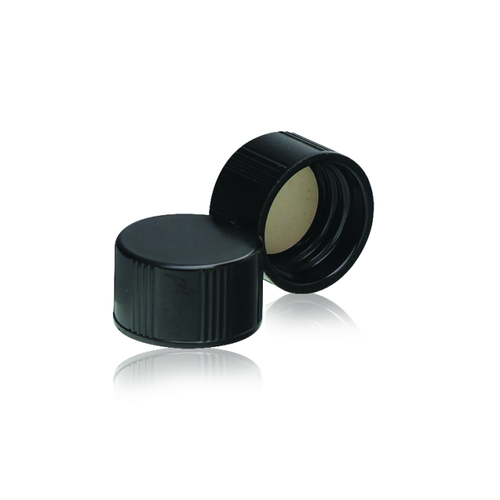
WHEATON 240683
33-430 Thread
Black Phenolic
Gray Chlorobutyl/50
Open-Top Closure
Autoclavable
1,000/Case
WHEATON 240683: understanding the 33-430 open-top cap and gray chlorobutyl septum
The WHEATON® 240683 is a laboratory screw closure manufactured by DWK Life Sciences. It combines a black phenolic cap, a 33-430 thread finish, and a gray chlorobutyl/50 septum with flange. The cap's open-top geometry provides access to the elastomeric septum for syringe-based liquid handling.
This configuration is designed for compatible WHEATON media bottles. The cap body, elastomeric septum, bottle neck, and laboratory procedure must be considered together because each component affects the suitability of the finished container-and-closure system.
Manufacturer part number 240683 is supplied in a 1,000-count case. DWK lists the closure as autoclavable but does not provide a product-specific sterilization cycle, validated leak rating, or supplied-sterile designation in the reviewed SKU specifications.
Operations takeaway: A correct closure selection requires more than matching the nominal cap diameter. Verify the 33-430 thread finish, the gray chlorobutyl/50 formulation, the required syringe-access method, and the processing requirements of the complete bottle-and-closure assembly.
Specifications (SKU controls for RFQs, SOPs, and receiving)
- Manufacturer: DWK Life Sciences
- Brand: WHEATON®
- Catalog number: 240683
- Product category: Laboratory screw caps and closures
- Closure style: Open-top screw cap with septum
- Thread finish: 33-430
- Cap material: Phenolic resin
- Cap color: Black
- Liner material: Gray butyl
- Detailed septum formulation: Gray chlorobutyl/50
- Septum design: Septum with flange
- Access: Syringe access through the open-top closure
- Autoclavable: Yes, according to the manufacturer
- Intended bottle family: Compatible WHEATON media bottles
- Packaging: 1,000 caps per case
- Supplied sterility: Not established in the reviewed SKU specifications
- Pre-slit configuration: Not confirmed for part number 240683
- Exact external cap dimensions: Not published in the reviewed specifications
- Validated pressure, vacuum, or leak rating: Not established in the reviewed SKU specifications
Specification-control note: DWK's product specification uses the abbreviated material description "Gray Butyl." Its detailed WHEATON closure documentation identifies the relevant septum formulation as "Gray Chlorobutyl/50." Use the exact manufacturer part number when requesting certificates, technical clarification, or purchase quotations.
Understanding the 33-430 thread finish
Laboratory screw closures are identified using a nominal diameter and thread-style designation. In the 33-430 format, the first number indicates an approximate nominal closure diameter of 33 mm, while the second number identifies the specific thread configuration.
DWK's Closure Liner Guide explains that matching the container and closure thread finishes is essential. The nominal diameter alone is not sufficient to determine fit.
| Thread feature |
Selection significance |
| 33 |
Approximate nominal closure diameter in millimeters |
| 430 |
Specific thread style required for the matching bottle finish |
| 33-430 container |
The intended thread-finish match for WHEATON 240683 |
| 33-400 container |
Different thread style; do not assume compatibility |
Compatibility checkpoint: The 33-430 designation is not a published measurement of the cap's outside diameter. Check the container manufacturer's neck-finish specification, particularly when substituting bottles from different product families or manufacturers.
Closure construction: the cap body, opening, septum, and flange
WHEATON 240683 contains components with different mechanical and material functions. Understanding these differences helps laboratories avoid treating every 33-430 cap as an equivalent closure.
| Component |
Function |
| Black phenolic cap |
Provides the rigid threaded closure body |
| 33-430 internal thread |
Engages the corresponding bottle-neck finish |
| Open-top aperture |
Exposes the septum for syringe access |
| Gray chlorobutyl/50 septum |
Provides the pierceable elastomeric access interface |
| Flange configuration |
Part of the manufacturer's specified septum and closure construction |
The open-top aperture does not itself create a seal. The complete closure's suitability depends on the elastomeric component, its seating against the bottle, the applied closure condition, and the intended operating environment.
Phenolic resin: why the cap material matters
Phenolic resin is a thermosetting polymer material commonly used in laboratory screw-cap construction. Thermoset resins contain a crosslinked structure formed during curing, distinguishing them from thermoplastic materials that can be repeatedly softened and remolded by heat.
For WHEATON 240683, phenolic resin forms the rigid screw-cap body, while the chlorobutyl rubber supplies the elastomeric access component. The two materials should not be assumed to have identical chemical resistance or thermal behavior.
Material qualification: The manufacturer lists this finished cap configuration as autoclavable. This designation does not provide a universal maximum operating temperature, chemical exposure limit, or approved number of processing cycles for every possible laboratory application.
Gray chlorobutyl/50: elastomer characteristics and limitations
Chlorobutyl is a halogenated butyl rubber material. DWK identifies the gray chlorobutyl/50 formulation in its technical guidance on rubber stopper materials. The manufacturer's formulation description discusses permeability, chemical resistance, autoclavability, and applications involving lyophilization.
The following characteristics are general manufacturer descriptions of the elastomer formulation. They are not guaranteed performance specifications for WHEATON 240683 when installed on an arbitrary bottle.
- Gas and vapor permeability: DWK describes gray chlorobutyl/50 as having low gas and vapor permeability.
- Animal and vegetable oils: DWK identifies resistance to these materials at the elastomer-formulation level.
- Lyophilization: The formulation is described as having characteristics useful for lyophilization applications.
- Autoclavability: The formulation can be autoclaved according to DWK's general material guidance.
- Irradiation: DWK describes the elastomer formulation as capable of irradiation; no irradiation-validation claim is established here for the finished 240683 closure.
- Chemical limitations: The manufacturer describes poor resistance to mineral oil and aliphatic, aromatic, and chlorinated solvents.
Important distinction: Low permeability of an elastomer does not establish that an assembled bottle is gas-tight, hermetically sealed, or leakproof. The cap, septum, bottle neck, handling method, and processing conditions affect the performance of the completed assembly.
Chemical compatibility: use the actual chlorobutyl formulation
DWK's Closure Liner Guide provides general chemical-resistance characteristics for gray chlorobutyl/50. The information below summarizes those material-level observations and should be used as an initial screening reference rather than a complete compatibility approval.
| Chemical or property |
Manufacturer guidance for gray chlorobutyl/50 |
| Animal oils |
Resistant at the formulation level |
| Vegetable oils |
Resistant at the formulation level |
| Mineral oil |
Poor resistance |
| Aliphatic solvents |
Poor resistance |
| Aromatic solvents |
Poor resistance |
| Chlorinated solvents |
Poor resistance |
| Gas and vapor permeability |
Low permeability characteristic |
| Other chemicals and mixtures |
Evaluate independently; no universal compatibility designation |
Chemical compatibility can depend on concentration, exposure duration, temperature, pressure, and the interaction between multiple materials. Evaluate both the phenolic cap and the chlorobutyl septum where either component may contact the chemical.
Selection warning: Do not apply the chemical-resistance properties of PTFE-faced liners, silicone septa, bromobutyl rubber, or unrelated chlorobutyl formulations to WHEATON 240683. A different elastomer formulation can have materially different compatibility characteristics.
Syringe access, septum puncture, and resealing considerations
The principal functional difference between an open-top septum cap and a solid-top screw cap is the ability to access the contents through a pierceable elastomeric surface.
In a qualified sampling procedure, a needle can pass through the septum to add or withdraw liquid without removing the complete screw cap. The closure must nevertheless remain appropriate for the selected needle, fluid, container, and sampling conditions.
- Needle selection: Establish the appropriate needle type, gauge, and technique through the laboratory procedure.
- Septum damage: Inspect for tearing, puncture enlargement, deformation, and visible damage.
- Coring: Evaluate the risk of elastomer fragments entering the contents during needle penetration.
- Repeated access: Do not assume a validated number of punctures or resealing cycles without supporting test data.
- Aseptic handling: A pierceable septum does not independently establish sterile access or prevent microbial contamination.
- Closure integrity: Evaluate the assembly after the intended handling sequence if leak performance or container integrity is critical.
DWK also describes pre-slit liners in the broader open-top closure family. However, the individual specifications reviewed for 240683 do not confirm a pre-slit design. Do not classify this SKU as pre-slit or specifically validated for automated liquid handling without manufacturer confirmation.
Autoclavability, sterilization, and processing requirements
DWK lists Autoclavable: Yes for manufacturer part number 240683. This is an important product characteristic, but autoclavability and supplied sterility are separate concepts.
Autoclavability indicates that the closure is intended to tolerate appropriate autoclave processing. It does not establish that the product arrives sterile, that a particular autoclave cycle has been validated for every use, or that an assembled and filled bottle can be safely processed while tightly sealed.
- Verify component compatibility: Confirm the bottle, cap, septum, and contents are suitable for the approved process.
- Define closure condition: Follow the validated procedure for venting, cap positioning, or closure application during heating and cooling.
- Use approved cycle parameters: Apply the laboratory's qualified temperature, exposure time, loading, and cooling conditions.
- Inspect afterward: Check for damaged caps, displaced septa, deformation, or changes in closure fit.
- Maintain process records: Document processing and release status where required by the facility's quality system.
Processing boundary: The reviewed specifications do not establish a SKU-specific sterilization time, temperature, maximum cycle count, sterility assurance level, endotoxin limit, or ready-to-use sterile presentation. Obtain additional manufacturer documentation when these parameters are required by the application.
Cleanroom suitability and controlled-environment considerations
WHEATON 240683 may be considered for appropriately qualified laboratory workflows occurring in controlled environments. However, the manufacturer's reviewed SKU specifications do not establish a product-specific ISO 14644 cleanroom classification, particle-release specification, or sterile packaging designation.
ISO cleanroom classification describes an environmental condition; it does not automatically certify a cap, septum, or laboratory bottle as suitable for that environment.
- Material introduction: Follow facility procedures for packaging removal, transfer, and staging.
- Cleaning requirements: Define any preparation process required before the closure enters a controlled work area.
- Sterile operations: Use only materials and preparation methods approved for the specific aseptic procedure.
- Particle and residue concerns: Qualify the closure for applications with strict contamination limits rather than assuming cleanroom-grade performance.
- Handling controls: Prevent contact between the septum and uncontrolled surfaces during storage and preparation.
Laboratory applications and technical selection checkpoints
The open-top design can support several laboratory workflows when the complete assembly and method are qualified.
- Media bottle access: Confirm bottle finish, media compatibility, preparation method, and required access technique.
- Liquid sampling: Define the needle type, puncture procedure, allowable access frequency, and sample-integrity requirements.
- Liquid addition: Qualify the addition procedure for the contents and applicable pressure or contamination risks.
- Research and analytical workflows: Evaluate potential elastomer interaction with the sample, including extractables or leachables where relevant.
- Autoclave preparation: Confirm the complete bottle-and-closure assembly is approved for the selected processing cycle.
- Recurring laboratory supply: Standardize the approved manufacturer SKU and case quantity in purchasing and inventory records.
These are selection and qualification checkpoints, not manufacturer-issued application approvals, analytical method validations, or process-specific performance guarantees.
Comparing verified WHEATON 33-430 closure configurations
DWK offers multiple 33-430 laboratory bottle caps. These configurations differ in cap style, liner construction, and purchasing quantity, even though they share the same nominal thread finish.
| WHEATON SKU |
Closure configuration |
Qty/Case |
| 240683 |
Open-top black phenolic; gray chlorobutyl/50 septum and flange |
1,000 |
| 240680 |
Open-top black phenolic; gray chlorobutyl/50 septum and flange |
100 |
| 240280 |
Solid-top black phenolic; 14B rubber liner |
200 |
| 240480 |
Solid-top black phenolic; PTFE-faced 14B rubber liner |
100 |
| W240540 |
Open-top black phenolic; linerless |
200 |
Selection rule: A common 33-430 finish does not make these products functionally equivalent. Solid-top, open-top, linerless, rubber-lined, and PTFE-faced closure configurations have different access and material characteristics. Select the appropriate manufacturer SKU for the validated application.
Storage and handling of phenolic caps and elastomeric septa
The reviewed manufacturer product specifications do not establish a specific shelf life or numerical storage-temperature range for WHEATON 240683. Facilities should obtain applicable manufacturer storage requirements when these are part of their purchasing or quality specifications.
General laboratory handling practices should minimize unnecessary exposure to conditions that could damage the cap, alter the elastomer, or compromise the cleanliness of the closure.
- Maintain the manufacturer's original product identification and required inventory records.
- Protect unused closures from physical damage and unnecessary contamination.
- Avoid uncontrolled contact with incompatible solvents, oils, or other chemicals.
- Inspect the phenolic body and elastomeric septum before use.
- Separate processed and unprocessed closures when required by laboratory procedures.
- Follow any manufacturer-issued storage or expiration requirements obtained for the specific product lot.
Receiving and inspection checklist
Laboratories using controlled purchasing procedures should confirm the closure's identity and physical condition before releasing a received case for use.
- Confirm the SKU: Verify WHEATON manufacturer part number 240683 against the purchase order.
- Confirm the quantity: Verify the 1,000-count case configuration.
- Check closure identity: Confirm black phenolic open-top construction and 33-430 thread designation.
- Check the septum: Verify the specified gray butyl/chlorobutyl component and its proper positioning.
- Inspect for damage: Look for cracks, deformed threads, torn septa, or visibly compromised components.
- Review packaging: Investigate damaged cases or disturbed packaging when required by the receiving procedure.
- Capture documentation: Record any required lot identification or manufacturer documentation.
- Confirm release status: Apply the facility's inspection, preparation, and acceptance requirements before use.
Important use limitations and unsupported assumptions
- Not universally compatible: The cap requires an appropriate 33-430 bottle finish and qualified sealing configuration.
- Not confirmed pre-slit: The reviewed 240683 specifications do not identify a pre-slit septum.
- No published repeated-puncture allowance: Do not assume a defined maximum number of access cycles.
- No validated leakproof claim: The product listing does not establish a universal leak or gas-tightness rating.
- No supplied-sterile designation: Autoclavability is not a sterile packaging certification.
- No universal solvent compatibility: Gray chlorobutyl/50 has documented chemical-resistance limitations.
- No product-specific ISO class: The cap is not assigned an ISO cleanroom classification in the reviewed specifications.
- No universal pressure rating: Do not assume suitability for pressurized or evacuated assemblies.
- No verified product-specific temperature limit: Do not substitute an arbitrary maximum service temperature or autoclave cycle for manufacturer or process documentation.
Technical FAQs
What is the exact thread size of WHEATON 240683?
The manufacturer identifies a 33-430 thread finish. Match this to a compatible 33-430 bottle. Do not assume compatibility with 33-400 threads.
Does the cap include the rubber septum?
Yes. DWK identifies the product as an open-top phenolic cap with a gray chlorobutyl/50 septum and flange.
Is the rubber butyl or chlorobutyl?
The product specification uses the general description "Gray Butyl." More detailed WHEATON technical documentation identifies the elastomer formulation as gray chlorobutyl/50.
What is the difference between 240683 and 240680?
Both are 33-430 open-top black phenolic caps with gray chlorobutyl/50 septa and flanges. Part number 240683 contains 1,000 caps per case, while 240680 contains 100 caps per case.
Can I access the contents using a syringe?
Yes. DWK identifies syringe access as a purpose of the open-top cap design. The actual needle, puncture procedure, and sample compatibility must be assessed for the intended application.
Is the septum pre-slit?
Pre-slit liners are mentioned within the manufacturer's broader product-family description, but a pre-slit configuration is not confirmed for manufacturer part number 240683 in the reviewed specifications.
How many times can the septum be punctured?
The reviewed product documentation does not establish a validated number of puncture or resealing cycles. Determine the acceptable access frequency through manufacturer data or laboratory qualification.
Is WHEATON 240683 autoclavable?
Yes. The manufacturer lists the product as autoclavable. Specific cycle parameters and complete assembly suitability must be established for the intended process.
Does autoclavable mean the caps arrive sterile?
No. Autoclavability identifies a processing capability. The reviewed SKU documentation does not establish a supplied-sterile designation or sterility assurance level.
Is the septum compatible with all laboratory solvents?
No. DWK's gray chlorobutyl/50 material guidance describes poor resistance to mineral oil and aliphatic, aromatic, and chlorinated solvents. Confirm chemical compatibility for the actual contents.
Can this cap be used on any WHEATON media bottle?
Not automatically. The selected bottle must have a compatible 33-430 thread finish and an appropriate sealing geometry. WHEATON media bottles are available with different neck finishes.
Are the caps supplied with laboratory bottles?
No. This manufacturer part number identifies a case of 1,000 closures, not a complete bottle-and-cap package.
Manufacturer documentation and technical references
Product identity, material, thread finish, autoclavability, and case quantity were checked against DWK manufacturer specifications. The detailed septum-and-flange description was confirmed against WHEATON closure documentation. Application guidance and qualification checkpoints do not represent additional manufacturer certifications.
Why purchase WHEATON laboratory closures from SOSCleanroom?
- Exact part-number control: Reference WHEATON 240683 to avoid confusion with alternate cap styles and quantities.
- Laboratory product support: Our team can assist with manufacturer specifications, purchasing questions, and closure-selection considerations.
- Documentation assistance: SOSCleanroom can help customers identify available DWK technical information for their purchasing or quality procedures.
- Case configuration support: Confirm whether the 100-count or 1,000-count closure configuration meets your purchasing requirements.
- Centralized purchasing: Source WHEATON laboratory products and other critical-environment supplies through Specialty Optical Systems, Inc.
If you have any questions please email us at Sales@SOSsupply.com or give us a call at (214) 340-8574.
For additional product guidance, use the SOSCleanroom AI ChatBot or contact our team for manufacturer documentation assistance.
Technical insight: A compatible thread finish is only the starting point. The cap, septum, bottle, contents, access method, and processing conditions must be evaluated as a complete system.
Last updated: October 26, 2026
© 2026 SOSCleanroom. All rights reserved.