The Technical Vault
By SOSCleanroom
WHEATON 374305
Peroxide-Cured Silicone
3 mm ID
7.6 mm OD
2.3 mm Wall
25 ft / 7.62 m
Autoclavable
1 Length/Case
WHEATON 374305: selecting silicone tubing by bore, wall thickness, material, and fluid-transfer method
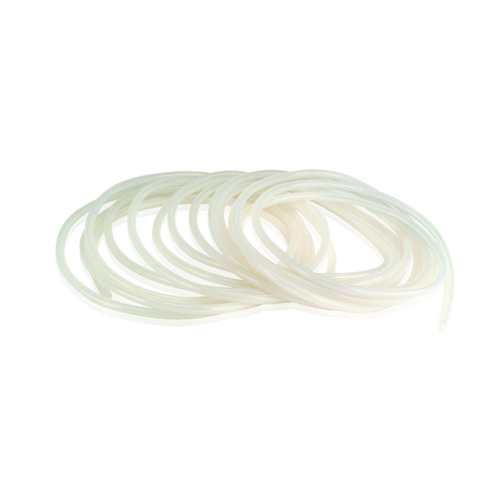
WHEATON® 374305 is peroxide-cured silicone rubber tubing supplied by DWK Life Sciences as a 25 ft (7.62 m) bulk length. It has a manufacturer-specified 3 mm inside diameter, 7.6 mm outside diameter, and 2.3 mm wall thickness.
These dimensions are important for laboratory fluid-transfer systems, particularly peristaltic pumps. Inside diameter helps determine the fluid passage, while outside diameter and wall thickness influence the interaction between the tubing and the pump head or connector system.
The tubing is manufactured from silicone rubber using a peroxide-curing process. It is supplied without fittings, unlike separately identified WHEATON tubing assemblies that include a glass sinker and delivery nozzle.
Operations takeaway: Selecting tubing by inside diameter alone can cause pump-head or connector mismatches. Confirm the 3 mm ID, 7.6 mm OD, 2.3 mm wall thickness, peroxide-cured silicone material, and 25 ft bulk configuration before introducing WHEATON 374305 into an established laboratory fluid-transfer procedure.
Specifications (SKU controls for RFQs, SOPs, and receiving)
- Manufacturer: DWK Life Sciences
- Brand: WHEATON®
- Catalog number: 374305
- Product: Peroxide-cured silicone bulk tubing
- Material: Silicone rubber
- Curing process: Peroxide-cured
- Inside diameter: 3 mm
- Outside diameter: 7.6 mm
- Wall thickness: 2.3 mm
- Length: 7,620 mm (7.62 m / 25 ft)
- Configuration: Bulk tubing supplied without fittings
- Autoclavability: Yes, manufacturer-listed
- Quantity per case: 1 bulk tubing length
- Glass sinker included: No
- Polypropylene delivery nozzle included: No
- Supplied-sterile designation: Not established in reviewed manufacturer data
- Validated operating pressure: Not established in reviewed SKU specifications
- Validated pumping service life: Not established in reviewed SKU specifications
- Specific autoclave cycle: Not provided in reviewed SKU specifications
- Product-specific USP Class VI or FDA compliance: Not established in reviewed SKU specifications
Documentation rule: Manufacturer dimensions and packaging identify the product. They do not establish processing validation, sterile status, chemical compatibility with every liquid, or compliance with a particular regulated fluid-contact standard. Obtain additional documentation when these requirements govern acceptance.
Tubing geometry: understanding ID, OD, and wall thickness
Three dimensions describe the cross-sectional geometry of a round laboratory tube: inside diameter (ID), outside diameter (OD), and wall thickness. Each dimension serves a different selection purpose.
| Dimension |
WHEATON 374305 |
Selection significance |
| Inside diameter |
3 mm |
Internal fluid passage and pump/connector selection |
| Outside diameter |
7.6 mm |
Overall tube size, clearance, and mechanical fit |
| Wall thickness |
2.3 mm |
Tube compression and pump-head compatibility |
| Bulk length |
7,620 mm |
Length available for preparing the fluid-transfer setup |
For a uniform round tube, the nominal outside diameter can be related to the inside diameter and wall thickness:
OD = ID + (2 x wall thickness)
For WHEATON 374305: 3 mm + (2 x 2.3 mm) = 7.6 mm. This agrees with DWK's published outside diameter.
Dimensional control: These are manufacturer-listed dimensions, not a complete dimensional tolerance specification. Where tubing fit is critical, obtain applicable tolerance information and qualify the actual tubing with the pump head and fittings. Do not substitute a tube based only on a matching 3 mm inside diameter.
How silicone tubing functions in a peristaltic pump
Peristaltic pumps move liquid by mechanically compressing and releasing flexible tubing. As the rollers turn, successive portions of the tubing are compressed, creating a moving zone that displaces fluid through the tube.
Unlike pumping systems where the process liquid passes directly through internal pump mechanisms, a conventional peristaltic pump generally confines the fluid to the tubing's internal passage. This makes the tubing material, connection system, and tubing condition central to fluid-path compatibility.
Silicone rubber is used in laboratory peristaltic applications because its elastomeric structure can support repeated flexing and compression. However, its actual operating life depends on the tubing formulation, pump-head design, compression setting, rotational speed, fluid, temperature, and operating duration.
- Tubing bore: Influences the amount of fluid displaced through the tubing.
- Wall thickness: Affects how the tube interacts with the pump-head compression mechanism.
- Elastic recovery: Influences how the tube returns toward its original shape after roller passage.
- Rotational speed: Influences the frequency of compression cycles and liquid delivery behavior.
- Fluid characteristics: Viscosity, chemical composition, and temperature can affect pumping performance.
- Mechanical wear: Repeated compression can eventually change tubing geometry and fluid delivery consistency.
Performance qualification: A 3 mm tubing bore does not establish a universal flow rate or dispensing accuracy. Calibrate the complete pump system using the actual tubing, liquid, speed, and setup. Recalibrate after tubing replacement or when the process requires it.
Pump-head selection and tubing compatibility
WHEATON 374305 has a 2.3 mm wall thickness, which must be considered when selecting peristaltic pump heads. Some pumping systems have different heads or compression arrangements for different tubing wall thicknesses.
DWK's WHEATON peristaltic equipment literature identifies pump-head options designed around 2.3 mm-wall tubing as well as other tubing formats. This supports the importance of checking the specified head and tubing configuration rather than assuming every pump accepts the same tubing.
- Identify the pump model: Confirm the manufacturer's model and installed pump-head configuration.
- Verify tubing wall compatibility: Confirm that the pump head is appropriate for 2.3 mm-wall tubing.
- Check the bore setting: Verify that the system accepts a 3 mm inside diameter.
- Confirm mechanical fit: Check tube retention, clamp adjustment, and applicable outside-diameter constraints.
- Install according to instructions: Follow the pump manufacturer's procedure to avoid twisting, overcompression, or improper retention.
- Calibrate and inspect: Confirm delivery performance and inspect the installed tubing during commissioning.
The WHEATON product record does not establish compatibility with every UniSpense, OmniSpense, or third-party peristaltic pump configuration. Confirm the exact equipment and pump-head requirements before substitution.
Peroxide-cured silicone: understanding the material and curing process
Silicone rubber is an elastomeric polymer material based on a siloxane structure. Its flexible characteristics make it useful in tubing applications requiring bending or repeated deformation.
The term peroxide-cured describes a curing method in which a peroxide-based initiating system promotes crosslinking of the silicone elastomer. Crosslinking creates the rubber network responsible for the material's elastic behavior.
Peroxide curing differs from platinum-catalyzed addition curing. These processes can produce silicone elastomers with different formulation characteristics, extractables profiles, processing histories, and qualification documentation.
- Material family: Silicone rubber.
- Identified cure system: Peroxide-cured.
- Mechanical function: Flexible elastomeric tubing suitable for applications requiring an appropriately qualified compressible fluid path.
- Extractables: Product-specific extractables or leachables data are not provided in the reviewed SKU specifications.
- Post-curing: No product-specific post-cure process or residual-peroxide specification is established in the reviewed record.
- Regulatory qualification: No product-specific USP Class VI, ISO 10993, or FDA fluid-contact compliance claim has been established from the reviewed SKU record.
Material-selection warning: Do not transfer purity, biological testing, extractables, or animal-derived-component claims from WHEATON platinum-cured silicone tubing or other product families to peroxide-cured SKU 374305. Obtain documentation for the exact product when such requirements apply.
Chemical compatibility and fluid-contact considerations
Chemical compatibility is one of the most important considerations in silicone tubing selection. A material may perform appropriately with one aqueous formulation but exhibit swelling, changes in elasticity, adsorption, permeation, or degradation with another liquid.
General silicone compatibility information can help identify candidate materials, but it cannot establish the performance of every silicone formulation or an assembled fluid-transfer system. The actual liquid composition, temperature, concentration, exposure time, and mechanical conditions must be considered.
| Fluid or condition |
Qualification considerations |
| Water-based laboratory solutions |
Evaluate formulation, temperature, extractables, and process requirements |
| Biological media |
Confirm fluid compatibility, required cleanliness, and applicable biological qualification |
| Organic solvents and hydrocarbons |
Evaluate possible swelling, material interaction, and changes in tubing performance |
| Acidic or alkaline liquids |
Confirm compatibility for the specific chemical, concentration, and temperature |
| Oils and lubricating fluids |
Assess material swelling, absorption, and long-term exposure effects |
| Sensitive analytical samples |
Evaluate potential adsorption, extractables, leachables, and sample recovery |
| Heated or continuously pumped fluids |
Evaluate combined temperature, chemical, and repeated-compression effects |
Compatibility rule: No chemical-specific resistance ratings are assigned to WHEATON 374305 in the reviewed manufacturer product specifications. This table describes qualification questions, not a pass/fail chemical compatibility chart. Obtain manufacturer guidance or perform an approved material assessment before use with sensitive or aggressive fluids.
Peroxide-cured versus platinum-cured silicone tubing
WHEATON offers different silicone tubing configurations. Peroxide-cured and platinum-cured silicone are not automatically equivalent, even when the nominal inside diameter is similar.
| Characteristic |
Peroxide-cured |
Platinum-cured |
| Curing method |
Peroxide-initiated crosslinking |
Platinum-catalyzed addition curing |
| 374305 designation |
Confirmed |
Not applicable to this SKU |
| Extractables profile |
Requires formulation-specific data |
Requires formulation-specific data |
| Regulatory claims |
Verify exact product documentation |
Verify exact product documentation |
| Substitution suitability |
Requires application qualification |
Requires application qualification |
Do not select a different curing formulation based solely on a general assumption that one process is always more appropriate for every application. The approved material specification, testing, dimensions, and intended fluid contact determine the correct selection.
Autoclavability, supplied sterility, and processing requirements
DWK lists WHEATON 374305 as autoclavable. This means the manufacturer identifies the tubing as suitable for appropriate autoclave processing; it does not by itself specify the processing conditions required for a particular application.
The reviewed SKU data do not establish a supplied-sterile designation, validated sterility assurance level, maximum number of processing cycles, or a universal temperature-and-time schedule.
- Confirm processing scope: Determine whether the procedure applies to the tubing alone or an assembled fluid path.
- Check connected components: Verify that fittings, clamps, and any other materials can tolerate the required process.
- Use approved cycle conditions: Apply facility-qualified loading, temperature, exposure, and cooling procedures.
- Consider lumen access: Confirm that the selected process effectively treats the required internal and external surfaces.
- Inspect after processing: Examine the tubing for distortion, discoloration, cracking, or other changes.
- Maintain records: Document the preparation method and release status when required by the laboratory quality system.
Processing boundary: Do not assume that the manufacturer's autoclavability designation establishes suitability for every autoclave cycle, repeated steam exposure, or sterile manufacturing application. Obtain the applicable processing documentation when a validated result is required.
Pump calibration, flow behavior, and dispensing accuracy
Peristaltic pumping performance depends on more than tubing dimensions. The installed pump head, roller geometry, speed, tubing condition, fluid viscosity, and operating temperature all influence flow and dispensing behavior.
An appropriate calibration procedure establishes the delivered liquid quantity using the actual equipment and operating conditions. It is especially important when fluid volume, dispense consistency, or sample recovery affects laboratory results.
- Identify the tubing: Confirm manufacturer SKU, bore, and wall thickness.
- Prepare the system: Install the tubing and selected fittings according to the pump manual.
- Prime the fluid path: Remove air according to the laboratory procedure.
- Select operating conditions: Set the approved speed and dispensing parameters.
- Measure the output: Use an appropriate calibrated measurement method.
- Adjust and verify: Establish the delivered volume or flow rate within the process acceptance criteria.
- Recheck when necessary: Recalibrate after material changes, tubing replacement, or other changes identified in the SOP.
Accuracy note: Manufacturer pump-performance specifications should not be transferred automatically to an individual tubing SKU. No standalone flow-rate accuracy, dispense tolerance, or maximum fluid pressure is assigned to 374305 here.
Tubing wear, mechanical fatigue, and replacement decisions
Flexible tubing in a peristaltic pump experiences repeated cycles of compression and recovery. Over time, these cycles may contribute to mechanical fatigue, loss of elastic recovery, dimensional changes, or surface damage.
The reviewed WHEATON 374305 product data do not specify an allowable service-hour limit or validated replacement interval. Laboratories should define inspection and replacement rules appropriate to the actual operating duty.
- Visual damage: Inspect for cracks, splits, cuts, and abrasion.
- Compression changes: Look for persistent flattening or loss of recovery.
- Connection integrity: Check for slipping, leaks, or loosening at fittings.
- Flow variation: Investigate delivery changes not explained by process or pump settings.
- Material changes: Investigate swelling, discoloration, tackiness, or unexpected softening.
- Replacement control: Use the facility's approved change-out criteria rather than relying on an unsupported universal service-life claim.
Cleanroom and controlled-environment suitability
WHEATON 374305 can be evaluated for use in laboratory fluid-transfer systems operating within controlled environments. However, its manufacturer product specifications do not establish a product-specific ISO 14644 classification, cleanroom packaging grade, particle-release specification, or sterile presentation.
For sensitive laboratory or cleanroom processes, evaluate the tubing as a material introduced into the controlled environment and as a potential fluid-contact surface.
- Material transfer: Follow approved packaging removal and introduction procedures.
- Clean preparation: Define any required cutting, cleaning, rinsing, or preparation method.
- Fluid-contact controls: Evaluate relevant extractables, leachables, adsorption, and sample-contamination concerns.
- Aseptic use: Verify sterilization and assembly requirements independently of the tubing's general autoclavability designation.
- Traceability: Record the manufacturer part number and any required material lot information.
Cleanroom qualification rule: ISO classification applies to the environment, not automatically to the tubing. Do not designate 374305 as ISO Class 5, sterile, low-endotoxin, or cleanroom processed without specific supporting documentation.
Comparing verified WHEATON silicone tubing configurations
DWK identifies several peroxide-cured silicone bulk tubing sizes with a common 2.3 mm wall thickness. The principal differences are the inside and outside diameters. A separate 5 ft assembly is also available for the 3 mm ID configuration.
| WHEATON SKU |
ID |
OD |
Wall |
Length / Configuration |
| 374304 |
2 mm |
6.6 mm |
2.3 mm |
25 ft bulk, no fittings |
| 374305 |
3 mm |
7.6 mm |
2.3 mm |
25 ft bulk, no fittings |
| 374306 |
6 mm |
10.6 mm |
2.3 mm |
25 ft bulk, no fittings |
| 374308 |
8 mm |
12.6 mm |
2.3 mm |
25 ft bulk, no fittings |
| 374311 |
3 mm |
7.6 mm |
2.3 mm |
5 ft assembly, sinker and nozzle |
The bulk configurations listed above are supplied as one length per case. The shorter 374311 assembly includes a borosilicate glass sinker and polypropylene delivery nozzle. These are distinct manufacturer SKUs and should not be substituted automatically.
Selection rule: A change in tubing ID changes the fluid passage and may affect pump delivery behavior, fitting selection, and mechanical compatibility. A change from bulk tubing to a preassembled configuration also changes the included components. Confirm both the dimensions and the product configuration.
Storage, cutting, and handling of bulk silicone tubing
The reviewed DWK product specifications do not identify a product-specific shelf life, numerical storage-temperature range, or validated storage duration for WHEATON 374305.
General laboratory handling practices should prevent unnecessary contamination, mechanical damage, and uncontrolled contact with incompatible chemicals. Where storage conditions are a procurement requirement, request manufacturer-specific guidance.
- Maintain identification: Preserve the manufacturer SKU and applicable lot records.
- Prevent mechanical damage: Avoid crushing, sharp edges, excessive stretching, and tight bends.
- Control cutting: Use an appropriate clean cutting tool and inspect the finished tube ends.
- Protect the internal passage: Minimize contamination of the tubing lumen during preparation and storage.
- Control chemical exposure: Avoid uncontrolled contact with fluids or cleaning agents that have not been assessed for compatibility.
- Separate processing status: Maintain identification of processed and unprocessed tubing when required by the quality system.
Receiving and inspection checklist
Laboratories with defined material controls should inspect incoming tubing before it is introduced into an approved fluid-transfer setup.
- Verify catalog number: Confirm WHEATON 374305 against the purchase order.
- Confirm material: Verify peroxide-cured silicone rubber.
- Confirm dimensions: Check the specified 3 mm ID, 7.6 mm OD, and 2.3 mm wall thickness.
- Confirm length: Verify the 25 ft (7.62 m) bulk configuration.
- Confirm case quantity: One bulk tubing length per case.
- Check included components: Confirm that the received item matches the tubing-only configuration.
- Inspect physical condition: Check packaging and tubing for visible damage or contamination.
- Capture documentation: Record required manufacturer and lot information.
- Release according to procedure: Complete applicable inspection, preparation, and quality checks before use.
Important use limitations and unsupported assumptions
- Not a complete dispensing assembly: The bulk tubing does not include the glass sinker or polypropylene delivery nozzle.
- Not universally pump-compatible: Verify the installed pump head and the 2.3 mm wall requirement.
- Not confirmed sterile: The reviewed product data do not establish a supplied-sterile designation.
- No universal chemical resistance: Evaluate each fluid and its actual exposure conditions.
- No published universal flow rate: Flow depends on the complete pumping system.
- No validated service life: Establish change-out and inspection criteria for the operating application.
- No specified pressure rating: Do not assign a maximum operating pressure without manufacturer or system qualification.
- No product-specific ISO class: The reviewed SKU data do not designate cleanroom processing or an ISO classification.
- No confirmed USP Class VI certification: Do not transfer compliance claims from separately identified platinum-cured tubing.
- No validated sterilization cycle: The manufacturer's autoclavability designation is not a complete cycle specification.
Technical FAQs
What are the exact dimensions of WHEATON 374305?
DWK identifies a 3 mm inside diameter, 7.6 mm outside diameter, 2.3 mm wall thickness, and 7,620 mm length.
How long is each piece of tubing?
The bulk tubing is supplied in a 7.62 m (25 ft) length. The manufacturer identifies one length per case.
Does WHEATON 374305 include a glass sinker and delivery nozzle?
No. Part number 374305 is a bulk tubing configuration supplied without fittings. The separately identified 374311 assembly contains a shorter tubing section with a borosilicate glass sinker and polypropylene delivery nozzle.
Is this silicone tubing peroxide-cured or platinum-cured?
WHEATON 374305 is identified by DWK as peroxide-cured silicone tubing. It should not be described as platinum-cured.
Why does the outside diameter measure 7.6 mm?
The nominal outside diameter equals the 3 mm inside diameter plus two 2.3 mm walls, resulting in 7.6 mm.
Is WHEATON 374305 suitable for peristaltic pumps?
It belongs to the WHEATON tubing range associated with laboratory peristaltic pumping. Confirm that the specific pump head accepts the 3 mm bore and 2.3 mm wall thickness before installation.
Can I cut the bulk tubing to shorter lengths?
The bulk configuration allows tubing to be prepared for an application-specific setup. Use an approved cutting and handling method to preserve a suitable internal passage and clean tube ends.
Is the tubing autoclavable?
Yes. DWK lists the tubing as autoclavable. Specific cycle conditions and the suitability of a complete installed assembly must be established independently.
Does autoclavable mean the tubing is supplied sterile?
No. Autoclavability describes a processing capability. The reviewed SKU specifications do not establish supplied sterility.
Is this tubing USP Class VI certified?
No product-specific USP Class VI claim has been established from the reviewed WHEATON 374305 data. Request applicable manufacturer documentation if biological testing or a particular regulatory standard is required.
Can I use the tubing with any solvent?
No universal solvent-compatibility claim is established. Assess the fluid composition, concentration, temperature, exposure duration, and effect on the silicone elastomer.
Does the manufacturer specify a maximum flow rate?
The reviewed tubing specifications do not identify a standalone maximum flow rate. Delivery performance depends on the selected pump and operating conditions.
How often should the tubing be replaced?
The reviewed product specifications do not assign a universal replacement interval. Establish inspection and change-out requirements based on the system's operating duty and acceptance criteria.
What is the difference between 374305 and 374311?
Both have a 3 mm ID and 2.3 mm wall thickness. 374305 is a 25 ft bulk length without fittings, while 374311 is a 5 ft tubing assembly with a glass sinker and polypropylene delivery nozzle.
Manufacturer documentation and technical references
- WHEATON 374305 manufacturer specifications: Confirm the 3 mm inside diameter, 7.6 mm outside diameter, 2.3 mm wall thickness, 7,620 mm length, autoclavability, and bulk configuration. Contact SOSCleanroom for help obtaining current manufacturer records.
- WHEATON peristaltic pump technical literature: Manufacturer literature documents 2.3 mm-wall tubing configurations, tubing installation requirements, and pumping equipment selection. Use the manual appropriate to the actual installed pump model.
- Material qualification records: Where required, request current product-specific information regarding the silicone formulation, chemical compatibility, processing, and applicable testing.
- Additional technical assistance: SOSCleanroom can help customers identify manufacturer documentation or request clarification of product-specific specifications.
The specifications in this Technical Vault were checked against the current DWK product record and manufacturer WHEATON peristaltic tubing literature. No separate, product-specific manufacturer technical datasheet URL was verified for public linking. Manufacturer shopping and product-detail links have therefore been omitted.
Why purchase WHEATON silicone tubing from SOSCleanroom?
- Exact-SKU purchasing: SOSCleanroom can assist with WHEATON tubing part number, material, geometry, and configuration identification.
- Application-selection support: Our team can help identify relevant manufacturer specifications for laboratory fluid-transfer tubing.
- Documentation assistance: Request help identifying available DWK product documentation and purchasing requirements.
- Configuration control: Distinguish bulk tubing from complete tubing assemblies and avoid accidental material or dimensional substitutions.
- Centralized purchasing: Source laboratory supplies and critical-environment consumables through Specialty Optical Systems, Inc.
If you have any questions please email us at Sales@SOSsupply.com or give us a call at (214) 340-8574.
For additional product guidance, use the SOSCleanroom AI ChatBot or contact our team for manufacturer documentation assistance.
Technical insight: Accurate tubing selection requires verifying the internal bore, wall thickness, outside diameter, curing type, and complete pump-system requirements. A matching inside diameter alone does not establish interchangeability.
Last updated: October 26, 2026
© 2026 SOSCleanroom. All rights reserved.