
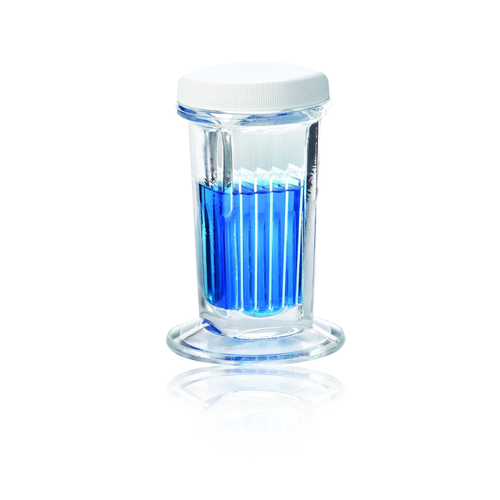
DWK 900570 WHEATON 5-10 Slide Unit Coplin Staining Jar, 60mL, with Screw Cap

$224.11
SKU: 900570 CASE 7 - 10 Business Days
(No reviews yet)
Availability:
7 - 10 Business Days
Shipping:
Calculated at Checkout

WHEATON® 900570 Coplin Staining Jar - 60 mL Soda-Lime Glass, 5–10 Slides, 58-400 Polypropylene Screw Cap, 6/Case

WHEATON® 900570 Coplin Staining Jar from DWK Life Sciences is a laboratory glass staining vessel designed for the manual processing of microscope slides and for use as a developing chamber in suitable thin-layer chromatography (TLC) procedures. Manufactured from soda-lime glass, the jar features a rectangular base, an approximate 60 mL capacity, and a white polypropylene screw cap with a 58-400 thread finish.

The internal design accommodates five standard 75 x 25 mm microscope slides individually in a vertical arrangement, or 10 slides positioned back-to-back. This provides two loading options for laboratory methods involving immersion in staining, rinsing, or other compatible processing solutions.

The jar has approximate inside-bottom dimensions of 26 mm long x 26 mm wide x 90 mm deep. These measurements describe the internal dimensions reported by DWK; they are not the jar's overall exterior dimensions or the dimensions of its threaded neck.

Each jar includes a linerless white polypropylene screw cap, identified by the manufacturer as replacement part number 900522. The cap is designed to reduce solvent evaporation during appropriate laboratory use and storage. Its function should not be interpreted as a certified airtight, leakproof, pressure-rated, or universal solvent-resistant seal.

WHEATON 900570 is also identified by DWK for use as a small developing chamber in thin-layer chromatography. Reagent and solvent selection must account for the soda-lime glass vessel, polypropylene cap, operating conditions, and the requirements of the specific analytical method.

Ordering note: WHEATON manufacturer part number 900570 is supplied as a case of six Coplin staining jars, each with a white linerless polypropylene 58-400 screw cap. Each jar has an approximate 60 mL capacity and holds five individual standard microscope slides or 10 slides back-to-back. Microscope slides, staining solutions, and the optional WHEATON 900575 slide grip are not included.

Specifications:
  • Manufacturer: DWK Life Sciences
  • Brand: WHEATON®
  • Manufacturer part number: 900570
  • Product type: Coplin microscope-slide staining jar
  • Product family: WHEATON 5–10 Slide Unit Coplin Staining Jar
  • Jar material: Soda-lime glass
  • Cap material: Polypropylene (PP)
  • Cap color: White
  • Cap style: Linerless screw cap
  • Cap thread finish: 58-400
  • Included replacement-cap reference: WHEATON 900522
  • Approximate capacity: 60 mL
  • Individual slide capacity: Five slides
  • Back-to-back slide capacity: 10 slides
  • Supported microscope slide size: 75 x 25 mm (3 x 1 in.)
  • Slide orientation: Vertical for five individual slides; back-to-back for 10 slides
  • Jar base: Rectangular
  • Approximate inside-bottom length: 26 mm
  • Approximate inside-bottom width: 26 mm
  • Approximate inside-bottom depth: 90 mm
  • Primary application: Manual microscope-slide staining
  • Additional application: Developing chamber for suitable thin-layer chromatography procedures
  • Cap function: Helps reduce solvent evaporation
  • Compatible optional accessory: WHEATON 900575 polypropylene slide grip, sold separately
  • Purchase unit: Case
  • Case quantity: Six jars with screw caps
  • Microscope slides included: No slides identified as included
  • Supplied sterility: Not established in the reviewed manufacturer specifications
  • Autoclavability: Not confirmed for this SKU; do not assume suitability for steam sterilization
What's Included With WHEATON 900570?

Each WHEATON 900570 unit consists of two principal components:

  • Soda-lime glass Coplin jar: The laboratory staining vessel, with a rectangular base and a nominal capacity of approximately 60 mL.
  • Linerless white polypropylene screw cap: The supplied 58-400 closure, identified by WHEATON as part number 900522, intended to help reduce solvent evaporation.

Microscope slides and a slide-holding grip are not included. WHEATON separately offers the 900575 polypropylene slide grip, which DWK identifies as fitting the 900570 Coplin jar and enabling the transfer of five slides as a group.

Where WHEATON 900570 Fits in Laboratory Workflows

Coplin jars are laboratory staining vessels designed to hold microscope slides during controlled immersion in staining or rinsing solutions. The WHEATON 900570 format supports manual workflows in which a limited number of prepared slides are processed together without requiring a larger staining dish or an automated staining instrument.

For microscopy applications, the jar accommodates either five individually positioned slides or 10 slides back-to-back. The appropriate arrangement depends on the specimen preparation and whether the staining solution must contact specific slide surfaces without obstruction.

DWK also identifies the jar as a potential thin-layer chromatography developing chamber. In a TLC workflow, a suitable vessel is used to contain the selected mobile phase while the analytical method governs solvent conditions, plate placement, development distance, and handling. WHEATON 900570's TLC suitability must be evaluated for the actual plate dimensions and solvent system.

Method qualification: The jar's approximate capacity and slide-holding configuration do not establish a validated staining method, fixed reagent fill volume, guaranteed TLC chamber saturation, or an approved exposure time. These parameters are determined by the laboratory procedure and actual sample or solvent system.

About the Manufacturer:

WHEATON® is a laboratory product brand within DWK Life Sciences, offering microscope-slide staining equipment, laboratory glassware, vials, closures, and other sample-handling products.

The WHEATON Coplin staining jar family includes different vessel capacities, internal dimensions, and closure configurations. Selecting by exact catalog number is important because superficially similar Coplin jars may differ in internal depth, slide handling, cap suitability, and intended laboratory use.

WHEATON 900570 Features:
  • Manufactured from soda-lime glass
  • Approximate 60 mL vessel capacity
  • Holds five standard 75 x 25 mm microscope slides individually
  • Alternative back-to-back configuration for 10 slides
  • Rectangular base construction
  • Approximate inside-bottom dimensions of 26 x 26 x 90 mm
  • Supplied with white polypropylene screw cap
  • Linerless 58-400 cap design
  • Manufacturer-identified evaporation-reduction function
  • Suitable for consideration in manual slide staining and TLC developing workflows
  • Replacement cap identified as WHEATON 900522
  • Compatible with separately sold WHEATON 900575 slide grip
  • Six jars with caps per case
  • WHEATON catalog number 900570 for purchasing control
WHEATON 900570 Benefits:
  • Small-batch slide processing: Supports manual staining of five individually positioned slides or up to 10 slides arranged back-to-back.
  • Multipurpose laboratory use: Manufacturer-listed applications include slide staining and use as a TLC developing chamber.
  • Compact solution vessel: The approximate 60 mL capacity supports laboratory methods using a relatively small staining chamber.
  • Reduced evaporation: The linerless polypropylene screw cap is designed to help reduce solvent loss during appropriate use.
  • Defined slide compatibility: The 75 x 25 mm slide-size designation helps users confirm the correct microscopy consumables.
  • Replacement-cap availability: WHEATON 900522 provides an exact manufacturer part-number reference when a replacement cap is needed.
  • Optional slide-handling accessory: The separately sold 900575 grip can assist with controlled transfer of five slides between staining vessels.
  • Case-level purchasing: Six jars with caps per case support multiple laboratory stations or replacement requirements.
  • Exact-SKU identification: Part number 900570 distinguishes this 60 mL Coplin jar from the smaller 55 mL screw-cap version and the 65 mL glass-cover version.
Common Applications:
  • Manual staining of standard microscope slides
  • Histology and cytology preparation workflows
  • Rinsing steps during microscopy sample preparation
  • Small-batch slide processing in research laboratories
  • General biological and analytical laboratory slide handling
  • Teaching and training laboratory staining procedures
  • Thin-layer chromatography development with a compatible plate and solvent system
  • Laboratory workflows requiring a screw-cap Coplin staining vessel
  • Sample preparation procedures involving controlled immersion
  • Research and quality-control applications using established staining protocols

These are potential application categories. Specific reagent compatibility, staining performance, temperature conditions, and suitability for diagnostic or regulated methods require separate evaluation.

Best-Practice Use:
  • Inspect the jar: Check the soda-lime glass for cracks, chips, scratches, or other damage before use.
  • Inspect the screw cap: Confirm that the polypropylene closure is clean, undamaged, and correctly matched to the 58-400 neck.
  • Verify slide dimensions: Use standard 75 x 25 mm microscope slides as identified by the manufacturer.
  • Select the loading arrangement: Follow the staining procedure when choosing five individual slides or 10 back-to-back slides.
  • Prepare the solution: Confirm the correct staining reagent, solvent compatibility, and required working volume.
  • Avoid overfilling: The 60 mL capacity is approximate. Establish the actual fill level after considering displacement by inserted slides or TLC materials.
  • Handle glass slides carefully: Insert and remove slides without forcing them against the jar walls or bottom.
  • Manage solvent vapors: Use suitable ventilation and chemical-handling procedures when working with volatile or hazardous reagents.
  • Use the cap appropriately: The closure may reduce evaporation but should not be relied upon as a leakproof, pressure-tight, or universal solvent-resistant seal.
  • Clean promptly: Remove staining and solvent residues using a compatible laboratory glassware-cleaning procedure.
  • Avoid thermal shock: Do not expose the jar to unapproved heating, autoclaving, microwaving, or rapid temperature changes.
  • Inspect before reuse: Remove glassware with visible damage or a compromised closure from service.
Selection Notes (900570 vs. Other WHEATON Coplin Jars)
  • 900570 vs. 900520: WHEATON 900570 is an approximately 60 mL jar with a 90 mm internal depth, supporting five individual slides or 10 back-to-back. WHEATON 900520 is an approximately 55 mL jar with a 70 mm internal depth, designed for 10 back-to-back slides extending above the opening.
  • Cap limitation on 900520: DWK specifically states that the screw cap of the shorter 900520 jar is not intended for use while slides remain inside. Do not transfer assumptions about the cap-and-slide arrangement between the two different jar models.
  • 900570 vs. 900470: WHEATON 900470 uses a glass cover rather than a polypropylene screw cap. It has an approximately 65 mL capacity and 28 x 26 x 92 mm inside-bottom dimensions.
  • 900522 replacement cap: The manufacturer identifies the white linerless polypropylene 58-400 screw cap as the replacement closure for 900570.
  • 900575 optional slide grip: A separately sold polypropylene accessory designed to hold and transfer five slides. It is not included with 900570.
  • 60 mL capacity: Represents approximate vessel capacity, not a calibrated reagent measurement or required working fill volume.
  • Five vs. ten slides: Ten-slide capacity requires back-to-back loading; it does not represent 10 individually separated positions.
  • Inside vs. outside dimensions: The 26 x 26 x 90 mm values are approximate inside-bottom measurements, not overall dimensions.
  • Solvent evaporation: The cap is intended to reduce loss, not provide a certified vapor-tight or leakproof seal.
  • Temperature limitations: No SKU-specific autoclave or thermal processing approval is established in the reviewed DWK product specifications.
Manufacturer Technical Documentation:

DWK Glass Types & Properties: Review Manufacturer Glass Material Guidance — General differences in glass composition, chemical resistance, thermal expansion, and thermal-shock behavior.

DWK Care & Maintenance of Laboratory Glassware: Review Laboratory Glassware Care Guidance — Handling, physical inspection, maintenance, and safe glassware-use principles.

DWK General Advice for Cleaning Glassware: Review Manufacturer Cleaning Guidance — Laboratory washing, rinsing, drying, and prevention of glass-surface damage.

DWK Chemical Resistance of Plastics: Review Polypropylene Material Guidance — General considerations for evaluating the polypropylene cap against the intended laboratory chemical exposure.

Why Order WHEATON 900570 From SOSCleanroom?
  • Exact-SKU sourcing: SOSCleanroom helps identify the correct WHEATON jar, capacity, internal dimensions, closure type, and case quantity.
  • Replacement-part assistance: Our team can help customers identify the compatible WHEATON 900522 replacement cap.
  • Laboratory product support: Request help comparing Coplin jar configurations or identifying the optional WHEATON slide grip.
  • Manufacturer documentation assistance: SOSCleanroom can help locate available technical material and request clarification of product-specific limitations.
  • Centralized purchasing: Source laboratory supplies, microscopy accessories, and critical-environment consumables through Specialty Optical Systems, Inc.
  • Responsive service: Contact our team directly for quotations, ordering questions, and availability information.

Notes: For detailed information about slide-loading arrangements, 58-400 screw-cap construction, evaporation control, soda-lime glass properties, TLC use, cleaning requirements, and related Coplin jar configurations, open The Technical Vault.

SOSCleanroom.com supports laboratory and critical-environment supply programs with product sourcing, manufacturer documentation assistance, and responsive customer service. For pricing, availability, or product questions, email Sales@SOSsupply.com or call (214) 340-8574.

Product page updated: October 26, 2026

© 2026 Specialty Optical Systems, Inc. (dba SOSCleanroom). All rights reserved.

The Technical Vault By SOSCleanroom
WHEATON 900570 60 mL Approx. Soda-Lime Glass 5 Single Slides 10 Back-to-Back 58-400 PP Cap 26 x 26 x 90 mm Internal Slide Staining / TLC 6/Case

WHEATON 900570: matching Coplin jar geometry, slide capacity, closure design, and chemical exposure

WHEATON® 900570 is a soda-lime glass Coplin staining jar with an approximately 60 mL capacity and a linerless white polypropylene 58-400 screw cap. It is designed for five individual standard microscope slides or 10 slides placed back-to-back.

DWK also identifies the vessel for use as a developing chamber in suitable thin-layer chromatography procedures. Its rectangular base, 26 x 26 mm approximate inside-bottom footprint, and 90 mm internal depth distinguish it from other Coplin jar configurations.

The screw cap is designed to reduce solvent evaporation. However, the glass-and-polypropylene assembly should not be treated as a certified hermetic, leakproof, pressure-rated, or universally chemically compatible vessel.

Correct use requires matching the slide arrangement and reagent to the laboratory procedure, verifying material compatibility, selecting the required working fill level, and maintaining the condition of the glass jar and closure.

Operations takeaway: Control five characteristics when specifying WHEATON 900570: 60 mL approximate capacity, five-single/ten-back-to-back slide arrangement, 26 x 26 x 90 mm approximate internal dimensions, 58-400 linerless polypropylene cap, and six complete jars per case. Do not assume manufacturer approval for autoclaving or leakproof solvent storage.


Specifications (SKU controls for RFQs, SOPs, and receiving)
  • Manufacturer: DWK Life Sciences
  • Brand: WHEATON®
  • Catalog number: 900570
  • Product family: 5–10 Slide Unit Coplin Staining Jar
  • Product type: Manual microscope-slide staining jar with screw cap
  • Jar material: Soda-lime glass
  • Jar base shape: Rectangular
  • Approximate jar capacity: 60 mL
  • Individual slide capacity: 5
  • Back-to-back slide capacity: 10
  • Standard slide size: 75 x 25 mm (3 x 1 in.)
  • Approximate inside-bottom length: 26 mm
  • Approximate inside-bottom width: 26 mm
  • Approximate inside-bottom depth: 90 mm
  • Cap material: Polypropylene (PP)
  • Cap color: White
  • Cap construction: Linerless
  • Cap thread: 58-400
  • Replacement cap: WHEATON 900522
  • Cap purpose: Reduce solvent evaporation
  • Manufacturer-listed applications: Slide staining; thin-layer chromatography developing chamber
  • Optional compatible accessory: WHEATON 900575 slide grip
  • Purchase unit: Case
  • Case quantity: 6 jars, each with screw cap
  • Microscope slides included: Not listed as included
  • Overall exterior dimensions: Not established in reviewed manufacturer specifications
  • Maximum working fill volume: Not separately established
  • Validated sealing pressure: Not established
  • Supplied sterility: Not established
  • Autoclavability: Not manufacturer-confirmed for this SKU
  • Specific storage and operating temperature limits: Not established by the reviewed DWK SKU record

Documentation rule: The manufacturer confirms the jar's approximate capacity, internal geometry, materials, slide arrangements, and included cap. Those specifications do not establish calibrated volume measurement, sterile status, a leakproof seal, universal solvent resistance, or thermal-processing qualification.


Jar and screw-cap construction

The WHEATON 900570 assembly combines a soda-lime glass jar with a separate polypropylene closure. These materials have different chemical and thermal properties and should be considered together when evaluating the complete vessel.

Component Material / configuration Function
Coplin jar Soda-lime glass Holds slides and appropriate staining or developing solutions
Screw cap White polypropylene Provides the manufacturer-designated closure
Cap liner None; linerless design No separate liner is supplied
Cap thread 58-400 Identifies the manufacturer-listed screw-cap finish

WHEATON catalog number 900522 identifies the replacement screw cap. The presence of a 58-400 thread does not establish compatibility with every unrelated jar or closure bearing a similar nominal size designation.


Understanding five individual slides versus ten back-to-back slides

DWK identifies two loading arrangements for the WHEATON 900570 Coplin jar. Both use standard 75 x 25 mm microscope slides.

Loading arrangement Slide count Selection consideration
Individual vertical slides 5 Use where the approved method calls for individual slide placement
Back-to-back slides 10 Confirm the required specimen-surface exposure and slide orientation

A ten-slide configuration uses back-to-back positioning rather than ten independently separated positions. Depending on the staining procedure, this arrangement may influence how much staining solution reaches individual slide faces.

  • Slide size: Use the manufacturer-listed standard 75 x 25 mm format.
  • Specimen orientation: Confirm which slide surfaces must contact the reagent.
  • Loading density: Use an arrangement approved by the staining SOP.
  • Careful insertion: Do not force slides into the glass vessel.
  • Removal: Avoid chipping the slide edges or striking the jar rim.
  • Cap clearance: Check the complete loaded arrangement before attaching the closure.

Staining-uniformity checkpoint: Physical slide capacity does not guarantee equivalent staining results for all arrangements. The procedure should specify slide spacing, orientation, reagent contact, and exposure time.


Approximate 60 mL capacity and 26 x 26 x 90 mm internal geometry

The jar's published 60 mL capacity is approximate. The manufacturer's 26 mm length, 26 mm width, and 90 mm depth describe approximate inside-bottom dimensions.

These figures are useful for identifying the correct Coplin jar, but they do not provide all dimensional information needed for mechanical clearance, rack design, instrument fit, or cap-height calculations.

Measurement Manufacturer value Interpretation
Capacity Approximately 60 mL Nominal capacity, not a calibrated measurement
Inside-bottom length 26 mm Approximate internal dimension
Inside-bottom width 26 mm Approximate internal dimension
Inside-bottom depth 90 mm Approximate internal depth
Exterior height and width Not confirmed Request an external dimensional drawing if required

The working fill volume may differ from the approximate nominal capacity because microscope slides, chromatography media, and other inserted materials displace liquid. Laboratory methods should specify the appropriate reagent level rather than simply filling the jar to its nominal capacity.

Measurement rule: WHEATON 900570 is a staining and developing vessel, not a certified volumetric measuring device. Use suitable calibrated equipment when preparing an accurately measured reagent volume.


Linerless polypropylene closure: evaporation reduction versus sealing performance

DWK identifies the included screw cap as white, linerless polypropylene. Its stated purpose is to help reduce solvent evaporation. This is especially relevant to laboratory vessels used with volatile staining reagents or chromatography mobile phases.

A linerless cap lacks a separate closure liner or septum. Its performance depends on the interaction between the cap and the vessel finish and should not be presumed equivalent to a gasketed closure or a certified solvent-containment system.

  • Verified purpose: Reduce solvent evaporation.
  • Closure material: White polypropylene.
  • Closure construction: Linerless.
  • Thread finish: 58-400.
  • Replacement catalog number: WHEATON 900522.
  • Leakproof claim: Not established by the reviewed SKU specifications.
  • Vapor-tight claim: Not established by the reviewed SKU specifications.
  • Pressure rating: Not established by the reviewed SKU specifications.

The cap's 58-400 thread designation should be used to identify the manufacturer-specified replacement component. It does not establish unrestricted compatibility with other closures, liners, or jars.

Solvent-handling warning: Do not rely on the cap as the sole control for flammable, hazardous, volatile, or pressure-generating substances. Follow the relevant safety data sheet, ventilation requirements, and laboratory containment procedures. Do not transport the filled jar in an orientation that depends on an unverified leakproof seal.


Soda-lime glass: chemical durability and thermal-shock considerations

WHEATON 900570 is manufactured from soda-lime glass. This is a different material family from the low-expansion borosilicate glass commonly used in laboratory vessels intended for more demanding thermal applications.

DWK's Glass Types & Properties reference explains that soda-lime glass generally has lower chemical resistance and higher thermal expansion than 3.3 expansion borosilicate glass. The complete staining vessel should therefore be used according to its own manufacturer specifications.

Characteristic Soda-lime glass 3.3 borosilicate glass
Material in WHEATON 900570 Confirmed Not specified for this SKU
Thermal expansion Generally higher Generally lower
Thermal-shock resistance Generally lower Generally higher
General chemical durability More limited than borosilicate Higher resistance for many chemicals
High-temperature use Requires product-specific approval Requires product-specific approval

DWK publishes general values for different soda-lime and borosilicate glass formulations. These values should not be assigned directly to WHEATON 900570 unless the exact glass formulation is identified for the finished product.

Material boundary: Do not advertise WHEATON 900570 as borosilicate, assign USP Type I glass properties, or infer a maximum working temperature from unrelated glass types. The manufacturer specifies soda-lime glass for this jar.

Review DWK Glass Types & Properties


Chemical compatibility of the glass jar and polypropylene cap

Chemical compatibility must be evaluated separately for the soda-lime glass vessel and the polypropylene closure. A chemical that is acceptable for one material may not be suitable for the other under the same exposure conditions.

Staining reagents and TLC mobile phases can include aqueous solutions, alcohols, organic solvents, acids, bases, and mixed chemical formulations. Compatibility depends on chemical identity, concentration, temperature, exposure duration, and the intended operation.

Reagent category Qualification consideration
Aqueous stains and buffers Assess reagent composition, pH, concentration, and exposure conditions
Alcohol-containing stains Verify material compatibility and vapor-management requirements
TLC mobile phases Evaluate both glass and polypropylene exposure, volatility, and operating conditions
Strong acids Confirm suitability of the specific glass formulation, cap, and exposure conditions
Strong alkaline reagents Assess possible glass-surface attack and polypropylene compatibility
Organic solvents Check the exact solvent, polypropylene resistance, evaporation, and ventilation controls
Cleaning chemicals Avoid agents or methods that could attack, scratch, or damage either component

The table describes selection considerations; it is not a product-specific compatibility approval chart. DWK's material guidance can support initial screening, but product and process qualification may be necessary for sensitive or aggressive chemical applications.

Chemical-selection rule: Do not assume that the presence of a screw cap means the vessel is suitable for long-term storage of every solvent. Confirm material compatibility and apply the required controls for hazardous fumes, flammability, and pressure generation.

Review DWK Chemical Resistance of Plastics


Manual slide staining: immersion, exposure, and rinsing controls

WHEATON 900570 supports manual staining of compatible standard slides. The actual stain, solution concentration, immersion duration, and rinse sequence are defined by the laboratory method, not by the jar's nominal capacity.

  1. Verify the jar: Confirm the correct 900570 model and inspect the glass and cap.
  2. Prepare the reagent: Use the required staining solution and confirm chemical compatibility.
  3. Set the working volume: Add the method-specified reagent amount with appropriate headspace and sample displacement.
  4. Verify slide size: Use standard 75 x 25 mm slides within the selected arrangement.
  5. Load carefully: Avoid chipping slides or contacting sensitive specimen surfaces.
  6. Immerse according to SOP: Maintain the specified exposure conditions.
  7. Withdraw safely: Remove slides using an approved technique or compatible handling accessory.
  8. Manage carryover: Apply appropriate draining and rinsing procedures.
  9. Finish the process: Remove residual reagent and clean the equipment.
  10. Inspect before reuse: Check for damage, retained deposits, or a compromised cap.

SOP guidance: Document slide orientation, reagent identity, working fill level, exposure time, removal method, and rinsing procedure. These variables can affect staining consistency and sample integrity.


Using the Coplin jar as a thin-layer chromatography developing chamber

DWK specifically identifies WHEATON 900570 for use as a thin-layer chromatography developing chamber. In TLC, a suitable chamber holds a mobile-phase solvent system while the method controls solvent movement through an appropriate stationary phase.

Use as a TLC chamber requires attention to the actual plate or strip dimensions, solvent composition, liquid depth, chamber atmosphere, and the position of the sample origin relative to the solvent level.

  • Plate fit: Confirm that the selected chromatography plate or strip can be used within the jar geometry.
  • Mobile phase: Verify that the selected solvent system is appropriate for the complete glass-and-cap assembly.
  • Solvent depth: Follow the analytical method to prevent unintended immersion of the sample origin.
  • Chamber conditioning: Apply method-specific saturation or equilibration requirements.
  • Vapor control: Use appropriate ventilation and laboratory safety precautions.
  • Development time: Stop the process according to the required solvent-front position.
  • Post-run handling: Manage solvents, remove the plate safely, and clean the chamber.

TLC qualification boundary: Manufacturer-listed TLC use does not establish compatibility with every plate size or mobile phase, a controlled vapor-leakage rate, guaranteed chamber saturation, or chromatographic performance for a specific analytical method.


Cleaning the glass jar and polypropylene closure

DWK's general laboratory glassware guidance recommends prompt washing, appropriate cleaning agents, thorough rinsing, and inspection for chips, cracks, and scratches. These principles apply to the reusable glass portion of WHEATON 900570.

Because the cap is polypropylene rather than glass, confirm that any cleaning agent is compatible with both components. The jar and closure should be inspected separately and cleaned according to the contamination or reagent involved.

  1. Empty the vessel: Remove samples and manage chemical or biological waste according to the laboratory procedure.
  2. Remove the cap: Inspect the linerless polypropylene closure and threaded neck.
  3. Choose the cleaner: Select a compatible cleaning solution for soda-lime glass and the relevant residues.
  4. Avoid abrasives: Do not use wire brushes or other implements that could scratch the glass.
  5. Rinse thoroughly: Remove detergent and chemical residues using the appropriate water quality.
  6. Clean the cap: Use a method compatible with polypropylene and the handled chemicals.
  7. Dry appropriately: Follow the laboratory procedure while avoiding unqualified high-temperature exposure.
  8. Inspect both parts: Check for glass damage, cap deformation, thread damage, and persistent residues.
  9. Release for reuse: Complete any required cleaning-verification or equipment-status documentation.

DWK's general glassware guidance recommends avoiding hard cleaning tools that can create scratches and weak points. After cleaning, the glassware should be checked for visible damage before it is returned to service.

Maintenance rule: Replace chipped or cracked jars and damaged closures. A compromised glass rim or screw cap can affect handling safety and evaporation-reduction performance.

Review DWK General Glassware Cleaning Advice


Autoclavability, microwave exposure, and temperature limitations

The reviewed DWK 900570 product record does not identify an approved autoclave cycle, microwave-use designation, or numerical operating-temperature range.

This is relevant because the jar uses soda-lime glass and a polypropylene cap. Both components must be qualified for a thermal process; approval for another glass vessel, a different plastic cap, or an unrelated staining jar does not automatically apply to this assembly.

  • Autoclaving: No SKU-specific manufacturer approval established; do not autoclave without written confirmation.
  • Microwave use: No SKU-specific approval established; avoid microwave processing.
  • Direct heating: Do not use the jar on a hot plate, over an open flame, or with another unapproved heating method.
  • Thermal shock: Avoid sudden heating or cooling that could damage the soda-lime glass.
  • Low-temperature applications: Do not assume suitability for freezing or cryogenic procedures.
  • Processing with chemicals: Evaluate the chemical, cap, and glass together before any nonambient procedure.
  • Supplied sterile status: No supplied-sterile designation is established.

Thermal-processing warning: Do not use generic borosilicate autoclave guidance to authorize processing of WHEATON 900570. Where a validated sterilization or heating procedure is necessary, obtain specific manufacturer confirmation or select an appropriately documented alternative product.


Comparing verified WHEATON Coplin staining jar configurations

DWK offers several Coplin jar styles that accommodate standard microscope slides but differ in capacity, internal depth, and closure configuration.

WHEATON SKU Approx. capacity Inside-bottom dimensions Closure Qty/Case
900520 55 mL 26 x 26 x 70 mm PP screw cap 6
900570 60 mL 26 x 26 x 90 mm 58-400 PP screw cap 6
900470 65 mL 28 x 26 x 92 mm Glass cover 6

All three are manufacturer-identified soda-lime glass Coplin jar configurations. Their physical dimensions and closures are different and should not be treated as interchangeable without checking the specific laboratory application.

Important 900520 distinction: DWK expressly states that the shorter 55 mL jar's cap is not intended for use with slides in the jar because its 10-slide arrangement extends above the opening. That specific warning belongs to SKU 900520. The 900570 record does not publish a universal cap-clearance approval for every loaded slide configuration, so confirm practical clearance before closing a loaded 900570 jar.


Replacement cap and optional slide grip

WHEATON identifies the 58-400 screw cap as a separately available replacement component. A compatible slide-handling accessory is also available for laboratories that prefer to move a group of slides between containers.

WHEATON SKU Description Quantity/Case
900570 60 mL Coplin jar with screw cap 6
900522 Replacement linerless white PP screw cap, 58-400 6
900575 Optional polypropylene grip for transferring five slides 2

The 900575 slide grip is identified by DWK as fitting WHEATON Coplin jars 900570, 900470, and 276840. It is an optional accessory rather than a component included in the 900570 jar case.

Purchasing distinction: Part number 900570 orders the jar-and-cap configuration. Part number 900522 orders replacement caps only. Part number 900575 orders the separate slide grip. Confirm the required item and its case quantity before submitting a purchase order.


Cleanroom and controlled-environment suitability

WHEATON 900570 may be evaluated for use in controlled laboratory environments when the jar's materials, cleanliness, handling, and reagent compatibility meet the facility's requirements.

The reviewed DWK record does not assign the jar an ISO 14644 cleanliness class, cleanroom-processed packaging designation, supplied-sterile status, or validated endotoxin or particle-release specification.

  • Material transfer: Follow the approved packaging and controlled-area introduction procedure.
  • Glassware condition: Inspect for damage that could create breakage or contamination risks.
  • Cleaning: Apply a documented preparation procedure appropriate to the laboratory environment.
  • Reagent exposure: Evaluate the staining solvent or TLC mobile phase against both jar and cap materials.
  • Sample integrity: Control specimen handling, slide arrangement, and carryover between solutions.
  • Sterile processes: Obtain product and process qualification before any application requiring sterile equipment.

Cleanroom qualification note: An item used inside a classified environment is not automatically ISO-classified or sterile. Suitability depends on the approved material introduction, preparation, cleaning, and operating procedures.


Storage, inspection, and maintenance controls

The reviewed product record does not establish a numerical shelf life, validated long-term solvent storage period, or SKU-specific storage-temperature range for WHEATON 900570.

Reusable glass staining vessels should be protected from mechanical impact, contamination, chemical attack, and unapproved thermal exposure. The polypropylene cap should be inspected separately.

  • Protect the glass: Avoid impacts, excessive force, and contact with hard objects.
  • Inspect the rim: Check the threaded glass neck for chips or cracks.
  • Inspect the closure: Check for deformation, damage, or chemical deterioration.
  • Control residual chemicals: Empty and clean the vessel according to the laboratory procedure.
  • Maintain identification: Keep the catalog number and required inventory or equipment records available.
  • Replace damaged parts: Use the correct manufacturer replacement reference when a cap requires replacement.

Receiving and inspection checklist

Laboratories with controlled purchasing procedures should verify product identity and configuration before the Coplin jars are released for use.

  1. Verify SKU: Match WHEATON 900570 to the purchase order.
  2. Check case quantity: Confirm six jars with screw caps.
  3. Confirm material: Verify soda-lime glass jars.
  4. Confirm capacity: Check the approximate 60 mL configuration.
  5. Inspect caps: Verify white linerless polypropylene 58-400 screw caps.
  6. Confirm slide format: Check that the application calls for standard 75 x 25 mm microscope slides.
  7. Verify internal geometry: Confirm the published 26 x 26 x 90 mm approximate inside-bottom dimensions when required.
  8. Inspect the glass: Check for cracks, chips, breakage, and rim damage.
  9. Confirm the procedure: Verify cleaning, reagent compatibility, and any special preparation requirements.
  10. Document acceptance: Record relevant receiving or quality information.

Important use limitations and unsupported assumptions
  • Not a certified volumetric vessel: The approximately 60 mL capacity is not a calibrated measurement.
  • Not ten individual slide positions: The 10-slide arrangement is back-to-back.
  • No microscope slides included: The product is a jar-and-cap configuration.
  • No optional slide grip included: WHEATON 900575 is a separate product.
  • No universal cap-clearance guarantee: Check the actual slide loading arrangement before closing the jar.
  • No certified leakproof seal: Evaporation reduction is not the same as leakproof or vapor-tight containment.
  • No pressure rating: Do not use as a pressure or vacuum vessel without a documented product approval.
  • No universal solvent compatibility: Both soda-lime glass and polypropylene must be assessed.
  • No manufacturer-confirmed autoclave cycle: Do not assume steam-sterilization capability.
  • No microwave-use approval: Avoid unqualified microwave exposure.
  • No supplied-sterile designation: The reviewed SKU record does not establish sterile packaging.
  • No external dimensional drawing: Do not treat inside-bottom measurements as overall dimensions.
  • No specific TLC method validation: Developing-chamber use requires appropriate plate and solvent selection.
  • No product-specific ISO class: The reviewed SKU specifications do not assign a cleanroom classification.

Technical FAQs

What is the capacity of WHEATON 900570?

The jar has an approximate capacity of 60 mL. It is not identified as a calibrated volumetric measuring vessel.

How many microscope slides can the jar hold?

It accommodates five standard slides individually or 10 slides back-to-back.

What slide dimensions does the manufacturer specify?

DWK specifies standard 75 x 25 mm (3 x 1 in.) microscope slides.

Are the ten slides individually separated?

No. The ten-slide arrangement requires back-to-back positioning. Five slides can be positioned individually.

What is the jar made from?

The manufacturer identifies soda-lime glass construction.

Is the screw cap included?

Yes. Each jar includes a white linerless polypropylene 58-400 screw cap.

What is the replacement screw-cap part number?

WHEATON 900522 is the manufacturer-designated replacement cap.

Does the cap contain a separate liner?

No. The manufacturer describes the white polypropylene cap as linerless.

Is the jar leakproof or airtight?

The manufacturer identifies the cap as reducing solvent evaporation. A certified leakproof, vapor-tight, or pressure-rated closure designation is not established in the reviewed specifications.

Can the cap be fitted over slides left in the jar?

The 900570 product record does not provide a universal cap-clearance statement for every loading arrangement. Confirm the actual slide position and clearance before closing the jar. The shorter 900520 jar has a manufacturer warning against cap use while slides remain inserted.

What are the internal dimensions?

The approximate inside-bottom dimensions are 26 x 26 x 90 mm.

Are these the outside dimensions?

No. They describe internal dimensions. Overall external dimensions are not established in the reviewed SKU record.

Can WHEATON 900570 be used for thin-layer chromatography?

Yes. DWK identifies it as a possible TLC developing chamber. Actual plate fit, solvent compatibility, and developing conditions must be confirmed for the method.

Does the jar include a slide-handling grip?

No. The compatible WHEATON 900575 slide grip is sold separately and is designed to transfer five slides.

Can the staining jar be autoclaved?

No manufacturer-confirmed autoclave cycle or approval was established for this SKU. Do not assume autoclavability or perform unqualified steam processing.

Can it be used in a microwave or heated directly?

No product-specific approval was established for microwave use or direct heating. Avoid unapproved heating and sudden temperature changes.

Is soda-lime glass chemically equivalent to borosilicate glass?

No. The two material families differ in chemical durability and thermal behavior. WHEATON 900570 is specified as soda-lime glass.

Can any solvent be used with the polypropylene cap?

No universal solvent-compatibility approval is established. Assess both cap and jar materials against the specific chemical and operating conditions.

What is the difference between WHEATON 900570 and 900520?

900570 has an approximate 60 mL capacity and 90 mm inside-bottom depth. The smaller 900520 has an approximate 55 mL capacity and 70 mm inside-bottom depth, and its slides extend above the opening in the manufacturer-described 10-slide configuration.

What is the difference between 900570 and 900470?

900570 includes a polypropylene screw cap and has an approximate 60 mL capacity. 900470 includes a glass cover and has an approximate 65 mL capacity with different internal dimensions.

How many jars are supplied in a case?

The manufacturer specifies six Coplin jars with screw caps per case.

Are the jars supplied sterile?

A supplied-sterile designation is not established in the reviewed product specifications. Do not assume sterile presentation or a validated sterilization process.

Manufacturer documentation and technical references
  • DWK Glass Types & Properties: Review Glass Composition and Properties — General soda-lime and borosilicate glass properties and chemical durability.
  • DWK Care & Maintenance of Laboratory Glassware: Review Glassware Handling Guidance — Inspection, maintenance, and safe handling of laboratory glass products.
  • DWK General Advice for Cleaning Glassware: Review Glassware Cleaning Guidance — General washing, rinsing, drying, and care procedures.
  • DWK Chemical Resistance of Plastics: Review Plastic Material Compatibility — General chemical-resistance considerations for polypropylene closures.
  • Product-specific documentation: For current dimension drawings, particular solvent compatibility questions, or thermal processing clarification concerning WHEATON 900570, contact SOSCleanroom.

WHEATON 900570's catalog number, approximate capacity, slide arrangements, material, cap, thread finish, internal dimensions, and case quantity were checked against the manufacturer's product record. The linked DWK technical resources provide general material guidance, not additional SKU-specific certifications.


Why purchase WHEATON Coplin staining jars from SOSCleanroom?
  • Exact-SKU sourcing: Confirm WHEATON 900570 to obtain the appropriate 60 mL Coplin jar with 58-400 linerless polypropylene cap.
  • Replacement-cap identification: SOSCleanroom can help identify WHEATON 900522 when replacement closures are needed.
  • Accessory assistance: Request guidance on the separately sold WHEATON 900575 slide grip.
  • Configuration comparison: Our team can assist customers comparing different Coplin jar sizes and closure types.
  • Manufacturer documentation support: Contact SOSCleanroom for available DWK specifications, material information, and product questions.
  • Centralized procurement: Source laboratory glassware and critical-environment supplies through Specialty Optical Systems, Inc.
  • Responsive customer service: Contact our team directly for quotes, availability, and purchasing assistance.

If you have any questions please email us at Sales@SOSsupply.com or give us a call at (214) 340-8574. For additional product guidance, use the SOSCleanroom AI ChatBot or contact our team for manufacturer documentation assistance. Technical insight: Select a Coplin staining jar using the required slide arrangement, internal vessel geometry, reagent compatibility, and closure construction. Approximate capacity and evaporation reduction should not be confused with calibrated liquid volume or certified containment performance. Last updated: October 26, 2026 © 2026 SOSCleanroom. All rights reserved.